
What 80 scientists learned about weaving knowledge in Monteverde
In late August, about 80 experts from more than 30 countries spent six days at the Monteverde Institute. They write the assessment of the Intergovernmental Science-Policy Platform on Biodiversity and Ecosystem Services (IPBES) on biodiversity-inclusive spatial planning and ecological connectivity. We recorded interviews with nine of them. Three ideas came up again and again, and none of them is only for scientists.
Spatial planning decides where nature fits
Spatial planning sets where roads, towns, farms, energy projects and reserves go. Luis Inostroza, one of the assessment's three co-chairs, said it organises human activity in space and steers how a territory develops. Today most of that happens with little attention to what biodiversity needs, "not only to avoid being destroyed, but to be maintained and even improved."
María José Martínez-Harms, another co-chair, described how the choice usually plays out. When conservation and development compete, biodiversity ends up last on the list. She argued that putting nature into the plan costs less in the long run, because forests and rivers also do work: they hold water and help communities adapt to a changing climate.
Connectivity is the second half of the same question. Luthando Dziba, IPBES Executive Secretary, explained that corridors between protected areas let wildlife move, and that movement matters more as the climate shifts. Animals that cannot reach food and breeding sites cannot adapt. A corridor is the space a plan leaves open.
"Weaving" and "integrating" are different verbs
The part of the meeting that stayed with us was about words. Martínez-Harms said her team avoids "integrating" Indigenous and local knowledge, because integration suggests one system absorbing another. They use "weaving": two bodies of knowledge that stay visible and inform each other. Indigenous knowledge can shape a spatial plan, she said, and Western science can inform it too.
She also named a history that planners have to face. In many places, conservation excluded the communities that lived on the land, and people lost access to sacred and ancestral sites. Her conclusion: people are part of nature, and traditional uses of land, which often have lower impact, have produced good results for biodiversity and for quality of life.
Wisdom Dlamini, a lead author from the University of Eswatini, gave the practical version. Meet a community on level ground. "You don't come as experts, as government, to say 'we want to know what you want.'" People who have lived somewhere for generations know its ecology, its economy and its social life, so extractive research falls short. Where he works, many people still depend on the forest for food and firewood, so any plan starts by understanding how they live.
Small decisions add up to a landscape
Dziba took an example from the place where he was sitting. Local conservationists told the visiting authors how the protected landscape around Monteverde grew: one purchase, one restoration, one decision at a time. "Small actions build up like a ripple effect," he said, "to cause major change at national level, regional level and globally."
Wisdom Dlamini added what he saw on a walk: protected forest within walking distance of people's homes. Where he comes from, you drive to a remote reserve. He wants communities back home to conserve in the spaces where they live.
Why this kind of meeting matters
IPBES authors work without a fee. Their institutions pay their salaries, and they give their time to a report that governments will negotiate and approve. Between June and August, the draft received close to 5,000 review comments. The Monteverde meeting was the moment to work through them, and to draft the Summary for Policymakers that governments will read.
For the world, the output is evidence that planners and ministries can use. For a community like Monteverde, it is a seat in a conversation that usually happens far from the territory, in another language. For the mission of an institution like ours, it is the same mission applied at a larger scale: education, research, conservation and community initiatives working as one practice.
Martínez-Harms said the hope is that the assessment will not end up as "one more book in the library." That depends on who reads it, and also on the places where its authors learned.
Why the Monteverde Institute hosted
Inostroza suggested holding the second author meeting in Costa Rica over lunch with a fellow author in Austria, in 2025. The Institute took it from there, and the group arrived in August.
Hosting 80 people for six days takes more than rooms. The Institute provided meeting spaces, food, logistics and field time in the forest, and it has done that kind of work for decades with university groups, researchers and community programs. The authors noticed it. Inostroza said the week turned an abstract task into something concrete and experiential: ask any of them what they enjoyed, he said, and they will show you photos of the biodiversity they saw. Martínez-Harms said it is very different to work in person, immersed in nature, than online. She added that Monteverde makes the questions the assessment works on tangible, because the authors could experience connectivity and coexistence directly.
Dziba said IPBES looks for inspiring venues so authors have a memorable experience of the work. He gave his thanks to the Institute's staff, the kitchen team and the logistics crew, and Inostroza closed his interview the same way: thanks for being a home for the group during the week.
We take that as a description of what a host should be, and we want to keep doing it: with scientists, with students and, always, with the neighbours of the corridor.
What you can do
You do not need to write a report to take part in this conversation. Think of a place you know well, a river, a farm, a trail. Ask someone who has lived there longer than you what changes they have seen. Then ask what the plan for that place should protect in fifty years.
If you want to hear the interviews in the speakers' own voices, the clips are in Dicho en Monteverde: [link].
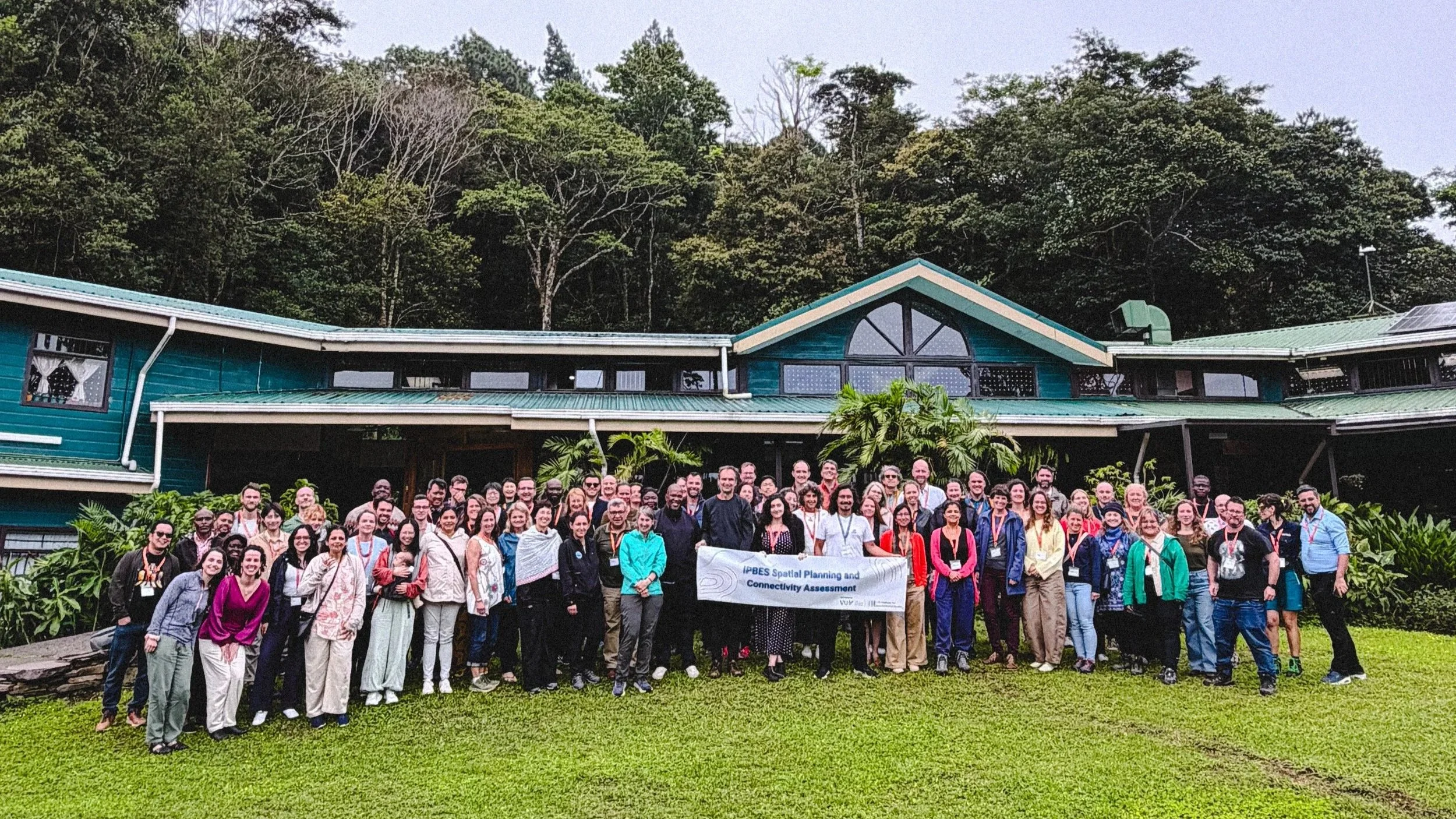
the IPBES team by the end of the Spatial Planning and Connectivity assessment meeting
