
Programa de MOSI en el IMV - MOSI Program at the MVI
Programa MOSI (Monitoreo de Sobrevivencia Invernal) en pájaros migratorios del Neotrópico --- MOSI Program (Interval Survival Monitoring) in migrant neotropical birds.
En español (for English please scroll down)

MoSI (Monitoreo de Sobrevivencia Invernal) es un programa de monitoreo de pájaros neotropicales terrestres que se enfoca en el monitoreo de pájaros migratorios a través de las Americas con estaciones en los neotrópicos del norte. La meta del programa es el de poder evaluar las tazas de sobrevivencia de la hibernación y las condiciones físicas de los pájaros en su llegada a sus zonas de invernada. Los pájaros migratorios del neotrópico viajan un promedio de 3000 millas hasta llegar a sus zonas de invernada donde permanecen al menos la mitad del año. Debido a la disminución de muchas especies migratorias, la "Bird Population Organization" (Organización de Poblaciones de Aves) empezaron un proyecto de investigación para estudiar la sobreviviencia de invernación. Si la sobrevivencia es baja en los trópicos, entonces los esfuerzos de conservación se deben de enfocar en la necesidades de las aves en estas zonas, en lugar de enfocarse en las necesidades en sus zonas de reproducción en latitudes más altas.
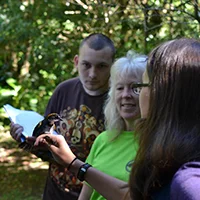
En Monteverde, Costa Rica se trabaja de noviembre a marzo intentando poner anillos de identificación a la mayor cantidad posible de pájaros migratorios y residentes. Pueden ver el siguiente video para escuchar sobre la experiencia de una de las pasantes que colaboró junto con Deb Hamilton en el proyecto. La estación de MoSI de Monteverde es uno de las 29 estaciones situadas entre México y el norte de Sur América. Se colocaron once redes siguiendo todos los protocolos de redes de niebla en laReserva Crandell detrás del Instituto Monteverde. A las especies migratorias que se encontraron se les colocaron anillos informativos del U.S. Fish and Wildlife y se soltaron ilesos con el fin de que se les pudiera seguir el rastro en caso de que los re-capturaran en Norte América.
Esta es una gran oportunidad educacional no solo para los miembros del equipo de MoSI, sino también para algunos miembros de la comunidad y las escuelas visitantes (programa de EAP y Goucher - Mt. Holyoke, entre otros) que tienen la oportunidad de ver el proceso en persona y poder aprender de los procesos migratorios de diferentes especies. Este proyecto ha dado la oportunidad a los participantes de entender un poco más sobre la importancia del conservación de hábitat en los bosques tropicales de Costa Rica.

English (Para español favor de subir) --
MoSI (Interval Survival Monitoring) is a Neotropical migrant landbird monitoring program that focuses on migratory birds throughout the Americas with stations in the northern Neotropics. The goal of this program is to assess overwintering survival rates and physical conditions of birds passing through and arriving at wintering grounds.
Neotropical migratory birds fly an average of 3000 miles to reach their wintering grounds where they live for at least one half of the year. Due to the decline of many migratory species, the Bird Population Organization started a research project to assess the migratory bird’s overwintering survival. If survival is low in the tropics, conservation efforts will need to focus on the birds’ survival needs here, rather than in their reproductive areas at higher latitudes.
In Monteverde, Costa Rica people work together from November through March to band as many migratory and resident passerines as possible. You can see a video about the experience of one of the participating interns here. The Monteverde MoSI station is one of 29 stations situated from Mexico to northern South America. Eleven nets were set up using standard mist netting protocols within the Crandell Reserve behind the Monteverde Institute. Migratory species that were captured were banded with U.S. Fish and Wildlife bands and released unharmed so they could be tracked if they are re-captured in North America.
This is great educational opportunity not only for theMoSI team but also for the community and visiting schools (EAP program and Goucher - Mt. Holyoke, amongst others) that get an opportunity to experience bird banding in person and learn about the migrating process for different bird species. This project also gives participants an opportunity to experience the importance of habitat conservation in tropical rainforests of Costa Rica.

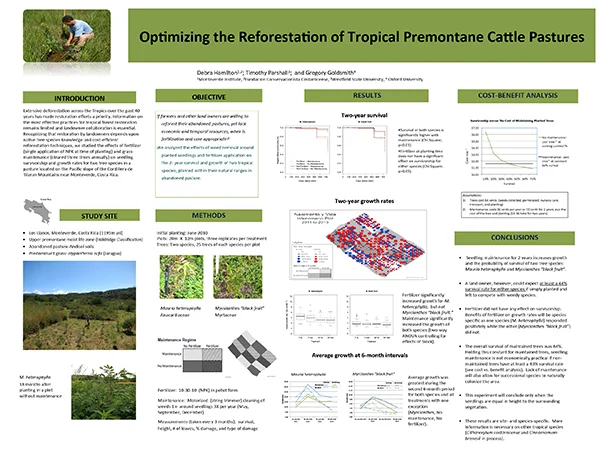
Poster: “ Optimizing the reforestation of tropical premontane cattle pasture through fertilization and grass maintenance”.
At the 26th International Congress for Conservation Biology in Baltimore, Debra Hamilton (Monteverde Institute), Tim Parshall (Westfield State University) and Greg Goldsmith (Oxford University) presented a poster entitled “ Optimizing the reforestation of tropical premontane cattle pasture through fertilization and grass maintenance”.
Poster: “ Optimizing the reforestation of tropical premontane cattle pasture through fertilization and grass maintenance”.
Afiche:
“Optimizando la reforestación de portrero tropical premontano a través de fertilización y mantenimiento”.
English: At the 26th International Congress for Conservation Biology in Baltimore, Debra Hamilton (Monteverde Institute), Tim Parshall (Westfield State University) and Greg Goldsmith (Oxford University) presented a poster entitled “ Optimizing the reforestation of tropical premontane cattle pasture through fertilization and grass maintenance”.
While the results of the two-year investigation demonstrate that grass maintenance significantly increased the survivorship and growth of planted seedlings, the application of fertilizer (10-30-10) at the time of planting had no effect on survivorship. Fertilizer application at time of planting did increase growth rates for one of the two tree species in the experiment.
More importantly, >44% of seedlings of both tree species (Mauria heterophylla (Cirri) and Myrsianthes “black fruit”) survived whether the seedlings received grass competition removal or not. Reforestation, therefore, should not necessarily be discouraged if a landowner does not have the economic resources to maintain the seedlings free of grass. This research is continuing to examine additional species and grass types.
Español:
En los 26th Congreso Internacional para Biología de la Conservación en Baltimore, Debra Hamilton (Instituto Monteverde), Tim Parshall (Westfield State University) y Greg Goldsmith (Oxford University) presentó un poster titulado “Optimizando la reforestación de portrero tropical premontano a través de fertilización y mantenimiento”.
Mientras que los resultados de la investigación de dos años demuestran que mantenimiento de pastos aumentó significativamente la supervivencia y crecimiento de los arbolitos, la aplicación de fertilizante (10/30/10) en el momento de la siembra no tuvo efecto sobre la supervivencia. La aplicación de fertilizantes en el momento de la plantación aumentar las tasas de crecimiento de una de las dos especies en el experimento.
Más importante aún, > 44% de las plántulas de ambas especies arbóreas (Mauria heterophylla (Cirri) y Myrsianthes "black fruit") sobrevivieron si los arbolitos recibieron mantenimiento o no. Por lo tanto, no necesariamente deben desanimarse si un terrateniente no tiene los recursos económicos para mantener las plantas de semillero libres de hierba. Esta investigación continúa para examinar otras especies de arboles y tipos de pastos.