

XI Neotropical Ornithological Conference | VI Costa Rican Ornithological Conference


Luisa Moreno and Debra Hamilton presented results of research on bird community changes over the last 30-46 years in the Monteverde region. Of primary interest is the reduction in mixed species feeding flock species and changes in insectivorous species. These results indicate changes in the guild compositions of avian communities as a possible result of climate change.

Debra also presented special considerations regarding the conservation of the Three-wattled Bellbird, as a result of specific reproductive strategies and dietary restrictions because of varying fruit availability. The dietary selection work was published by Debra and colleagues, Rhine Singleton and J. Devereaux Joslin in Biotropica in 2017. A Spanish version of this article is available upon request at the MVI.
Luisa Moreno participated in the MoSI (Overwintering Survival of Neotropical Birds) round table, organized by Bird Population Organization of Point Reyes, and presented the MVI’s results in this program over the last 6 years.


Luisa Moreno y Debra Hamilton presentaron los resultados de la investigación sobre los cambios en la comunidad de aves en los últimos 30-46 años en la región de Monteverde. De sumo interés es la reducción de especies mixtas que se alimentan de especies de bandadas y los cambios en especies insectívoras. Estos resultados indican cambios en las composiciones de los gremios de las comunidades aviares como un posible resultado del cambio climático.

Debra también presentó consideraciones especiales con respecto a la conservación del Pájaro Campana, como resultado de estrategias reproductivas específicas y restricciones dietéticas debido a la variable disponibilidad de fruta. El trabajo de selección dietética fue publicado por Debra y sus colegas, Rhine Singleton y J. Devereaux Joslin en Biotropica en 2017. Una versión en español de este artículo está disponible a pedido en el IMV.
Luisa Moreno participó en la mesa redonda MoSI (Supervivencia invernal de aves neotropicales), organizada por la Organización de Población de Aves de Point Reyes, y presentó los resultados del IMV en este programa durante los últimos 6 años.

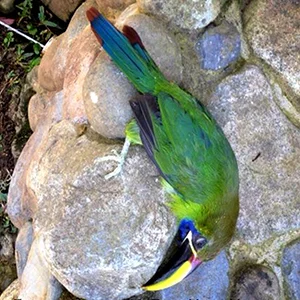
Algunos resultados previos del proyecto Aves y Ventanas en Monteverde - A preview of some of the results from the Birds and Windows Project in Monteverde
Las aves golpean contra los vidrios de las ventanas porque no saben que allí hay un obstáculo pues la transparencia y reflejo de los alrededores en los cristales las engaña completamente
---Birds will hit against the glass from windows because they are not aware that there is an obstacle in front of them as these are transparent and the reflection of the surrounding areas in them fool the birds completely.
En español (for English please scroll down).

Por: Rose Marie Menacho Odio
Las aves golpean contra los vidrios de las ventanas porque no saben que allí hay un obstáculo pues la transparencia y reflejo de los alrededores en los cristales las engaña completamente. Con la intención de estudiar qué especies de aves mueren al golpear contra las ventanas en la comunidad de Monteverde, Puntarenas, desde el mes de septiembre del 2014 y hasta el mes de marzo, 2016, solicité a vecinos de Monteverde que entregaran cualquier ave que encontraran había muerto por golpear contra vidrios en edificios y casas de Monteverde. Las personas que desearan colaborar con el proyecto podían llevar las aves y completar un formulario que Marlene Leitón en el Instituto Monteverde, Martha Garro y Yoryineth Méndez en la Reserva Bosque Nuboso de Monteverde y a Marvin Hidalgo, en la Estación Biológica de Monteverde tenían en su poder. En el formulario se pidió la siguiente información: el nombre de la persona que entregaba el aves, el lugar donde la había encontrado, el nombre del ave (si lo sabía), la fecha y hora y, si fuese posible, que enviaran fotos de la ventana a mi correo personal roseamena@yahoo.com. Las aves colectadas fueron identificadas y en este momento estoy preparándolas para su destino final: la colección del Museo Nacional de Costa Rica.

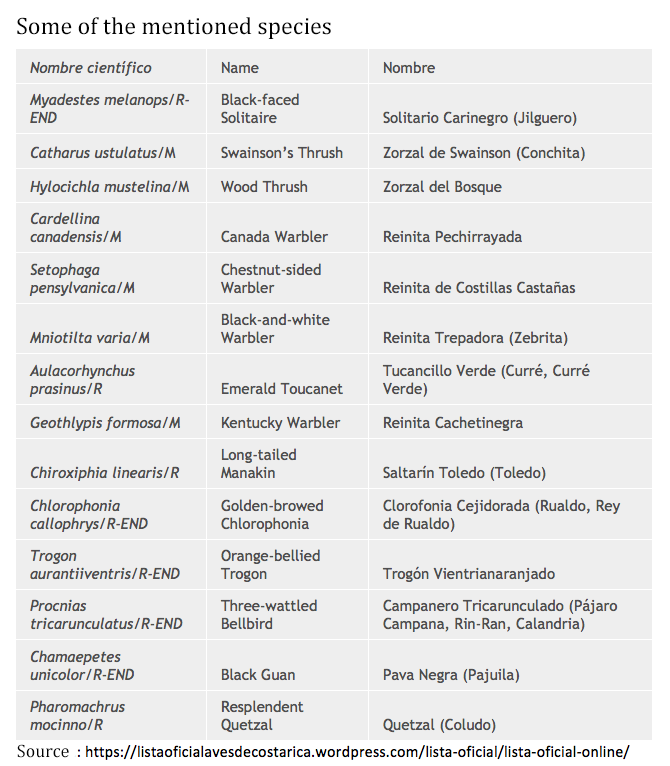
Durante el tiempo del estudio, más de 55 personas de la comunidad colaboraron con el proyecto y se recogieron 139 individuos de 47 especies de aves. La especie que se encontró en mayor número es el zorzal de Swainson (Catharus ustulatus), un ave migratoria que atraviesa el país en grandes cantidades durante el mes de abril, cuando viaja hacia el norte, y en los meses de octubre y noviembre, cuando se dirige hacia el sur. Por supuesto, durante esos meses es que murieron esas aves, llegando a un total de 26 individuos de sólo esta especie. Otras aves migratorias que fueron recolectadas en el tiempo de estudio fue el colibrí garganta de rubí (Archilochis colubris), reinita pechirayada (Cardellina canadensis), reinita cachetinegra (Geothlypis formosa), reinita trepadora (Mniotilta varia) yzorzal del bosque (Hylocichla mustelina) entre otras.

Por otra parte, las especies residentes que se encontraron en mayor número fueron el tucancillo verde (Aulacorhynchus prasinnus) y el jilguero (Myadestes melanops). Para cada una de estas especies se recogieron 14 individuos. Otras muchas especies residentes fueron encontradas, algunas de bellos colores, como el rualdo (Chlorophonia callophrys), el toledo (Chiroxiphia linearis) y el trogón vientrianaranjado (Trogon aurantiiventris). Asimismo, se reportó la colisión de pájaros campana (Procnias tricarunculatus), pavas negras (Chamaepetes unicolor) y un quetzal (Pharomachrus mocinno) que habían golpeado contra ventanas de edificios durante la época del estudio. Algunos de ellos sobrevivieron y otros murieron.
En forma preliminar, se encontró que las ventanas son una amenaza constante para la vida de las aves, aún en lugares como Monteverde, donde la densidad de edificios no es tan alta como en las ciudades. Algunos métodos que se están estudiando y se han encontrado efectivos para prevenir las colisiones se presentan en este enlace.
Aún espero analizar otros aspectos de las aves, tales como, dependencia del bosque, edad, sexo y la abundancia que presentan en la zona. También espero compartir con la comunidad algunos métodos para prevenir estas muertes en el futuro.
Quiero aprovechar para agradecer sinceramente a todos los vecinos y amigos de Monteverde que tomaron de su tiempo para colaborar con este proyecto. De igual forma, al Instituto Monteverde, la Reserva Bosque Nuboso de Monteverde, la Estación Biológica de Monteverde y la Escuela de Los Amigos, que han brindado su apoyo en todo momento. Espero continuar compartiendo con ustedes los resultados. Si desean conocer más del problema y soluciones, a nivel de Costa Rica, pueden visitar: https://avesyventanascostarica.wordpress.com/
Sobre la investigadora:
Mi nombre es Rose Marie Menacho Odio, soy bióloga y trabajo en la cátedra de Ecología y Educación Ambiental, de la Escuela de Ciencias Exactas y Naturales de la Universidad Estatal a Distancia de Costa Rica (UNED). También formo parte de la Junta Directiva de la Asociación Ornitológica de Costa Rica. Si gustan comunicarse conmigo pueden hacerlo escribiendo más abajo o al correo roseamena@yahoo.com.
Sitios recomendados:
https://abcbirds.org/get-involved/bird-smart-glass/

A preview of some of the results from the Birds and Windows Project in Monteverde
By: Rose Marie Menacho Odio

Birds will hit against the glass from windows because they are not aware that there is an obstacle in front of them as these are transparent and the reflection of the surrounding areas in them fool the birds completely. With the intention of studying which species die from impact against windows in the community of Monteverde, Puntarenas, from the months of September 2014 until March 2016, I asked the neighbors of Monteverde to give me all the birds they had found that had died from hitting windows in buildings and houses in the area. The people who wished to collaborate with the project could take the samples and complete the proper questionnaires either with Marlene Leitón from the Monteverde Institute, Martha Garro and Yoryineth Méndez at the Monteverde Cloud Forest Reserve, or with Marvin Hidalgo at the Monteverde Biological Station. The questionnaire included the following information: name of the person who handed in the bird, place where it was found, name of the bird (if known), date and time, and if possible digital photos of the window sent to my personal e-mail. All the collected birds where identified and are currently being prepared for their final destination: the collection of the National Museum of Costa Rica.

During the duration of the study more than 55 members of the community collaborated with the project and 139 samples were collected from 47 different bird species. The species that was most commonly found was the Swainson’s thrush (Catharus ustulatus), a migratory bird that crosses the country in large amounts during the months of April, when it travels north, and in the months of October and November, when it travels South. Of course it was during these months that these birds died, amounting to a total of 26 individuals of this single species. Other migratory birds that were collected at the time of the study were the Ruby-throated Hummingbird (Archilochis colubris), the Canada Warbler (Cardellina canadensis), the Kentucky Warbler (Geothlypis formosa), the Black-and-white Warbler (Mniotilta varia) and the Wood Trush (Hylocichla mustelina), amongst others.

On the other hand the resident species most found were the Emeral Toucanet (Aulacorhynchus prasinnus) and the Black-faced-Solitaire (Myadestes melanops). For each one of these species we collected 14 specimens. Many other resident species were found, some very colorful ones, like the Golden-browned Chlorophonia (Chlorophonia callophrys), the Long-tailed Manakin (Chiroxiphia linearis) and the Orange-bellied Trogon (Trogon aurantiiventris). We also had collision reports of Bellbirds (Procnias tricarunculatus), black guans (Chamaepetes unicolor) and a quetzal (Pharomachrus mocinno) that had hit against windows during the lapse of the study. Some of these survived, others died.

Preliminarily, it was found that windows pose a constant threat to birds, even in places like Monteverde, where the density of buildings is not as high as in other cities. Some of the collision-preventing methods that are being researched and that have been shown to be effective can be found here.
I still have hopes to be able to analyze other aspects of the birds, such as, forest dependency, age, sex, and the abundance that each species represents in the area. I also want to be able to share with the community some more of the methods for further death prevention.
I want to take the opportunity to thank all the friends and neighbors in Monteverde who took the time to collaborate with this project; as well as the Monteverde Institute, the Monteverde Cloud Forest Reserve, the Monteverde Biological Station and the Friends’ School who have showed their support at all moments. I hope to be able to continue sharing more results from the research with you. If you wish to know more about this problem and solutions for it, at a more national level, please visit: https://avesyventanascostarica.wordpress.com/
About the researcher:
My name is Rose Marie Menacho Odio, I’m a biologist and I work in the school of Natural Sciences of the National University for Distance Education (UNED). I’m also a board member of the Board of Directors of the Ornithological Association of Costa Rica. If you would like to get in contact with me you can do so by writing to my e-mail: roseamena@yahoo.com.
Recommended pages:
https://abcbirds.org/get-involved/bird-smart-glass/
Programa de MOSI en el IMV - MOSI Program at the MVI
Programa MOSI (Monitoreo de Sobrevivencia Invernal) en pájaros migratorios del Neotrópico --- MOSI Program (Interval Survival Monitoring) in migrant neotropical birds.
En español (for English please scroll down)

MoSI (Monitoreo de Sobrevivencia Invernal) es un programa de monitoreo de pájaros neotropicales terrestres que se enfoca en el monitoreo de pájaros migratorios a través de las Americas con estaciones en los neotrópicos del norte. La meta del programa es el de poder evaluar las tazas de sobrevivencia de la hibernación y las condiciones físicas de los pájaros en su llegada a sus zonas de invernada. Los pájaros migratorios del neotrópico viajan un promedio de 3000 millas hasta llegar a sus zonas de invernada donde permanecen al menos la mitad del año. Debido a la disminución de muchas especies migratorias, la "Bird Population Organization" (Organización de Poblaciones de Aves) empezaron un proyecto de investigación para estudiar la sobreviviencia de invernación. Si la sobrevivencia es baja en los trópicos, entonces los esfuerzos de conservación se deben de enfocar en la necesidades de las aves en estas zonas, en lugar de enfocarse en las necesidades en sus zonas de reproducción en latitudes más altas.
En Monteverde, Costa Rica se trabaja de noviembre a marzo intentando poner anillos de identificación a la mayor cantidad posible de pájaros migratorios y residentes. Pueden ver el siguiente video para escuchar sobre la experiencia de una de las pasantes que colaboró junto con Deb Hamilton en el proyecto. La estación de MoSI de Monteverde es uno de las 29 estaciones situadas entre México y el norte de Sur América. Se colocaron once redes siguiendo todos los protocolos de redes de niebla en laReserva Crandell detrás del Instituto Monteverde. A las especies migratorias que se encontraron se les colocaron anillos informativos del U.S. Fish and Wildlife y se soltaron ilesos con el fin de que se les pudiera seguir el rastro en caso de que los re-capturaran en Norte América.
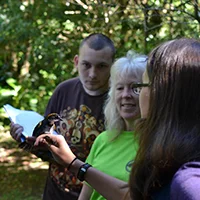
Esta es una gran oportunidad educacional no solo para los miembros del equipo de MoSI, sino también para algunos miembros de la comunidad y las escuelas visitantes (programa de EAP y Goucher - Mt. Holyoke, entre otros) que tienen la oportunidad de ver el proceso en persona y poder aprender de los procesos migratorios de diferentes especies. Este proyecto ha dado la oportunidad a los participantes de entender un poco más sobre la importancia del conservación de hábitat en los bosques tropicales de Costa Rica.

English (Para español favor de subir) --
MoSI (Interval Survival Monitoring) is a Neotropical migrant landbird monitoring program that focuses on migratory birds throughout the Americas with stations in the northern Neotropics. The goal of this program is to assess overwintering survival rates and physical conditions of birds passing through and arriving at wintering grounds.
Neotropical migratory birds fly an average of 3000 miles to reach their wintering grounds where they live for at least one half of the year. Due to the decline of many migratory species, the Bird Population Organization started a research project to assess the migratory bird’s overwintering survival. If survival is low in the tropics, conservation efforts will need to focus on the birds’ survival needs here, rather than in their reproductive areas at higher latitudes.
In Monteverde, Costa Rica people work together from November through March to band as many migratory and resident passerines as possible. You can see a video about the experience of one of the participating interns here. The Monteverde MoSI station is one of 29 stations situated from Mexico to northern South America. Eleven nets were set up using standard mist netting protocols within the Crandell Reserve behind the Monteverde Institute. Migratory species that were captured were banded with U.S. Fish and Wildlife bands and released unharmed so they could be tracked if they are re-captured in North America.
This is great educational opportunity not only for theMoSI team but also for the community and visiting schools (EAP program and Goucher - Mt. Holyoke, amongst others) that get an opportunity to experience bird banding in person and learn about the migrating process for different bird species. This project also gives participants an opportunity to experience the importance of habitat conservation in tropical rainforests of Costa Rica.
