
Reflexiones de una "pilarica" que vive en Monteverde. - Reflections of a “pilarica” that lives in Monteverde.
Reflexiones de una pilarica que vive en Monteverde. "Uno siempre vuelve porque aquí está tu familia, aunque sea medio disfuncional a veces, pero es como tu familia y el bosque se vuelve como tu casa."
--- Reflections of a “pilarica” that lives in Monteverde. " You always return because here is where your “family” is, even if it’s a bit dysfunctional, but it’s like this forest and it’s neighbour truly become your home."

Artículo por Cristina Navarro, integrante de la comunidad de Monteverde.
Reflexiones de una "pilarica" que vive en Monteverde
Usted debe estar pensando “¿pilarica?”, “¿qué es eso?”. Pilaricos es como se hacen llamar a sí mismas las personas oriundas de Tres Ríos, cantón La Unión en la provincia de Cartago. ¿Por qué pilaricos? Porque la Virgen del Pilar (según la iglesia católica) es la patrona del cantón, además suena un poco más fácil de decir que “tresriense”, o como sea que se diga, bueno, el asunto es que ese gentilicio no se usa.

Foto de Cristina Navarro
Vine a vivir a Monteverde en el 2007 con mi esposo y una bebé de 11 meses. Un día tuve que ir a la clínica con mi hija y varias señoras me miraban como queriendo saber quién era yo, para mi ese fue el primer “choque” cultural (aunque seamos del mismo país), porque en la Clínica de Tres Ríos simplemente nadie me hubiera notado. Días después, una mujer en Santa Elena, me saludó y me preguntó por mi hija, que si ya estaba bien de salud, y después me dijo: - Porque usted fue a la clínica por la chiquita ¿verdad? o ¿por usted?. Yo tuve un colocho mental en ese momento y pensé: ¿quién rayos es esta señora y por qué sabe que fui a la clínica?, me sentí un poco paranoica la verdad, porque sentí que me vigilaban, después recordé a las señoras que me observaron en la clínica y supuse que era una de ellas y sólo le conteste, que muy bien gracias y que si, era porque mi hija tuvo fiebre pero que ya estaba todo bien, luego nos despedimos y ya.
Nunca había notado eso, que en la ciudad uno es anónimo, a nadie le importa quién es usted o que hace, pero aquí la gente te nota, se interesa por usted y si uno no está acostumbrado a eso puede ser un poco raro al inicio pero después termina uno más bien preguntando por la salud de niños a mamás que uno ni conoce pero que las vió en la clínica. Termina uno saludando a todos los que pasan aunque uno no los conozca, sonriéndole a gente que uno ni siquiera sabe uno cómo se llaman. Termina uno conociendo a todos sus vecinos por nombre y tomando café en casa de ellos de vez en cuando. Termina uno sabiendo el parentezco del taxista con el señor que trabaja haciendo arreglos en casas y que el otro hermano de ellos fue a vivir a Cañitas, en fin termina uno sabiendo más de la cuenta de la vida de la gente, no porque yo sea chismosa, ni porque me interese saber, la información sólo llega.
En el proceso de hacerse Monteverdense, es inevitable que uno se vuelva importante para la gente para bien o para mal, de igual manera la gente se vuelve importante para uno, ya sea que lo quiera o no. Existe una familiaridad rara, pero que te lleva a sentir confianza de hablar y preguntarle a las personas, cosas tan tontas como cuando le pregunté: ¿cómo están tus pececitos?, a un muchacho que no sé cómo se llama, pero me había enseñado un estanque lindísimo con peces rojos que hizo en su jardín.
La gente en Monteverde genera lazos de familiaridad, incluso con aquellas con las que uno no se lleva tan bien o te caen mal, se vuelven como el hermano jodión, el primo petulante, pero hermano y primo al fin y al cabo.
Un día venía hablando paja con el taxista (uno de los que habitualmente llamo) y me di cuenta de algo sorprendente, me dije: ¡Wow, yo creo que tengo más confianza al hablar con este señor que con mi papá!, y es cierto, en Tres Ríos, aun con tu familia, uno no puede ser simplemente uno mismo.
Ahora más bien cuando voy a Tres Ríos ando desentonando por ahí saludando a todo el que pasa (más que todo porque se me olvida que no estoy en Monteverde), la gente reacciona rarísimo cuando uno las saluda sólo porque sí, es chistosísimo, es como un shock, algunos saludan otros aceleran el paso. Ahora cuando voy a Tres Ríos veo la basura en el piso que antes no notaba, créanlo o no, aunque en Monteverde no hay basureros públicos, Santa Elena está limpia, en cambio en Tres Ríos, hay basureros cada 100 metros y aun así hay basura por todos lados.
Monteverde tiene algo mágico que te hace añorar volver aquí, aunque todo sea muy caro, no haya mucho que hacer, no se puedan conseguir ciertas cosas acá, haya un frio del demonio y estés harto de ver siempre las mismas caras. Uno siempre vuelve porque aquí está tu familia, aunque sea medio disfuncional a veces, pero es como tu familia y el bosque se vuelve como tu casa.

Dibujo hecho por Selena Avendaño.
Nota de la editora: Las publicaciones hechas en esta parte del blog no representan necesariamente las creencias del Instituto Monteverde. Este espacio lo abrimos para que las personas tengan un espacio para compartir. Si a usted les gustaría colaborar favor de escribir a communications@mvinstitute.org.

Articule written by Cristina Navarro, member of the Monteverde community.
Reflections of a “pilarica” that lives in Monteverde.
You might be thinking “pilarica”? What’s that?! Pilaricas are the way the people who come from Tres Ríos (Cartago, Costa Rica) call themselves. Why pilaricos? Because the Virgin of Pilar, according to the Catholic Church, is the county’s patron. Also, it is easier than saying “tresriense”, or however it is that we are supposed to call ourselves, point is, we don’t use it.
I came to live in Monteverde in 2007 with my husband and our baby who at the moment was 11 months old. One day I had to got o the clinic with my daughter and we got many stares from women who were wondering, “who is she?” This was my first “cultural shock” (even though we come from the same country), this, because in the clinic in Tres Ríos, nobody would have noticed me.

Photo of Cristina Navarro
Days later, a woman in Santa Elena, greeted me and asked me about my daughter’s health and proceeded to ask me: “because you were at the clinic for your daughter, right, or was it for yourself?” I had a mental confusion at this point and was wondering: “who on earth is this lady, and why does she know I was at the clinic?” In all honesty I got a bit paranoid. I felt watched. But then I remembered the ladies who were watching me at the clinic and assumed it was one of those, and I replied: “very well, thank you. And yes, my daughter had fever but all is ok now”. Then we said goodbye and that was the end of that.
I had never experienced anything like this, in the city one is anonymous, and nobody cares who you are or what you do, but here in Monteverde, people notice, they care about you. If you are not used to this it can be a bit odd at the beginning, but after a while, you will yourself also asking about the health of the children and moms that you had never met before but that you saw at the clinic. You well end up saying “hi” to all those who pass even if you don’t know them, smiling at people even if you don’t know who they are. You get to know all of your neighbors by name and drinking coffee with them once in a while. You also end up knowing things like the fact that the taxi driver is related to the guy who fixes things in your house, and that their brother went to live to Cañitas. Basically, you find out about people’s lives, not because you are “nosey”, not even because you want to know, but because the information just happens to arrive.
In the process of becoming “Monteverdian” it’s unavoidable to become important for the people, for good or bad, and in the same way people become important to us, whether we want it or not. There is an odd type of familiarity, but it gives you confidence to talk and ask people about things. I have asked people things as silly as “how are you fishes?”, to a boy who once showed my a fish pond he had made in his garden and filled it with red fish.
The people in Monteverde bond, even with those they don’t really get along with, those become like an annoying brother or a petulant cousin, but brother and cousin after all.
One day I was having a meaningless conversation with a taxi driver (one of the ones I usually call) and I realized something surprising, I said to myself: “wow, I feel more at ease talking to this guy than with my own dad!” and it’s true. In Tres Ríos, even if it with your own family, you can’t be just yourself.
So now when I am in Tres Ríos I look a bit odd as I walk around greeting everybody (mostly because I forget that I am not in Monteverde). People react in a weird way when someone greets them “out of the blue”, it’s funny, people are in a sort of shock, some return the greeting, some walk faster. Now when I go to my hometown I notice garbage in the floor that I didn’t see before, because even though there are no public trash cans in Monteverde, Santa Elena is clean, while sin Tres Ríos there a garbage cans every 300 feet and yet, there is garbage all over.
Monteverde has something magical that makes you want to come back, even if it’s expensive, there isn’t much to do, it’s hard to get some things, it’s very cold and you are tired of always seeing the same faces. You always return because here is where your “family” is, even if it’s a bit dysfunctional, but it’s like this forest and it’s neighbors truly become your home.
Note from the editor: What we publish on this part of the Blog do not necessarily represent the Monteverde Institute's views. This space is given for people to share. If you would like to collaborate please write to communications@mvinstitute.org. Thank you.
Parque Recreativo * San Luis * Recreational Park
San Luis decidió construir un parque. Que se complemente como una oportunidad recreativa adicional.
--- San Luis decided to build a park that will complement the other recreational opportunities.


Parque Comunitario: Una oportunidad de recreación para la comunidad.
Por: Noé Vargas - Presidente Junta Directiva Asoc. Desarrrollo San Luis
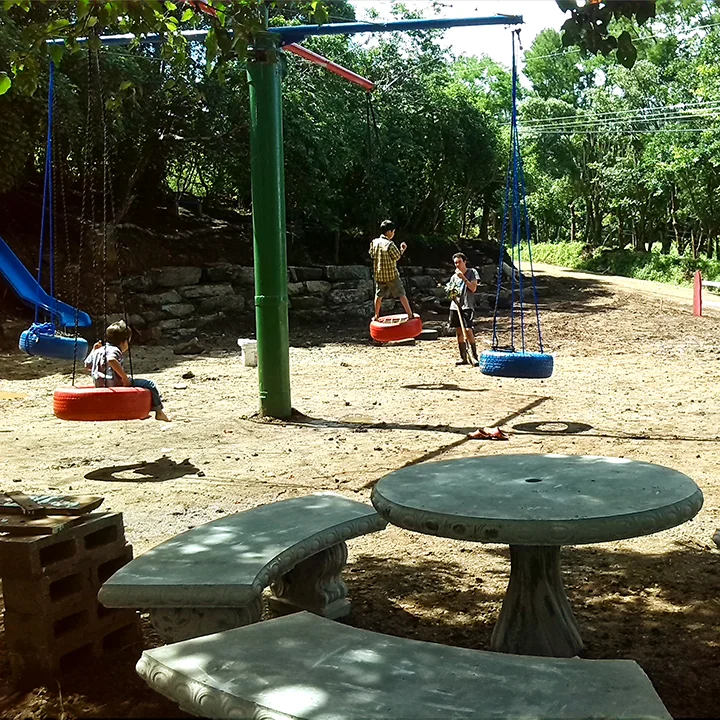
Fotos del parque - aún está en proceso
La recreación y los espacios de encuentro social son una necesidad para el sano desarrollo de las comunidades. En Monteverde es usual escuchar que la falta de oportunidades de recreación para las familias, es una limitación que afecta nuestra comunidad. Ciertamente las condiciones de vida actuales, exigen ofrecer más y diversas alternativas recreativas a la población en general.
A través de un parque recreativo se puede ofrecer oportunidades como: recreación familiar, sana diversión, fomento a la salud física y emocional, encuentro comunitario, compartir con respecto y armonía.
San Luis decidió construir un parque. Que se complemente como una oportunidad recreativa adicional, a las otras que ya existen administradas por la comunidad como: La red de senderos del Sendero Pacífico, la Plaza de fútbol, el Centro Educativo Cultural.
Este parque recreativo San Luis se construye en Finca La Bella, de manera que en muchas formas es un proyecto colaborativo. Más recientemente, se tomó la decisión de disponer de un área de 1500 metros de esta finca para construir el parque, ubicado muy estratégicamente al lado del Centro Educativo Cultural y muy céntrico para la comunidad.
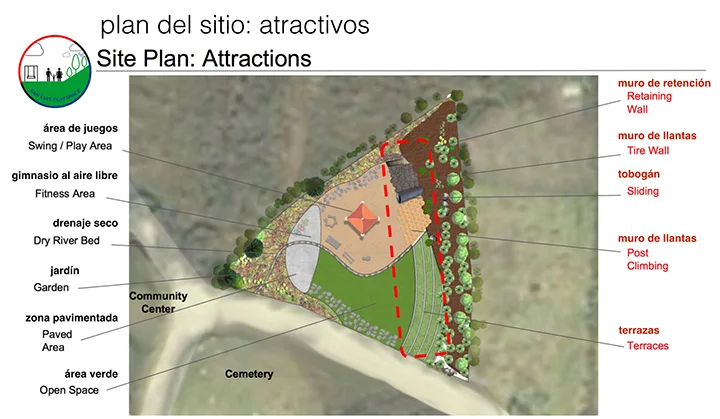
Copia del plan hecho por los estudiantes de Futuros Sostenibles.
La planificación del uso del espacio se realizó con el apoyo del programa de Futuros Sostenibles del IMV, y entre otras cosas incluirá: Áreas de estar con mesas y bancas, senderos internos, área de jardín, área con árboles nativos y frutales. Así como, graderías construidas con piedra, muro de llantas para jugar y como retén de suelo. Juegos como tobogán, carrusel, espacio para juegos tradicionales. Para su construcción, se ha tratado de reutilizar la mayor cantidad posible de materiales(ej llantas) y otros materiales de la región (ej piedra).
Pero, y el dinero para hacerlo? Es la pregunta que usualmente viene de primero.......No hay excusa. Si tiene el propósito y personas dispuestas a lograrlo se hace. Así se ha avanzado significativamente con aportes de mano de obra, materiales, maquinaria, diseños, fondos etc.
Perseverancia, trabajo, alianzas son parte de la receta en este exitoso proyecto!!!
Para más información u ofrecer su apoyo al proyecto contacte a:
Tel 2645 7485. Email trcsanluis@gmail.com face: San Luis de Monteverde
Asociación de Desarrollo Integral de San Luis
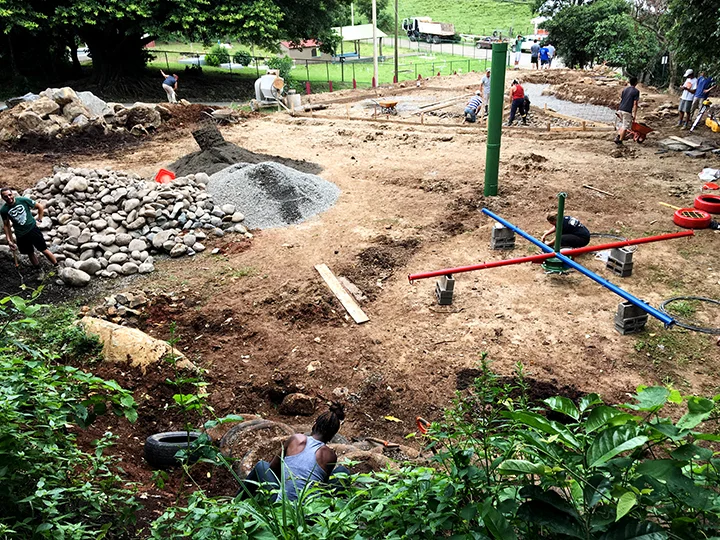
Fotos de miembros de la comunidad y estudiantes de Futuros Sostenibles trabajando en el proyecto.


Photos of the Sustainable Futures students with community members working on the park.

Community Park: A recreational Opportunity for the Community.
By: Noé Vargas –President of the Board of Directors of the San Luis Development Association

Putting the carousel together.
For a healthy community development it’s important to have spaces for recreation and social gatherings. In Monteverde it’s common to hear about the lack of recreation opportunities for families, and this is a limitation that has affected our community. Clearly current lifestyles demand to have a more diverse offer of recreative alternatives for the general population.
A recreational park offers opportunities such as: family entertainment, healthy amusement, promotion of healthy lifestyles, community encounters, respectful sharing and harmony.
San Luis decided to build a park that complements other recreational opportunities such as: the Pacific Pathway Network, the soccer field, and the Cultural Education Center.
This recreational park is being built in Finca la Bella, so in many ways it’s a collaborative project. Recently, the decision was made to use 1500 m (4900 ft.) of this farm’s area to build the park, located strategically next to the Cultural Education Center, and in a very centric location for the community.
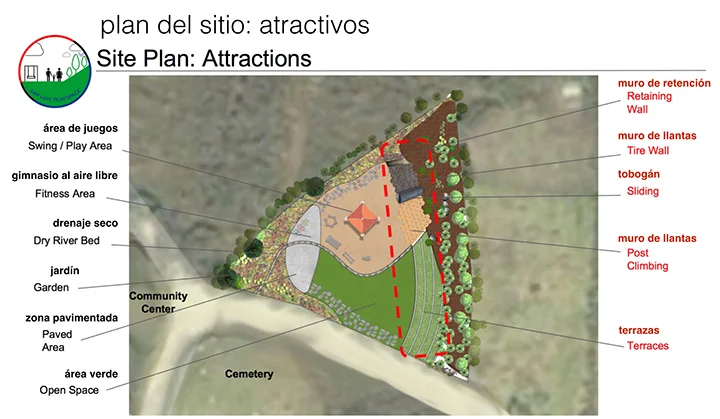
Copy of the plan designed by the Sustainable Futures Group
The space management plan was made with support from the Sustainable Futures Program of the Monteverde Institute, the finished park will include: sharing spaces with tables and chairs, paths, open areas, and native plant gardens and fruit trees. It also includes stone bleachers, a recycled tire wall that can be used for climbing, a slide, a carrousel, and a space for playing Costa Rican traditional games. For its construction we tried to use recycled material as much as possible (ex. tires and metal pipes) and materials from the location (ex. rocks).
But, what about the money to build it? ---This is usually the first question people have, but in reality there is no excuse. If you have the goal and the people supporting it, it’s possible. We have managed to get a lot done with volunteers, donations of materials, designs, funds, etc.
Our perseverance, work and partnerships are part of the recipe to this successful project!
For more information about this project, or if you wish to collaborate please contact:
Tel 2645 7485. Email trcsanluis@gmail.com face: San Luis de Monteverde
Asociación de Desarrollo Integral de San Luis
Curso sobre Formulación de Proyectos en la Comunidad--- Community Project Development Workshop
Resumen del curso sobre formulación de proyectos --- Summary of the project creating workshop
En español (for English please scroll down)
Durante los meses de octubre y noviembre el Instituto Monteverde ofreció un curso cargado de herramientas para los proyectos de integrantes de la zona involucrados en proyectos comunitarios y/o personas con interés de comenzar alguno. Este curso se dio como parte del proyecto de Monteverde en Movimiento del Instituto Monteverde y se hizo gracias al patrocinio del Fondo Comunitario.
El programa de Monteverde en Movimiento es dirigido a las comunidades de la zona para promover estilos de vida saludable, a través de la actividad física, deporte, la recreación y alimentación saludable y tiene como lema, "Monteverde en Movimiento: Comunidades creativas, activas y saludables".
La experiencia del curso fue positiva, no solo para los estudiantes, pero también para los charlistas. Como resultado del curso todos pudieron aprender sobre los diferentes programas comunitarios y los retos que estos tienen.
El curso se dio por medio de ocho módulos, cada uno enfocado en un tema distinto en temas como formulación de proyectos, presupuestos, planificación, comunicación, liderazgo, trabajo en equipo, monitoreo y otros.
Los talleres fueron impartidos por: Jenny Peña (Coordinadora del Programa de Salud Comunitaria y del curso), Francisco Burgos (Director del Centro de Iniciativas Comunitarias del IMV), Justin Welch (Director del Fondo Comunitario), Milena Ramírez (Secretaria del Consejo de Distrito de Monteverde), Zoraida Brenes (Directora Financiera del IMV), Selena Avendaño (Coordinadora de Comunicaciones del IMV) y Lucecita Portilla (Asesora de calidad de vida).
Un agradecimiento especial a Plaza Centro Comercial Monteverde y al Centro Educativo de San Luis por permitir el uso de sus instalaciones.
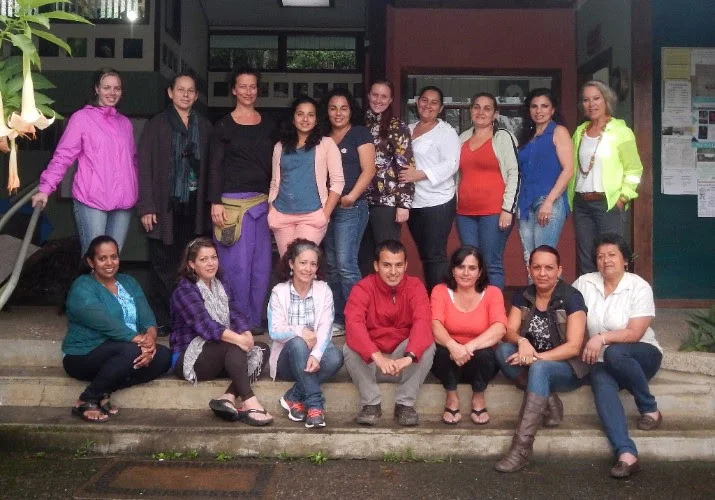
In English (para español favor de subir).
During the months of October and November, the Monteverde Institute offered a course for community members wishing to learn new skills for their on-going or proposed projects. This workshop was offered as part of the Monteverde in Motion program of the Monteverde Institute and sponsored by the Monteverde Community Fund.
The Monteverde in Motion Program was created to promote healthy lifestyles for members of the community by promoting physical activity, sports, recreation and healthy eating. The motto is “Monteverde in Motion: creative, active and healthy communities”.
The experience of the course was very positive, not only for those who participated as students, but also for those who taught the modules. As a result of the courses, everyone learned more about the different community programs and the challenges that they face.
The course was offered through eight modules, each one with a different theme such as project development, budgeting, planning, communication, leadership, teamwork, and follow-up.
The modules were given by: Jenny Peña (Coordinator of the MVI Health Program and organizer of the course), Francisco Burgos (Director for the Center of Community Initiatives of the MVI), Justin Welch (Director of the Monteverde Community Fund), Milena Ramirez (Secretary to the District Municipal Counsel), Zoraida Brenes (Financial Director of the MVI), Selena Avendaño (Communications Coordinator of the MVI) and Lucecita Portilla (Quality of Life Advisor).
We thank the Plaza Centro Comercial Monteverde and the Cento Educativo de San Luis for the use of their installations, the instructors of the course, and the Monteverde Community Fund for their sponsorship of the program.

From the MVI Library --- De la Bibliotica del Instituto Monteverde
From the MVI Library: Local and Global Impacts of Increased Open Access to Scholarship
---De la biblioteca del IMV: Impactos locales y globales del libre acceso a la sabiduría
(Para la versión en español favor de desplazar hacia abajo).
From the MVI Library:
Local and Global Impacts of Increased Open Access to Scholarship
Each year, hundreds of students spend time studying at the Monteverde Institute and conducting research in the area. For many, they engage in impactful educational experiences that have meaning well beyond the end of their time here. Our students engage in research that adds to the knowledge-base of the local community; we have students that return to conduct further research and remain engaged with the local community.
Through the open access digital collections accessible from the MVI library home page, the research output of the MVI-based programs, Globalization and Community Health and Sustainable Futures, and CIEE’s Tropical Ecology program, has been made accessible to the world community. With recent improvements to the discoverability of these collections through Google and Google Scholar, the usage statistics for the documents in these collections has substantially increased, and we can expect them to continue to increase into the future. Every time an article is accessed, whether through Google Scholar, Google, or by searching within the collections, the student research conducted here is making a potential impact on future knowledge, understanding, or scholarship. That’s exciting to us.
The MVI has been actively committed to the principles of open access since launching our first digital collection in 2008. At that time, the open access movement for dissemination of scholarship was considered a fringe movement that could not compete with powerful proprietary scholarly publishers. It’s come a long way since then; in fact, it has fully arrived. Proprietary publishers have had to take notice and respond, by offering options for scholars to deposit their papers as well into open access institutional repositories. For example, the largest university system in the United States that has the largest collective research output in the world, the University of California, in 2013 adopted a system-wide open access mandate for its researchers. You can see the text of their Open Access Policy here: http://osc.universityofcalifornia.edu/open-access-policy/policy-text/
MIT has been a long-term leader in supporting open access for dissemination of scholarship; many large research universities in the United States have also adopted open access mandates.
On a much smaller scale, here at the MVI, we remain actively committed to the principles of open access. To this end, we are revising documentation for MVI research affiliates to include an expectation that formal research output goes into an open access repository, and a link to that research is provided to us so that we can provide direct access to it. At the same time, we are expanding our existing open access digital collections to invite researchers to contribute their MV research to our existing collections that focus on tropical ecology, community health, and sustainable community development.
As more of our own students at MVI add research they have done into their own college and university institutional repositories, we are able to understand further the impact of their experiences here. For example, a student in the 2014 Globalization and Community Health program recently completed her senior thesis, entitled, “Home Gardens: A Key to a Sustainable Future.”
Galvin, Keara C., "Home Gardens: A Key to a Sustainable Future" (2015). Student Theses 2015-Present. Paper 9.
http://fordham.bepress.com/environ_2015/9
In her thesis she acknowledges the impact the Globalization and Community Health course had on her interest in further researching this topic. For us, her senior thesis is a highly relevant area of interest, and we are happy to have located it so that we learn from it and provide access to it.
Recently, a Spanish language version of the “Monteverde” book, edited by Nat Wheelwright and Nalini Nadkarni was published in an open access format by Bowdoin College, and the original English language edition of the book was also made available as an open access publication. According to librarian Bryn Geffert’s Lever Initiative Annapolis User Group Presentation on Publishing (June 16, 2015), the new Spanish language version of the book has been downloaded 1,153 times in the seven months since it has been available as an open access publication. While the world population now has access to these books, the print copies of the Monteverde book only have the potential to be accessible to users of libraries or individuals that have purchased these books.
These are exciting times regarding increased open access to world scholarship. If you have MV-based research that you have produced that you would like to contribute to our open access digital collections, please be in touch, and feel free to contact me if you have any questions regarding any aspect of the open-access publishing process (laurie.kutner@uvm.edu)
Submitted by:
Laurie Kutner
University of Vermont Libraries/ Monteverde Institute
De la biblioteca del IMV: Impactos locales y globales del libre acceso a la sabiduría
Cada año, cientos de estudiantes pasan tiempo estudiando en el Instituto Monteverde y elaborando investigación en la zona. En muchos casos, ellos participan en experiencias educativas de gran impacto que mantienen relevancia aún después de su estadía. Nuestros estudiantes se empeñan en investigación que suma a la base de conocimiento de la comunidad local; tenemos estudiantes que regresan a hacer investigación adicional y se mantienen comprometidos con la comunidad.
A través de las colecciones de libre acceso de la página web de la biblioteca del IMV, los resultados de investigación de programas ubicados en el IMV, Globalización y salud comunitaria y Futuros Sostenibles, y el programa del CIEE de biología tropical, se han hecho accesibles a la comunidad mundial. Con mejoras en la detectabilidad de estas colecciones a través de Google y Google Scholar, el uso estadístico de estas colecciones se ha aumentado de manera significativa, y podemos contar con que sigan creciendo en el futuro. Cada vez que un artículo es visitado, ya sea a través de Google Scholar, Google, o al buscar por medio de las colecciones, la investigación estudiantil que aquí se produce está creando un impacto en conocimiento a futuro, entendimiento, y sabiduría. Para nosotros eso es algo emocionante.
Es IMV a estado activamente comprometido a los principios del libre acceso desde 2008. En ese momento, el movimiento por el libre acceso de sabiduría era considerado como un movimiento que no podía competir con los poderosos editores escolares privados. Las cosas han cambiado mucho desde entonces; de hecho, un cambio total ya está aquí. Publicadores privados han tenido que tomar nota y acción, y han hecho esto al ofrecer opciones para que las personas puedan depositar sus trabajos de investigación, como el ponerlos en repositorios de acceso libre. A modo de ejemplo, el sistema más grande de universidades de Estados Unidos tiene la emisión más grande de investigación del mundo, la Universidad de California, en el 2013 adoptó un sistema de mandato de libre acceso para todo el sistema para sus investigadores. Pueden ver el texto de sus políticas de libre acceso aquí: http://osc.universityofcalifornia.edu/open-access-policy/policy-text/.
MIT ha sido un líder desde hace mucho tiempo en apoyar la diseminación de sabiduría de libre acceso; muchas universidades grandes de investigación en Estados Unidos también han adoptado políticas de libre acceso.
En una escala mucho más pequeña, aquí en el IMV, nos mantenemos activamente comprometidos con los principios de libre acceso. Con este fin, estamos revisando la documentación de los investigadores afiliados para así incluir una petición formal que la investigación hecha vaya a un repositorio de libre acceso, y que un enlace de esa investigación se nos entregue para así poder compartir un acceso directo. Al mismo tiempo, estamos expandiendo nuestra colección actual digital para invitar a investigadores a contribuir con su investigación de Monteverde en nuestras colecciones actuales que sean enfocados en ecología tropical, salud comunitaria, y/o desarrollo sostenible comunitario.
Al tener más de nuestros estudiantes del Instituto Monteverde agregar investigación que han hecho en los repositorios de sus instituciones, somos capaces de entender un poco más el impacto de sus experiencias aquí. Por ejemplo, una estudiante del Programa de Globalización y Salud Comunitaria recientemente terminó su tesis de grado llamado, “Huertas caseras: Una llave para un futuro sostenible.”
Galvin, Keara C., "Home Gardens: A Key to a Sustainable Future" (2015). Student Theses 2015-Present. Paper 9.
http://fordham.bepress.com/environ_2015/9
En sus tesis ella reconoce el impacto que el curso de Globalización y salud comunitaria tuvo en aumentar su interés en investigar más este tema. Para nosotros, su tesis es de una tema de interés muy relevante, y estamos felices de haberlo ubicado para que podamos aprender de él, y dar acceso a este.
Recientemente, una versión en español del “libro de Monteverde”, editado por Nat Wheelright y Nalini Nadkarni fue publicado en un formato de libre acceso por Bowdoin College, la edición original en inglés también se abrió de manera digital. Según la bibliotecaria Bryn Geffert’s Lever Initiative Annapolis User Group Presentation on Publishing (June 16, 2015), la nueva versión en español se ha descargado 1,153 veces en los siete meses desde que ha estado disponible de manera libre. Mientras que la población mundial tiene acceso a estos libros, las copias impresas del libro de Monteverde solo tienen el potencial de ser accedidas por medio de bibliotecas o de individuos que han comprado el libro.
Estos son tiempos emocionantes en cuanto al libre acceso a la sabiduría mundial. Si usted tiene investigación de Monteverde que has producido y le gustaría contribuir con nuestra colección de libre acceso digital, por favor póngase en contacto, y siéntase en libertad de contactarme si tiene alguna pregunta en relación a cualquiera aspecto del proceso de publicación de libre acceso (laurie.kutner@uvm.edu).
Escrito por:
Laurie Kutner
University of Vermont Libraries/ Monteverde Institute
Campamento de Hormiguitas - Hormiguitas Summer Camp
Campamento las Hormiguitas del IMV - Hormiguitas Summer Camp of the MVI
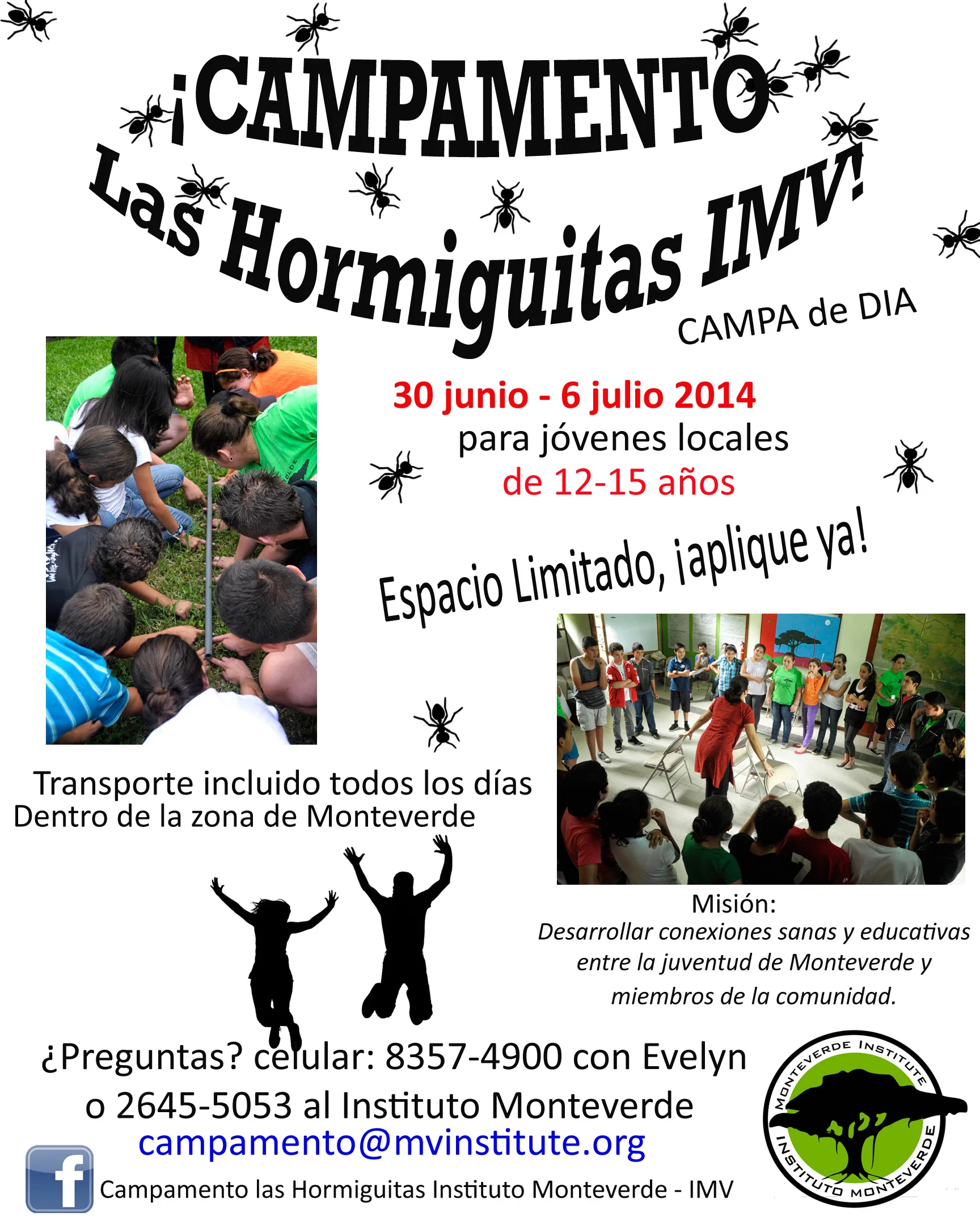
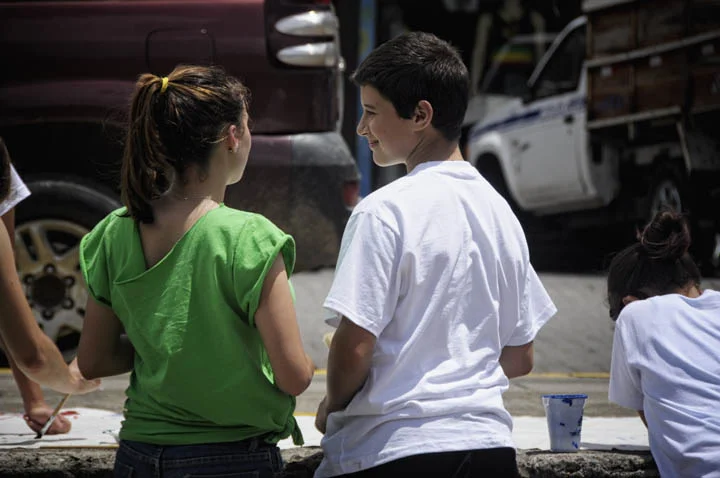
Fotos del campamento del año pasado. Los participantes hicieron unos banners con mensajes para la comunidad en Santa Elena.
---------------------------------------------------
Photos from last year's camp. The participants made banner with messages for the community in downtown Santa Elena.
En julio el Instituto Monteverde organiza un campamento para jóvenes de la comunidad. Este campamento está cargada de actividades interesantes llenas de aprendizaje y diversión. Para más información e inscripciones pueden escribir a campamento@mvinstitute.org.
--------------------------------------------------------
In July the Monteverde Institute organises a Summer Camp for children in the community. This camp is full of interesting activities full of learning opportunities and fun. For more information on how you can help, or if you know someone who would like to participate please write to campamento@mvinstitute.org.




Manual de Huertas - Vegetable Garden Manual
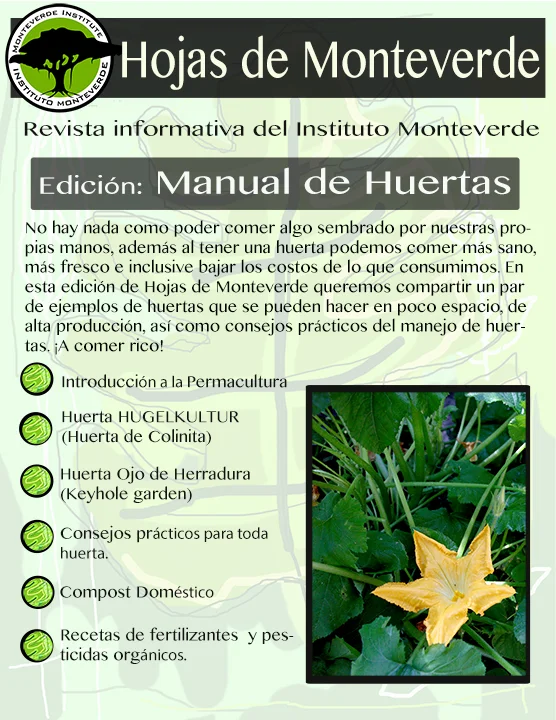
El Instituto Monteverde hace publicaciones para la comunidad, en este caso fue una manual de huertas para poder hacerlas en casa, aquí se lo dejamos en versión digital y pueden pasar el Instituto si quieren uno impreso! /
The Monteverde Institute does publications for the community in this case it's a manual on how to make a vegetable garden at home, this is the digital version, and we have a printed version at the MVI if you are interested.


