

Salud Comunitaria 2018
El Programa de Salud Comunitaria, tiene la meta de motivar a las familias a producir o consumir lo que se produce localmente; e igualmente que las empresas y negocios compren y apoyen la producción de la zona de Monteverde.
The Community Health Program has the goal of motivating families to produce or consume what is produced locally; and also that companies and businesses buy and support the production of the Monteverde area.


¡Producir y comprar productos locales orgánicos, beneficia su salud!
El Programa de Salud Comunitaria, tiene la meta de motivar a las familias a producir o consumir lo que se produce localmente; e igualmente que las empresas y negocios compren y apoyen la producción de la zona de Monteverde. De esa manera podemos promover la producción sostenible que beneficia la salud de quienes consumimos estos productos, así como el ambiente y la economía de productores y negocios que venden alimentos de estas huertas orgánicas.
Alianza… En el 2018, avanzamos en alianza con Hotel Belmar se desarrollaron talleres de huertas orgánicas, impartidos por su experto en agricultura sostenible Gerardo Calderón, así como el apoyo de Richard Garro del Departamento de Sostenibilidad. Con estos talleres buscamos difundir el conocimiento, las técnicas y experiencias de agricultores y expertos/as, para que más y más personas-familias produzcan en sus huertas orgánicas. Es uno de los caminos para garantizar la seguridad alimenticia en el Distrito.

El año pasado ejecutamos seis talleres….
Mis primeros pasos en la producción de huertas caseras: como iniciar una huerta orgánica.
Creación de Huertas Caseras bio-Intensivas (tradicional- suelo)
Manejo de Desechos orgánicos por medio de compostaje: importancia de los micro organismos y proceso de preparación.
Huertas Orgánicas y Control de Plagas: abono foliar y bio-controladores orgánicos.
Creando Equilibrio: relación entre nutrición, salud de la planta y salud humana.
Gastronomia Sostenible: explorando diferentes maneras de preparar alimentos saludables y producidos localmente.
Algo de lo que Aprendimos:
“(…) Debemos cambiar un poco la mentalidad sobre quê entendemos como plagas y enfermedades antes de intervenir en una huerta, porque si queremos erradicar totalmente insectos que se alimenten o micro organismos que se alimenten de las plantas, vamos a tener una batalla casi que a muerte con la naturaleza, porque en la naturaleza debe existir todo y debe existir un equilibrio”. (Taller control de plagas y bio-controladores: Gerardo Calderón, Hotel Belmar)


Producing and buying organic local products, benefits your health!
The Community Health Program has the goal of motivating families to produce or consume locally; but also that our companies and businesses buy and support the production of the Monteverde area. In this way we can promote sustainable production that benefits the health of our families, the environment and the economy of producers and businesses that sell food from local organic gardens.
Alliance ... In 2018, we partnered with Hotel Belmar to provide a series of organic garden workshops. These were taught by the expert in sustainable agriculture, Gerardo Calderón, with support of Richard Garro of the Department of Sustainability. With these workshops we seek to spread the knowledge, techniques and experiences of farmers, so that more and more people-families produce organic vegetables in their gardens. It is one of the ways to ensure food safety in the District.

Last year we ejecuted six workshops ...
My first steps in the production of home gardens: how to start an organic garden.
Creation of Bio-Intensive Homegardens (traditional- soil)
Management of organic waste through composting: importance of micro organisms and preparation process.
Organic Vegetables and Pest Control: foliar fertilizer and organic bio-controllers.
Creating Balance: relationship between nutrition, plant health and human health.
Sustainable Gastronomy: exploring different ways to prepare healthy and locally produced foods.
Some of what we learned:
"(...) We must change our mentality about what we understand as pests and diseases before intervening in our gardens. If we want to completely eradicate insects or micro organisms that feed on plants, we are going to have a battle almost to death with nature. In nature, everything exists and must exist in balance ". (Pest control and bio-control workshop: Gerardo Calderón, Hotel Belmar)

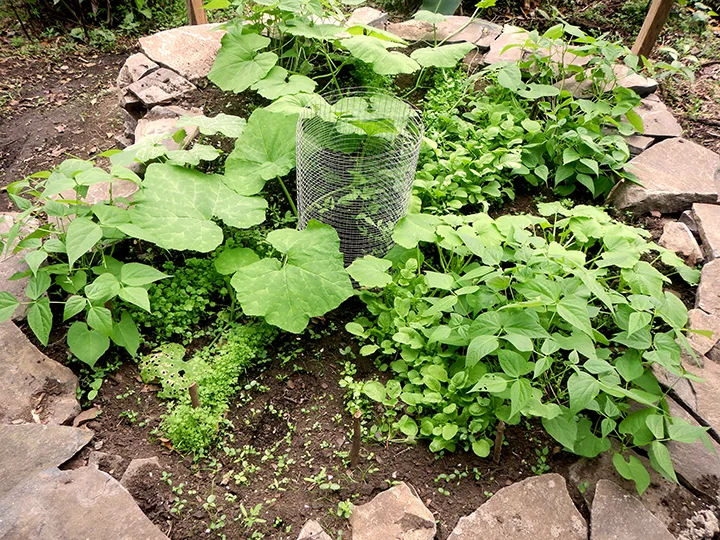
Keyhole Garden- Jardín Ojo de Herradura-Costa Rica.
Manual on how to make a KeyHole garden in the tropics. This is a high yielding agricultural system.---Manual de como hacer una huerta Keyhole en zonas lluviosas.
Keyhole Garden a la Tica: Organic and Sustainable
Sara Arias, Emily Bissett, Constanza Carney, Lillie Dao, Alejandro Garcia, Zuhra Malik
Globalization and Community Health Field School National Science Foundation REU Program University of South Florida
Monteverde Institute
Monteverde, Costa Rica May 29 – August 3, 2013
Adaptación de Keyhole para Latinoamérica en lugar lluvioso. --- Keyhole adaptation to rainy area in Latin America, this is a printable brochure.
Side one of the brochure on hoy to make a keyhole.
Side two of the brochure on how to make the keyhole.


RECOMMENDATIONS
Keyhole Construction Recommendations and Alternatives
Although the exterior of both Monteverde Institute demonstration keyhole gardens were constructed using large stones, there are many other feasible alternatives. These materials were used due to greatest availability to the Institute. Other potential exterior materials suggested by community advisors include recycled materials (glass bottles, tires), lamina roofing material, cinderblocks, or bamboo/sticks.
The layers may also be varied depending upon what is most readily available to the household or organization constructing the garden. Many other kinds of manure, such as goat, rabbit, or cow, may be used instead of chicken manure and/or coffee shells. Limestone can be easily substituted for ash because both materials maintain the neutral balance of the soil and compost pH. Finally, as recommended by several focus group participants, dry leaves can be substituted for rice shells (gransa de arroz) depending upon what is accessible.
Additionally, many other materials, specifically recycled resources, may be implemented to facilitate drainage. Focus group members and community advisors proposed several drainage items options that included halved tires, inverted plastic crates, inverted plastic bottles, and bamboo shoots. These materials, especially used tires and plastic bottles, may require further research to ensure that they are safe for food production use.
Finally, much debate was raised with regard to the roof construction. Several focus group and interview participants stated that saran was the ideal material, while other members supported the use of clear greenhouse plastic. Either of these materials could be used to form the roof. Furthermore, the roof could incorporate covered sides, though this is not required. Each of these alternative materials could be incorporated in a future experimental research garden. Local community members who decide to create their own keyhole garden could also integrate these alternative materials.
For more information please write to us at info@mvinstitute.org.
----------------------------------------------------------------------------------------------------------------------------------
Ventajas jardín Ojo de Herradura:
Producción intensiva en espacio pequeño, tiene periodo de 5 años antes de volver a cambiar los sustratos, es relajante-terapeutico y tiene diseño universal, por ello es adecuado para personas adultas mayores, personas con discapacidad o mujeres embarazadas.