

From the MVI Library --- De la Bibliotica del Instituto Monteverde
From the MVI Library: Local and Global Impacts of Increased Open Access to Scholarship
---De la biblioteca del IMV: Impactos locales y globales del libre acceso a la sabiduría
(Para la versión en español favor de desplazar hacia abajo).
From the MVI Library:
Local and Global Impacts of Increased Open Access to Scholarship
Each year, hundreds of students spend time studying at the Monteverde Institute and conducting research in the area. For many, they engage in impactful educational experiences that have meaning well beyond the end of their time here. Our students engage in research that adds to the knowledge-base of the local community; we have students that return to conduct further research and remain engaged with the local community.
Through the open access digital collections accessible from the MVI library home page, the research output of the MVI-based programs, Globalization and Community Health and Sustainable Futures, and CIEE’s Tropical Ecology program, has been made accessible to the world community. With recent improvements to the discoverability of these collections through Google and Google Scholar, the usage statistics for the documents in these collections has substantially increased, and we can expect them to continue to increase into the future. Every time an article is accessed, whether through Google Scholar, Google, or by searching within the collections, the student research conducted here is making a potential impact on future knowledge, understanding, or scholarship. That’s exciting to us.
The MVI has been actively committed to the principles of open access since launching our first digital collection in 2008. At that time, the open access movement for dissemination of scholarship was considered a fringe movement that could not compete with powerful proprietary scholarly publishers. It’s come a long way since then; in fact, it has fully arrived. Proprietary publishers have had to take notice and respond, by offering options for scholars to deposit their papers as well into open access institutional repositories. For example, the largest university system in the United States that has the largest collective research output in the world, the University of California, in 2013 adopted a system-wide open access mandate for its researchers. You can see the text of their Open Access Policy here: http://osc.universityofcalifornia.edu/open-access-policy/policy-text/
MIT has been a long-term leader in supporting open access for dissemination of scholarship; many large research universities in the United States have also adopted open access mandates.
On a much smaller scale, here at the MVI, we remain actively committed to the principles of open access. To this end, we are revising documentation for MVI research affiliates to include an expectation that formal research output goes into an open access repository, and a link to that research is provided to us so that we can provide direct access to it. At the same time, we are expanding our existing open access digital collections to invite researchers to contribute their MV research to our existing collections that focus on tropical ecology, community health, and sustainable community development.
As more of our own students at MVI add research they have done into their own college and university institutional repositories, we are able to understand further the impact of their experiences here. For example, a student in the 2014 Globalization and Community Health program recently completed her senior thesis, entitled, “Home Gardens: A Key to a Sustainable Future.”
Galvin, Keara C., "Home Gardens: A Key to a Sustainable Future" (2015). Student Theses 2015-Present. Paper 9.
http://fordham.bepress.com/environ_2015/9
In her thesis she acknowledges the impact the Globalization and Community Health course had on her interest in further researching this topic. For us, her senior thesis is a highly relevant area of interest, and we are happy to have located it so that we learn from it and provide access to it.
Recently, a Spanish language version of the “Monteverde” book, edited by Nat Wheelwright and Nalini Nadkarni was published in an open access format by Bowdoin College, and the original English language edition of the book was also made available as an open access publication. According to librarian Bryn Geffert’s Lever Initiative Annapolis User Group Presentation on Publishing (June 16, 2015), the new Spanish language version of the book has been downloaded 1,153 times in the seven months since it has been available as an open access publication. While the world population now has access to these books, the print copies of the Monteverde book only have the potential to be accessible to users of libraries or individuals that have purchased these books.
These are exciting times regarding increased open access to world scholarship. If you have MV-based research that you have produced that you would like to contribute to our open access digital collections, please be in touch, and feel free to contact me if you have any questions regarding any aspect of the open-access publishing process (laurie.kutner@uvm.edu)
Submitted by:
Laurie Kutner
University of Vermont Libraries/ Monteverde Institute
De la biblioteca del IMV: Impactos locales y globales del libre acceso a la sabiduría
Cada año, cientos de estudiantes pasan tiempo estudiando en el Instituto Monteverde y elaborando investigación en la zona. En muchos casos, ellos participan en experiencias educativas de gran impacto que mantienen relevancia aún después de su estadía. Nuestros estudiantes se empeñan en investigación que suma a la base de conocimiento de la comunidad local; tenemos estudiantes que regresan a hacer investigación adicional y se mantienen comprometidos con la comunidad.
A través de las colecciones de libre acceso de la página web de la biblioteca del IMV, los resultados de investigación de programas ubicados en el IMV, Globalización y salud comunitaria y Futuros Sostenibles, y el programa del CIEE de biología tropical, se han hecho accesibles a la comunidad mundial. Con mejoras en la detectabilidad de estas colecciones a través de Google y Google Scholar, el uso estadístico de estas colecciones se ha aumentado de manera significativa, y podemos contar con que sigan creciendo en el futuro. Cada vez que un artículo es visitado, ya sea a través de Google Scholar, Google, o al buscar por medio de las colecciones, la investigación estudiantil que aquí se produce está creando un impacto en conocimiento a futuro, entendimiento, y sabiduría. Para nosotros eso es algo emocionante.
Es IMV a estado activamente comprometido a los principios del libre acceso desde 2008. En ese momento, el movimiento por el libre acceso de sabiduría era considerado como un movimiento que no podía competir con los poderosos editores escolares privados. Las cosas han cambiado mucho desde entonces; de hecho, un cambio total ya está aquí. Publicadores privados han tenido que tomar nota y acción, y han hecho esto al ofrecer opciones para que las personas puedan depositar sus trabajos de investigación, como el ponerlos en repositorios de acceso libre. A modo de ejemplo, el sistema más grande de universidades de Estados Unidos tiene la emisión más grande de investigación del mundo, la Universidad de California, en el 2013 adoptó un sistema de mandato de libre acceso para todo el sistema para sus investigadores. Pueden ver el texto de sus políticas de libre acceso aquí: http://osc.universityofcalifornia.edu/open-access-policy/policy-text/.
MIT ha sido un líder desde hace mucho tiempo en apoyar la diseminación de sabiduría de libre acceso; muchas universidades grandes de investigación en Estados Unidos también han adoptado políticas de libre acceso.
En una escala mucho más pequeña, aquí en el IMV, nos mantenemos activamente comprometidos con los principios de libre acceso. Con este fin, estamos revisando la documentación de los investigadores afiliados para así incluir una petición formal que la investigación hecha vaya a un repositorio de libre acceso, y que un enlace de esa investigación se nos entregue para así poder compartir un acceso directo. Al mismo tiempo, estamos expandiendo nuestra colección actual digital para invitar a investigadores a contribuir con su investigación de Monteverde en nuestras colecciones actuales que sean enfocados en ecología tropical, salud comunitaria, y/o desarrollo sostenible comunitario.
Al tener más de nuestros estudiantes del Instituto Monteverde agregar investigación que han hecho en los repositorios de sus instituciones, somos capaces de entender un poco más el impacto de sus experiencias aquí. Por ejemplo, una estudiante del Programa de Globalización y Salud Comunitaria recientemente terminó su tesis de grado llamado, “Huertas caseras: Una llave para un futuro sostenible.”
Galvin, Keara C., "Home Gardens: A Key to a Sustainable Future" (2015). Student Theses 2015-Present. Paper 9.
http://fordham.bepress.com/environ_2015/9
En sus tesis ella reconoce el impacto que el curso de Globalización y salud comunitaria tuvo en aumentar su interés en investigar más este tema. Para nosotros, su tesis es de una tema de interés muy relevante, y estamos felices de haberlo ubicado para que podamos aprender de él, y dar acceso a este.
Recientemente, una versión en español del “libro de Monteverde”, editado por Nat Wheelright y Nalini Nadkarni fue publicado en un formato de libre acceso por Bowdoin College, la edición original en inglés también se abrió de manera digital. Según la bibliotecaria Bryn Geffert’s Lever Initiative Annapolis User Group Presentation on Publishing (June 16, 2015), la nueva versión en español se ha descargado 1,153 veces en los siete meses desde que ha estado disponible de manera libre. Mientras que la población mundial tiene acceso a estos libros, las copias impresas del libro de Monteverde solo tienen el potencial de ser accedidas por medio de bibliotecas o de individuos que han comprado el libro.
Estos son tiempos emocionantes en cuanto al libre acceso a la sabiduría mundial. Si usted tiene investigación de Monteverde que has producido y le gustaría contribuir con nuestra colección de libre acceso digital, por favor póngase en contacto, y siéntase en libertad de contactarme si tiene alguna pregunta en relación a cualquiera aspecto del proceso de publicación de libre acceso (laurie.kutner@uvm.edu).
Escrito por:
Laurie Kutner
University of Vermont Libraries/ Monteverde Institute
MASTER PLAN: EFFORTS TOWARD SUSTAINABLE LAND USE MVI
By: Matthew Spehlmann - Monteverde Institute
An internship courtesy of the Grace Elizabeth Groner Foundation in conjunction with Lake Forest College.
Abstract
The efficiency of land use on the Monteverde Institute grounds plays a significant role in the overall degree of sustainability of the Monteverde community at large. For this reason, creating a master plan to guide the use of land is of primary concern to Institute land users.
Introduction
Landscape architecture has taken on many definitions over the course of my internship. At its core, my internship has moved from obtaining information about the natural environment surrounding Monteverde, to gathering impressions of the Monteverde Institute from the nearby community, to plotting the infrastructural layout of the Institute grounds. All said and done, the purpose of my internship has been to get the ball rolling, to put it colloquially, in terms of efficient land use on the Institute grounds. The physical manifestation of this goal takes form as a landscape master plan.
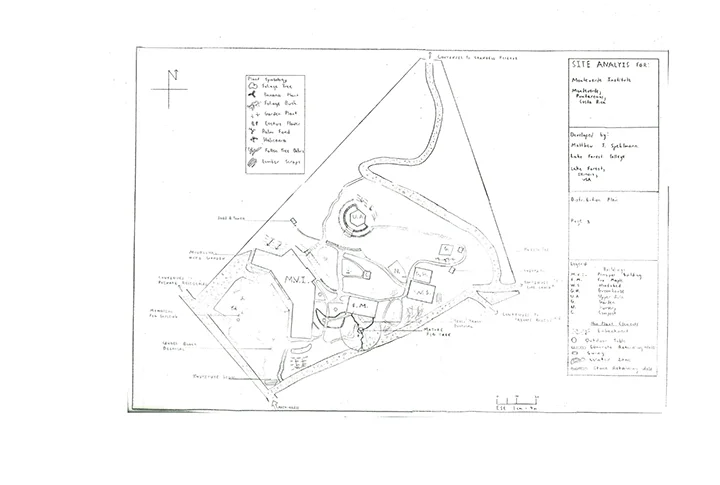
The master plan serves as a guide for future projects that deal with land development on the Institute grounds. Essentially, Monteverde´s unique environment, input from the community regarding desired directions of land use on the Institute grounds, and personal analysis gleaned from the creation of an accurate distribution plan have been blended together into an end product that should be phenomenally helpful in coordinating land use projects on Institute grounds. Communication between different users of the Institute property based on an agreed upon representation of the property is a great step towards coordinated land use and, ultimately, efficient land use.
Study Area and Methods
Early in my internship, research on Monteverde´s unique natural environment was crucial in order to gain an appreciation of the land on which the Institute is situated. For instance, Nadkarni and Wheelwright´s (2000) text, Monteverde, provided ample insight into aspects such as climate, vegetation, soil characteristics as well as other elements pertinent to my eventual work regarding low-impact land use in the region. Furthermore, Wolf Guindon´s narrative, Walking with wolf, written by Chornook (2008) gave a story of man´s quest to live off of the land while leaving as light a footprint as possible. Together the two texts served to familiarize me with the atmosphere the Institute operated in: the Institute acts in some ways as a mediator in the struggle to preserve the extraordinary wildlife of the region while catering to a tourist demand that has negative impacts on the very environment that inspires the demand.
Points of interest at the MVI.
After acquainting myself to the dilemma faced by Monteverde and the surrounding communities, I took up pencil and paper and set out to meet face-to-face with different members of the community. The meetings were unofficial interviews in which I recorded the interviewees´ impressions of the Institute and its land use. Interviewees ranged from staff at the Institute to Quaker practitioners living as far as San Luis. At that point in my internship, I was more of a social architect, as the interviews served to construct a mental image of what the Institute was in the minds of the community.


With an understanding of where the Institute stood in terms of its physical location and with the community´s perception of the Institute in my mind, I began my work on the immediate property of the Institute campus. Armed with a tape measure I sent out among the campus taking note of the triangulated positions of every structure and feature that may be relevant to future projects. The process lasted weeks. Generally, I bounced from the office where I had a developing map draft on a large scale plan to the grounds where I would store measurement notes on a clip board to be transferred back to the office at a later point in time.
Finally, the required measurements were taken and the final step of formalizing the drafts went underway. My supervisor closely guided me along the way as we moved from border design to texturing elements such as gravel roads to adding special interest layers. It is the distribution plan with its special interest layers that provide the bulk of the end products.
Results
The product that has arisen out of my literature study constitutes a small portion of the overall end product. Essentially, I have condensed scientific and social literature down to the most relevant information regarding land use on Institute grounds. This boiling down of information is found in my final presentation PowerPoint. Furthermore, the pertinent information that I felt was necessary in introducing the land use predicament special to Monteverde contains reference pages to sections in texts that elaborate on a finer scale the environmental or social issue to which I refer to in the presentation. The inclusion of reference pages will help future special interest projects cut time on the research stage of their project.
Concerning the interviews, I have compiled many reports of how the Institute is seen by the community. Most of all, the interview reports serve as a checkup on how narrowly the Institute is conforming to its desired goal of being a sustainable voice in the area. The information from the reports has been charted several different ways. The analysis of the reports can be found in the discussion section.
However, the ultimate gift to the Institute resulting from my internship is the distribution plan and its subsequent layers. The distribution plan details the layout of the property, again complete with all elements pertinent to future land use projects. On top of the distribution plan can be placed four special interest layers (more layers can be drafted in order to analyze different aspects of the property that may become of interest when future projects are being considered). However, the four current layers detail access and circulation routes, water ways and flood zones, forest zones, and special features to the Institute that add character to the land while having minimal impact.
These maps will be the first maps that accurately communicate where land use has occurred and potential areas for future land use. Due to this, interns, workers, the community, and any other party interested in the lands on the Institute grounds will share the same understanding of the property on which the Institute is situated. The implications of the final products gain significance upon the review of a trained eye.
Discussion
Upon analysis of the interview reports, I found that the community desires that the Institute serve as a recreation center that emphasizes the nature present in Monteverde. As a recreation center, the Institute would provide the community with a space for activities as well as down-time pursuits such as chatting or reading. Most of the members of the community I spoke with were older and thus recognized that it will be the younger generation who will soon be responsible for staying committed to sustainability. Due to this, members expressed a palpable hope that drawing the community onto the Institute campus will inspire a respect for the land in the youth of the region.
At first glance of the Institute maps, one might simply locate herself according to the other features of the property. Though maps serve to locate and contextualize the user according to her immediate location, the maps and ensuing analysis serve a larger purpose. Efforts towards sustainable land use can be significantly more efficient when users of the land share a common goal for subsequent land use. There have been several projects carried out by single groups of interns only to be neglected when the interns leave the Institute. The land used is then neglected as well and left to future interns to deal with wondering how to convert the land to their specific needs. Instead of having discordant users develop parcels of land for their select interest, an accurate map can serve to coordinate land use over the long run ensuring at the least a consistent use of land.
The Institute is a gem in terms of property value. The difficulty in maintaining the gleam of the gem results from a population of users that sees the land as per select members´ individual, current interests. What belies sustainability is jumbled land use due to failures of carrying out long term visions. I mentioned this master plan was a way of getting the ball rolling in a sustainable direction. Yet, like past projects, the biggest threat to the success of this project is the lack of follow-through by a future intern. The ball may be rolling, but the friction of noncompliance has been a formidable force.
Acknowledgements
Necessary to thank for this opportunity is the Grace Elizabeth Groner Foundation. Without their funding and oversight, this internship opportunity would not have been possible. The Foundation´s association with Lake Forest College enabled my participation in this internship.
Furthermore, the direct supervision of primary coordinators Ashley Gora and Felipe Negrini required hours of time and a bundle of patience in mending my mind from an economic orientation to one of a landscape architect´s. I would like to thank them for their support over the course of my research.
The Monteverde Institute, the community of Santa Elena and nearby towns, and all others who I cannot name person by person deserve my thanks, as they were extremely open and accommodating to the needs of my internship. It was a pleasure to have met those with whom I worked.
References
Chornook, K., & Guindon, W. (2008). Walking with wolf. Canada: Wandering Words Press.
Nadkarni, N., & Wheelwright, N. (2000). Monteverde. New York: Oxford University Press.

AN ANNOTATED BIBLIOGRAPHY OF CURRENT WRITING ON PUBLIC HEALTH ISSUES IN CONFRONTING CHAGAS DISEASE
AN ANNOTATED BIBLIOGRAPHY OF CURRENT WRITING ON PUBLIC HEALTH ISSUES IN CONFRONTING CHAGAS DISEASE
Prepared by the Students in the Goucher-Mt. Holyoke Course on Human Health and Development in the Tropics, April 9, 2014
Prepared by the Students in the Goucher-Mt. Holyoke Course on Human Health and Development in the Tropics, April 9, 2014
To see the document please follow this link:
AN ANNOTATED BIBLIOGRAPHY OF CURRENT WRITING ON PUBLIC HEALTH ISSUES IN CONFRONTING CHAGAS DISEASE I
Para información sobre el CHAGAS en español favor visitar Información sobre Chagas en Radio Comunitaria Monteverde. Gracias.


You can follow the website posted above and also check out the slides by clicking on them.