
Internship - Rachel and Dwight Crandell Memorial Reserve - Pasantía
With the help of my supervisor, Randy Chinchilla, and some members of the Monteverde Institute we were able to create two maps of the Reserve that showed the path system, some signs and an entranceway to the reserve.
--- Con ayuda de mi supervisor, Randy Chinchilla, y con algunos miembros del Instituto Monteverde se logró crear dos mapas de la Reserva indicando los senderos, algunos rótulos de señalamiento y una entrada en la Reserva.

Signage and mapping of the Rachel and Dwight Crandell Memorial Reserve
by Jacqueline Zamudio
August, 2016
I had the opportunity of living in Monteverde in May through July with the help of the Grace Groner Foundation and Lake Forest College. During this time I did an internship and lived with a family in Cerro Plano.
My internship consisted in creating a basic maps and signs for the Rachel and Dwight Crandell Memorial Reserve. Before this the Reserve had some signs that could be found on the paths however, with time this signs had become damaged.
Crandell Memorial Reserve and paths
Also, the Institute did not have an up-to-date map, so, with the help of my supervisor, Randy Chinchilla, and some members of the Monteverde Institute we were able to update the Reserve maps by showing the location of the paths and signs as well as the Reserve limits.
Combining field work with Geographical Information System (GIS) techniques we determined the location and distance of the three paths that make up the Reserve: Bioluminosa Path, Bellbird Path, and Fungi Path. The following maps show the paths and the Reserve's limits.
Crandell Memorial Reserve and neighbouring properties.
The sign making part of the project was done in several steps. First we had to decide where we were going to put up the signs and what kind they were going to be. For this we took GPS points. After getting all the GPS points and deciding on the types of signs, we worked on several designs to determine the materials that would be necessary. After getting all the necessary materials, the signs were made. Finally, and with the help of the MVI’s staff, the signs were put alongside the paths. The following are pictures of the final Project.


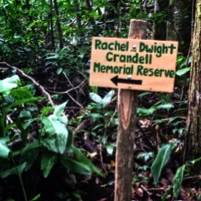
Before and after: These signs indicate the way to get to the Reserve. (Before and after placing the sign).
Before and after photos. ---
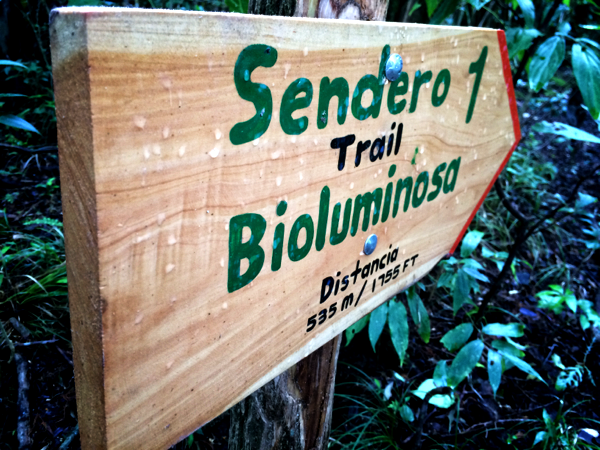
These are some of the signs pointing out the different paths. These signs show the path name and distance in meters and feet.

It’s also possible to find signs in each path that indicate the exit and end of path.
Finally, we build a small entrance way to the Reserve. The purpose of this small project was to create an entrance that would have several functions, the main one being for people to easily identify the way to enter the Reserve. The structure was also built in a way that it would prevent the entrance of bicycles, motorcycles and vehicles. On it, it's possible to observe the path map, information tables about the Crandell’s, biological registration forms, rules and logos. To build this entrance first we needed the design, then we got all the materials and finally we built it.
The following are pictures of how the entrance used to be, and how it is now.
These three projects were done in two months. Also during this time I was living with a family in Cerro Plano. Living with a family was also one of the things that made my experience in Costa Rica unique. Living with the family and being part of the community gave me the opportunity to learn about the Costa Rican culture which interested me. The Monteverde Institute and the Monteverde community gave me the opportunity to learn about Costa Rica while I helped out the community with my Project at the Rachel and Dwight Crandell Memorial Reserve.

Rotulación y mapeo en la Rachel & Dwight Crandell Memorial Reserve
Por Jacqueline Zamudio
Agosto 25, 2016
Entre los meses de mayo y julio , con ayuda de Grace Groner Foundation de Lake Forest College, tuve la oportunidad de vivir en Monteverde por dos meses. Durante ese tiempo realicé una pasantía mientras vivía con una familia en Cerro Plano.
Reserva Crandell y sus senderos.
La pasantía consistía en crear cartografía básica y rotulación para la Reserva Rachel & Dwight Crandell. Anteriormente la Reserva contaba con unos pequeños rótulos que se encontraban en los senderos. Sin embrago, con el paso del tiempo los rótulos se fueron dañando. Además el Instituto Monteverde no contaba con un mapeo actualizado. Con ayuda de mi supervisor, Randy Chinchilla, y con algunos miembros del Instituto Monteverde se lograron crear y actualizar los mapas de la Reserva indicando información de los senderos, de los rótulos de señalamiento y del punto de acceso y fin de la Reserva.
Combinando trabajo de campo con técnicas de los Sistemas de Información Geográfica (GIS en inglés) se determinó la ubicación y distancia de los tres senderos que conforman la reserva: Sendero Bioluminosa, el Sendero Pájaro Campana y el Sendero Fungi. Los siguientes mapas muestran los senderos que se pueden encontrar en la Reserva.
Este mapa muestra los límites de la Reserva y las propiedades vecinas.
Como se mencionó anteriormente, además del mapeo de los senderos también se hicieron algunos rótulos de señalamiento. Para este proyecto se tomaron varios pasos. Primero se decidió donde se iba a colocar cada rótulo y qué tipo de rótulo. Para este paso se tomaron puntos de GPS. Después de haber obtenido los puntos finales de GPS y los tipos de rótulos, se hicieron algunos diseños determinando los materiales que se necesitarían. Después de haber obtenido todos los materiales necesarios, se hicieron los rótulos. Por último, con ayuda de algunos miembros del Instituto Monteverde, se colocaron los rótulos en los senderos. Estas son algunas fotografías del producto final.

Antes y después:
Estos rótulos indican el camino que se puede tomar para llegar a la Reserva.
Antes y después:
Estos son rótulos indicando los senderos. En estos rótulos se indica el nombre del sendero y la distancia en metros y pies.
También se pueden encontrar rótulos en cada sendero indicando la salida y fin del sendero.
Por último, se construyó una pequeña entrada en la Reserva. El propósito de este pequeño proyecto era poder construir una entrada que tuviera varias funciones. La función principal era que las personas puedan identificar la entrada a los senderos con más facilidad. La entrada también se construyó de una manera que impide el paso de bicicletas, motocicletas o vehículos. La entrada también cuenta con un mapa de los senderos y algunas tablas con información sobre los Crandell, registros biológicos, algunas reglas y los logos. Para la construcción de esta entrada primero se obtuvo un diseño, después se determinaron los materiales, y finalmente llevó a cabo toda la construcción.
Aquí se puede apreciar cómo era la entrada anteriormente y como es ahora.
Estos tres proyectos se pudieron llevar a cabo en dos meses. Durante esos dos meses estuve viviendo con una familia en Cerro Plano. Vivir con una familia fue una de las cosas que también hizo mi estancia en Costa Rica única. Vivir con una familia y ser parte de la comunidad me dio la oportunidad de aprender sobre la cultura de Costa Rica lo cual me interesaba aprender. El Instituto Monteverde y la comunidad de Monteverde me dio la oportunidad de aprender sobre Costa Rica mientras ayudaba a la comunidad con mi proyecto en Rachel and Dwight Crandell Memorial Reserve.
The Night of the Bat---La Noche de los Murciélagos
The night of the bat was nothing to be scared of. Truthfully, it was an incredible night. I am so happy we had nice weather and had the luck to meet the expert Dr. Laval and his friends.
Blog 9.7.13 by Lana Panitch Lake Forest Intern
After a day´s work at the Monteverde Institute, my cohorts from Lake Forest and I went to Tramonti´s for a dinner full of pizza (or pixa as they called it here) and laughs. We ordered my favorite type, vegetarian, and some meaty ones as well for the meat-lovers at the table. We demolished three pizzas between the four of us in hardly any time at all. We left very satisfied.

Having Pizza at Tramonti
Soon after, we hiked back up to the Institute to meet up with our Costa Rican “Mommy away from home” (our internship coordinator), Sarah Burbank. An adventure in the forest behind the Institute awaited us. We mounted the stairway, passing the strong, perfumed odor of the Angel’s Trumpets flowers. We entered the Dwight and Rachel Crandell preserve when the sun had just set.
As we approached, we could see with our headlamps a net, almost like a tennis net, stretched between two big trees. Then, we saw three figures…the legendary local bat expert, Dr. Richard LaVal and his assistants, his daughter and son-in-law. Right away, the fun began. Dr. LaVal brought us the first victim…a brown insectivorous bat that belongs to the same family of brown bats that are very common where I live in Chicago, Illinois.
Dr. LaVal explained to us that this bat was clearly an insect bat because it has a simpler nose than fruit bats. He showed us the length and breadth of its wings. The wings are made up of a very fine and smooth skin that is surprisingly strong and durable. I learned that if a wing breaks or tears, it would take five days for it to heal. I feel very thankful for these bats because they eat thousands of insects, such as mosquitoes, every night. What nice pest control!
Then, he brought us a fruit bat. These bats are also very cute, I think, although their noses are more complex, bigger, and uglier than those of the insect bats. The fruit bats are also very important for humans because they help to distribute many types of fruits’ seeds. Some fruit they pollinate, for example, are mangos, peaches, and even almonds! If I were a bat, I would most definitely be a fruit bat. This victim was very small, and calmer than the insect bat. Dr. LaVal thought it was a good candidate for us to hold. Gabe was the first brave soul to hold it, followed by Ashley, Luis, and then me. At first I hesitated…then I had to ask myself, “When will I ever get this opportunity to hold a wild bat again in the future?” The answer was, “Never!” And that was that. I held it carefully, and it was a wonderful experience. My new little friend was soft and its heart beat like a little drum. It was an experience I will never forget.

Lana with a bat, and Richard Laval in the Background.
For the rest of the night, Dr. LaVal showed us many more fruit and insect bats. Surprisingly though, many of them were quite unique. Some were male, some were juvenile, and some were female. The females interested me the most because some were pregnant with big, swollen bellies. Dr. LaVal was good at guessing how much more time they had until delivery. We also got to see lactating females, which meant that they were mothers of pups. What a treat it was to learn and see all of those small details in real life!
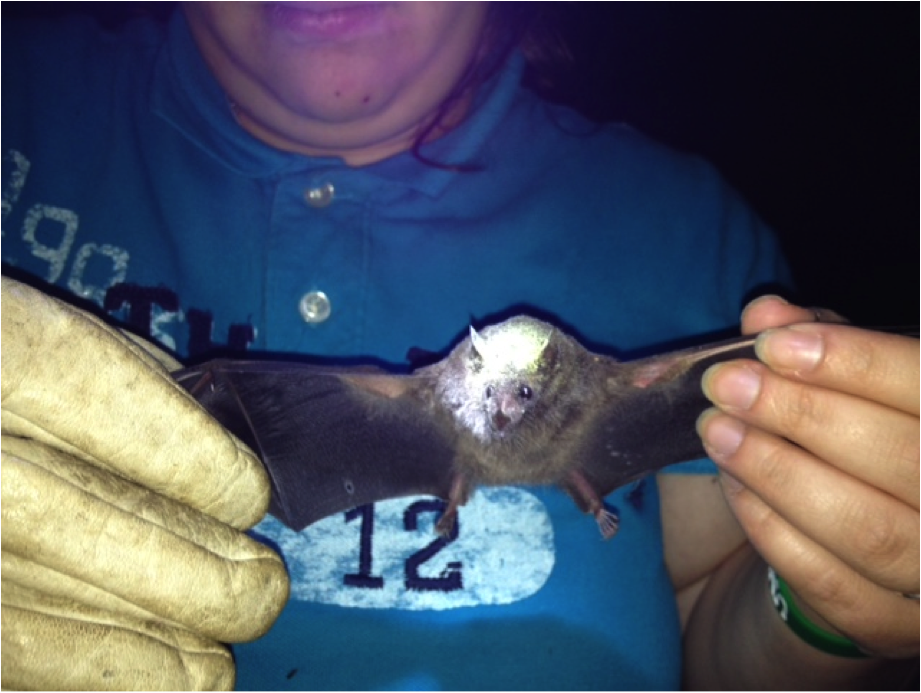
After more than fifteen bats of all shapes, sizes, and life stages, we were getting ready to leave. Suddenly, Kelly LaVal brought us the final bat…a nectar bat! It had pollen on its head! This bat is in the photo below, but the flash makes it a little tricky to see the yellow pollen. This bat was a pleasure and total surprise!
The night of the bat was nothing to be scared of. Truthfully, it was an incredible night. I am so happy we had nice weather and had the luck to meet the expert Dr. Laval and his friends.
-------------------------------------------------------------------------------------------------------------------------------------
En Español:
La Noche de Murciélagos
Después de un día de trabajo en el Instituto Monteverde, mis compañeros de Lake Forest College y yo fuimos a Tramonti´s por una cena llena de pizza (o pixa como se llama aquí) y risas. Pedimos mi tipo favorito, vegetariano, y otras de carnes ricas como salami y salchicha. Nosotros cuatro matamos tres pizzas en poco tiempo, y nos sentimos muy satisfechos.
Luego, nos juntamos con nuestra mamacita de acogida, Sarah Burbank (nuestra coordinadora de pasantías), para una aventura en la selva detrás del instituto. Subimos la escalera, pasando el olor fuerte y perfumado de las flores de las Trompetas de Ángel. Entramos la reserva de Dwight y Rachel Crandell cuando el sol acabó de atardecer.
Vimos con los focos de cabeza una red, casi como una red de tenis, estirado entre dos árboles grandes. Luego, vimos dos hombres…el legendario experto de murciélagos, Dr. Richard Laval, y su asistente, Kelly LaVal. Pronto después, la diversión empezó. Dr. Laval nos trajo el primer victima…un murciélago café e insectívoro que pertenece a la misma familia de murciélagos cafés que son comunes donde yo vivo en Chicago, Illinois.
Dr. Laval nos explicó que este murciélago es claramente un insectívoro porque tiene una nariz más sencilla que los murciélagos de fruta. Nos mostró la longitud de sus alas que son de piel muy fuerte pero muy fina y lisa también. Aprendí que si un ala se rompe, duraría cinco días para curarse. Yo me siento muy agradecida a estos murciélagos porque comen millones de insectos, como mosquitos, ¡cada noche! ¡Que útiles son!

Sosteniendo un murciélago!
Luego, nos trajo un murciélago de fruta. Estos murciélagos también son muy preciosos, yo pienso, aunque tienen narices complejas, grandes, y un poco feas. Los murciélagos de fruta también son muy importantes para los humanos porque ayudan a distribuir las semillas de muchas y muchas frutas que comimos cada día. Si yo fuera un murciélago, pienso que yo sería un murciélago de fruta. Este victima también fue muy pequeño, pero más tranquilo. Por eso, Dr. Laval pensó que sería un buen tipo para nosotros agarrar. Gabe fue el primer valiente agarrarlo, luego Ashley, Luis, y finalmente yo. Me pregunté, ¿Cuándo tendré la oportunidad agarrar un murciélago silvestre en el futuro? Me respondí, ¡nunca!, y eso fue. Lo agarré, y me alegró mucho. El amiguito nuevo fue suave y su corazón latió como un tambor. Fue una experiencia que nunca me olvidaré.
Por el resto de la noche, Dr. Laval nos mostró muchos más murciélagos insectívoros y de fruta. Pero no eran todos los mismos. Algunos eran machos, algunos juveniles, y algunos eran hembras. Las hembras me interesaban mucho porque algunas estaban embarazadas. Tenían panzas llenas e hinchadas. Dr. Laval adivinó cuanto tiempo se las quedaba hasta que dirían la luz. También, había hembras en lactancia, lo que significa que tenían cachorros. Que regalo fue aprender y ver estos detalles en vivo.
Después de más de quince murciélagos, de todos talleres y formas, íbamos a salir. De repente, Kelly nos trajo un murciélago final… ¡un murciélago que come néctar de las flores! ¡Tenía polen en la cabeza! Está en la foto abaja, pero por la luz es un poco difícil ver el polen amarillo. De ninguna manera, ¡fue un placer y sorpresa total!
La noche de murciélagos no fue nada escalofriante. De veras, fue una noche increíble. Me alegro que hacía buen tiempo y que tuvimos la suerte de conocer al experto Dr. Richard Laval y a sus amigos.