
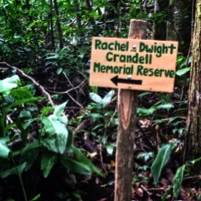
Internship - Rachel and Dwight Crandell Memorial Reserve - Pasantía
With the help of my supervisor, Randy Chinchilla, and some members of the Monteverde Institute we were able to create two maps of the Reserve that showed the path system, some signs and an entranceway to the reserve.
--- Con ayuda de mi supervisor, Randy Chinchilla, y con algunos miembros del Instituto Monteverde se logró crear dos mapas de la Reserva indicando los senderos, algunos rótulos de señalamiento y una entrada en la Reserva.

Signage and mapping of the Rachel and Dwight Crandell Memorial Reserve
by Jacqueline Zamudio
August, 2016
I had the opportunity of living in Monteverde in May through July with the help of the Grace Groner Foundation and Lake Forest College. During this time I did an internship and lived with a family in Cerro Plano.
My internship consisted in creating a basic maps and signs for the Rachel and Dwight Crandell Memorial Reserve. Before this the Reserve had some signs that could be found on the paths however, with time this signs had become damaged.
Crandell Memorial Reserve and paths
Also, the Institute did not have an up-to-date map, so, with the help of my supervisor, Randy Chinchilla, and some members of the Monteverde Institute we were able to update the Reserve maps by showing the location of the paths and signs as well as the Reserve limits.
Combining field work with Geographical Information System (GIS) techniques we determined the location and distance of the three paths that make up the Reserve: Bioluminosa Path, Bellbird Path, and Fungi Path. The following maps show the paths and the Reserve's limits.
Crandell Memorial Reserve and neighbouring properties.
The sign making part of the project was done in several steps. First we had to decide where we were going to put up the signs and what kind they were going to be. For this we took GPS points. After getting all the GPS points and deciding on the types of signs, we worked on several designs to determine the materials that would be necessary. After getting all the necessary materials, the signs were made. Finally, and with the help of the MVI’s staff, the signs were put alongside the paths. The following are pictures of the final Project.


Before and after: These signs indicate the way to get to the Reserve. (Before and after placing the sign).
Before and after photos. ---
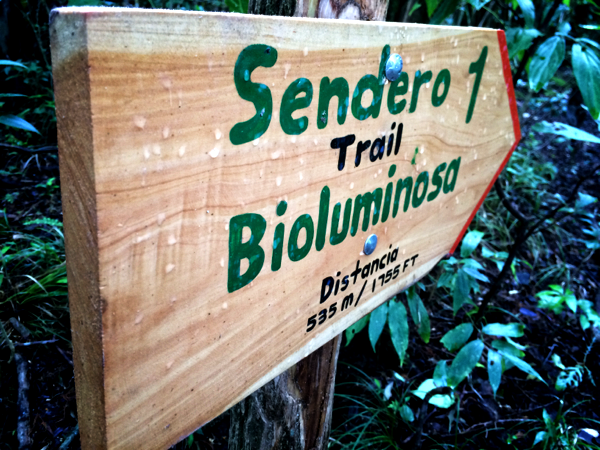
These are some of the signs pointing out the different paths. These signs show the path name and distance in meters and feet.

It’s also possible to find signs in each path that indicate the exit and end of path.
Finally, we build a small entrance way to the Reserve. The purpose of this small project was to create an entrance that would have several functions, the main one being for people to easily identify the way to enter the Reserve. The structure was also built in a way that it would prevent the entrance of bicycles, motorcycles and vehicles. On it, it's possible to observe the path map, information tables about the Crandell’s, biological registration forms, rules and logos. To build this entrance first we needed the design, then we got all the materials and finally we built it.
The following are pictures of how the entrance used to be, and how it is now.
These three projects were done in two months. Also during this time I was living with a family in Cerro Plano. Living with a family was also one of the things that made my experience in Costa Rica unique. Living with the family and being part of the community gave me the opportunity to learn about the Costa Rican culture which interested me. The Monteverde Institute and the Monteverde community gave me the opportunity to learn about Costa Rica while I helped out the community with my Project at the Rachel and Dwight Crandell Memorial Reserve.

Rotulación y mapeo en la Rachel & Dwight Crandell Memorial Reserve
Por Jacqueline Zamudio
Agosto 25, 2016
Entre los meses de mayo y julio , con ayuda de Grace Groner Foundation de Lake Forest College, tuve la oportunidad de vivir en Monteverde por dos meses. Durante ese tiempo realicé una pasantía mientras vivía con una familia en Cerro Plano.
Reserva Crandell y sus senderos.
La pasantía consistía en crear cartografía básica y rotulación para la Reserva Rachel & Dwight Crandell. Anteriormente la Reserva contaba con unos pequeños rótulos que se encontraban en los senderos. Sin embrago, con el paso del tiempo los rótulos se fueron dañando. Además el Instituto Monteverde no contaba con un mapeo actualizado. Con ayuda de mi supervisor, Randy Chinchilla, y con algunos miembros del Instituto Monteverde se lograron crear y actualizar los mapas de la Reserva indicando información de los senderos, de los rótulos de señalamiento y del punto de acceso y fin de la Reserva.
Combinando trabajo de campo con técnicas de los Sistemas de Información Geográfica (GIS en inglés) se determinó la ubicación y distancia de los tres senderos que conforman la reserva: Sendero Bioluminosa, el Sendero Pájaro Campana y el Sendero Fungi. Los siguientes mapas muestran los senderos que se pueden encontrar en la Reserva.
Este mapa muestra los límites de la Reserva y las propiedades vecinas.
Como se mencionó anteriormente, además del mapeo de los senderos también se hicieron algunos rótulos de señalamiento. Para este proyecto se tomaron varios pasos. Primero se decidió donde se iba a colocar cada rótulo y qué tipo de rótulo. Para este paso se tomaron puntos de GPS. Después de haber obtenido los puntos finales de GPS y los tipos de rótulos, se hicieron algunos diseños determinando los materiales que se necesitarían. Después de haber obtenido todos los materiales necesarios, se hicieron los rótulos. Por último, con ayuda de algunos miembros del Instituto Monteverde, se colocaron los rótulos en los senderos. Estas son algunas fotografías del producto final.

Antes y después:
Estos rótulos indican el camino que se puede tomar para llegar a la Reserva.
Antes y después:
Estos son rótulos indicando los senderos. En estos rótulos se indica el nombre del sendero y la distancia en metros y pies.
También se pueden encontrar rótulos en cada sendero indicando la salida y fin del sendero.
Por último, se construyó una pequeña entrada en la Reserva. El propósito de este pequeño proyecto era poder construir una entrada que tuviera varias funciones. La función principal era que las personas puedan identificar la entrada a los senderos con más facilidad. La entrada también se construyó de una manera que impide el paso de bicicletas, motocicletas o vehículos. La entrada también cuenta con un mapa de los senderos y algunas tablas con información sobre los Crandell, registros biológicos, algunas reglas y los logos. Para la construcción de esta entrada primero se obtuvo un diseño, después se determinaron los materiales, y finalmente llevó a cabo toda la construcción.
Aquí se puede apreciar cómo era la entrada anteriormente y como es ahora.
Estos tres proyectos se pudieron llevar a cabo en dos meses. Durante esos dos meses estuve viviendo con una familia en Cerro Plano. Vivir con una familia fue una de las cosas que también hizo mi estancia en Costa Rica única. Vivir con una familia y ser parte de la comunidad me dio la oportunidad de aprender sobre la cultura de Costa Rica lo cual me interesaba aprender. El Instituto Monteverde y la comunidad de Monteverde me dio la oportunidad de aprender sobre Costa Rica mientras ayudaba a la comunidad con mi proyecto en Rachel and Dwight Crandell Memorial Reserve.
Emma and Molly's internship on births in Costa Rica
Emma and Molly's experience during their internship on birthing in the zone.
For two aspiring midwives, finding the perfect internship seemed like it would be challenging in Costa Rica, a place where birth often occurs within a specific system and midwives are rarely used. However, we took our love of everything birth-related and created a project where we could listen to and create relationships with women while conducting prevalent research about the area.
Our project was to create a questionnaire, available in both English and Spanish, that we used as a guideline to interview women about their birth experiences. We interviewed both Tica and non-Tica women who had given birth in Costa Rica within the past six or so years. Our sample was diverse; we talked to women who had given birth at home, in public hospitals and clinics, and in private hospitals and clinics. Our questionnaire included questions about perceptions of different birth professionals, the differences between public and private hospitals, birth interventions, and personal stories.
We discovered interesting themes, some that supported our hypotheses and some that surprised us. The most rewarding aspect of the project was talking to women about something so personal and hearing about the challenges, the beauties, the fears and the hopes about the incredible shared experience of childbirth.
This internship has given us the opportunity to learn relevant Spanish vocabulary that we will need in order to work with Spanish-speaking women in the United States. We have made valuable relationships with women in the Monteverde community through this project that is so important to both of us. We worked with the Monteverde Institute to make sure that our project was conducted ethically and in a specific way that made it possible for us to talk to a diverse group of women from different backgrounds. This experience has opened our eyes to differences between birth options in Costa Rica and in the United States and has further excited us about our future careers as midwives.
by: Emma and Molly
___________________________________________________________________
Como dos posibles futuras parteras, pensamos que sería difícil encontrar una pasantía perfecto en Costa Rica, un lugar donde el parto ocurre en un sistema específico y las parteras casi no se usan. Pero creamos un proyecto en que pudiéramos escuchar a las historias y formar relaciones con mujeres de la zona—un proyecto que involucra nuestra pasión sobre todo lo que tiene que ver con el proceso del parto—a la vez aprovechar de hacer investigaciones interesantes y relevantes sobre la zona.
Para nuestra proyecto creamos un cuestionario, que podíamos usar en ingles o español, que usábamos como guía para entrevistas con mujeres sobre sus experiencias de parto. Hacíamos entrevistas con mujeres Ticas y extranjeras que han dado a luz en Costa Rica en los últimos seis años. Nuestra muestra era diversa; hablamos con mujeres que han dado a luz en casa, en hospitales y clínicas públicas, y hospitales y clínicas privadas. El cuestionario incluyó preguntas sobre percepciones de diferentes tipos de profesionales del parto (parteras, obstetras, enfermeras obstetras), las diferencias entre los hospitales públicos y privados, intervenciones del parto, y historias personales.
Descubrimos temas interesantes, unos que apoyaron nuestras hipótesis y unos que nos sorprendieron. Lo más gratificante era hablar con mujeres sobre algo tan personal y escuchar sus cuentas sobre los retos, las bellezas, los temores y las esperanzas sobre la experiencia increíble del parto, que compartimos las mujeres.
Esta pasantía nos dio la oportunidad aprender vocabulario relevante que necesitaremos para trabajar con mujeres hispanohablantes en los Estados Unidos. Hemos creado relaciones valiosos con las mujeres de la comunidad en este proyecto que es tan importante para nos dos. Trabajamos con el Instituto Monteverde para asegurar que el proyecto era conducido de manera ético y de manera en que era posible que hablemos con un grupo diverso de mujeres de experiencias diferentes. Esta experiencia nos mostró las diferencias entre los opciones del parto en Costa Rica e en los Estados Unidos y nos emocionó más sobre las careras futuras como parteras.
-Emma and Molly
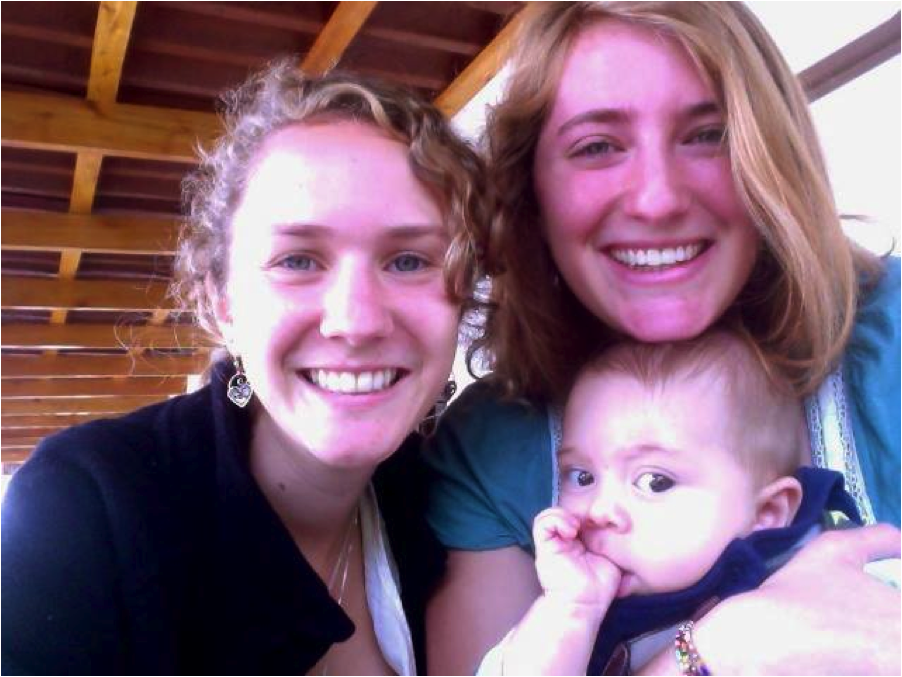
Emma and Molly with baby Santiago during their Internship at the Monteverde Institute.
The Institute and Living Routes Program- El programa del Instituto y Living Routes
About the Living Routes program of the Monteverde Institute- sobre el programa de Living Routes del Instituto Monteverde
"The Living Routes Program: Tropical Ecology, Development, and Social Justice began as a spring pilot project in the Spring of 2011; since 2011-2013, it has been offered fall and spring semesters. Living Routes, a non-profit organization focused on intentional communities and located in Amherst, MA, has a number of international programs. While the University of Massachusetts, Amherst grants academic credit for the courses, the program is open enrollment and has drawn students from many different universities and colleges, including Stanford, Sarah Lawrence, Cornell, Smith, the University of Vanderbilt, etc..
The Program in Monteverde urges students to "explore how international and national trends and policies have affected local sustainable development, environmental conservation and social justice efforts" This Program stresses experiential learning, community building, and personal sustainability (including yoga). Students take four courses: Ecological Relationships in the Tropics (primarily a field course), Community Service Learning in Costa Rica: Theory and Practice (also a field course that involves a heavy internship component), Sustainable Development and Social Justice, and Spanish Language and Costa Rican Culture (students pick appropriate language level). While classes are held at MVI and in forest reserves, much service learning (such as creating material for a rural school) and personal knowledge comes from the small agricultural community of San Luis where students live with a local family."
By: Leslie Burlingame
The Monteverde Institute has as one its goals to offer an integrated education to our students, which includes an active participation in the community. This involvement allows mutual learning experiences where our students learn from the community they live in and the community learns from our students.
As an example, last semester our students from the Living Routes program who live with homestay families in San Luis, worked on projects in both schools (Alto y Bajo), also worked in permaculture projects in Finca la Querencia and helped establish an ecology program for schools in the Monteverde Butterfly Farm.
In the last year, two of our students were really impressed with the community and decided to offer extra support once the program was finished: Lauren Wallace donated funds for an English program in the San Luis schools and Emily Barbour decided to finance the entire tuition for the final year at the Creativa (CFS) for a San Luis student.
tuition for the final year at the Creativa (CFS) for a San Luis student.
Our students leave with positive and transformative experiences and we would like to thank the community for helping to make this possible.
This video was made by one Sarah Fletcher about her internship and the butterfly farm:
http://www.youtube.com/watch?v=t221X7FGgmc&feature=youtu.be
El Instituto Monteverde tiene como una de sus metas ofrecer una educación integral a nuestros estudiantes donde se incluye una participación activa en la comunidad. Esto tiene como fin que haya un aprendizaje mutuo: los estudiantes aprenden de la comunidad y la comunidad de los estudiantes..
A modo de ejemplo el semestre pasado nuestros estudiantes del programa de Living Routes que se hospedan con familias en San Luis, trabajaron con las escuelas del Alto y Bajo, además hicieron unos proyectos de permacultura en Finca la Carencia y ayudaron a establecer el programa de ecología para las escuelas del Mariposario Monteverde.
El año pasado dos de nuestros estudiantes quedaron realmente impresionadas con la comunidad, y decidieron apoyar un poco más una vez que terminaron el proyecto, Lauren Wallace dono fondos para un programa de ingles para las escuelas de San Luis, y Emily Barbour que decidió financiar el ultimo año de estudio en la Escuela Creativa (CFS) a un estudiante de San Luis.
Nuestros estudiantes salen con experiencias muy lindas y queremos agradecer a la comunidad ayudar hacer esto, por compartir con ellos.

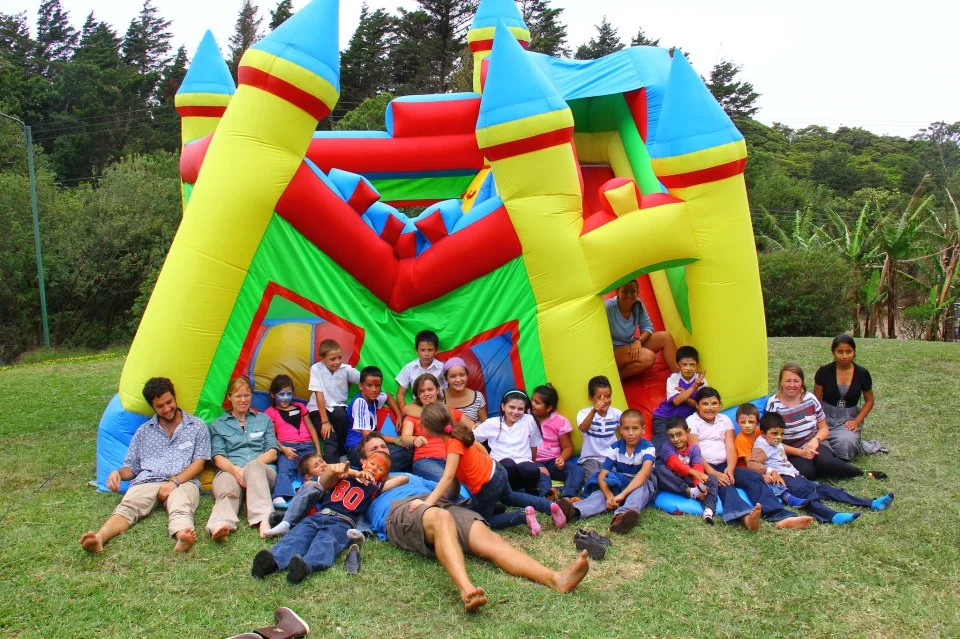
Living Routes students chilling with kids from San Luis Monteverde