
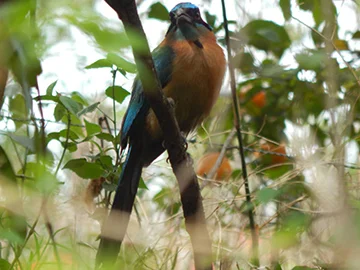
I must have seen the same Blue-Crowned Motmot more than three dozen times … /// Debo haber visto al mismo pájaro péndulo (bobo) más de tres docenas de veces...
I must have seen the same Blue-Crowned Motmot more than three dozen times as I ventured through brush and thicket.../ Debo haber visto al mismo pájaro péndulo más de tres docenas de veces mientras me aventuraba a través de espeso bosque y matorral..
por Luis Beltran
Blog Post Julio 27, 2015 (para español favor de bajar).
I must have seen the same Blue-Crowned Motmot more than three dozen times as I ventured through brush and thicket with Bellbird Biological Corridor Coordinator, Randy Chinchilla, volunteer, Mauricio Belmar, and intern, Brittany Schweiger, searching for missing trees, as if noir detectives hired by the Monteverde Institute. Cumbersome and scattered were the clues key to completing this assignment—an outdated map, missing tags, and misidentified trees—though nothing got in the way as much as that azure plumage. Self-fascinated with its own elongated, auricular raquet tip feather, this Motmot waved its tail from side-to-side, as if sensual hypnotist of the natural world. I must have fallen for the charm more than three dozen times.
Oh, what fascinating colors and what wondrous stage! Learning to identify the plants and animals of Monteverde is to me much like really getting to know your old friends – those companions that have been with you far longer than you can remember. It aches to leave these friends behind, which is part of the reason why I keep returning and returning to Monteverde. Equally invaluable to me is the staff of the Monteverde Institute, the warmth of the local community, and the incredible wealth of knowledge—hidden in leaf litter or canopy cover—just waiting to be discovered. Thank you for allowing me to volunteer with you this year! I will see you next time!
by: Luis Beltran (Lake Forest and Monteverde Institute's Lake Forest).


Debo haber visto al mismo pájaro péndulo más de tres docenas de veces mientras me aventuraba a través de espeso bosque y matorral. En aquellas ocasiones fui bien acompañado por el coordinador del corredor biológico del pájaro campana, Randy Chinchilla, voluntario Mauricio Belmar, y por la pasante Brittany Schweiger; juntos en búsqueda de ciertos árboles desaparecidos, comprometidos en la misión como cuatro detectives botánicos contratados por el Instituto Monteverde. Nuestro objetivo de encontrar y medir los árboles detrás del instituto se veía ofuscado por la falta de un mapa adecuado, árboles sin identificación, y etiquetas extraviadas. Sin embargo, nada presentaba semejante devaneo como aquel azur celeste plumaje. Fascinado por sus propias plumas terminales (alongadas y auriculares como raquetas de cielo), el pájaro péndulo, posado tranquilamente sobre una rama, movía tal vaivén del viento su cola esplendorosa, como sensual hipnotista de los bosques. Debo haber caído por su hechizo más de una docena de veces.
Ah, ¡pero que fascinantes colores y que encantadora escena! Mientras aprendo los nombres de los animales y plantas de Monteverde no logro descartar un sentimiento de amistad usualmente reservado para aquellos amigos fieles desde tiempos antaños. Es doloroso dejar a mis amigos de pluma y hoja, y en parte por eso vuelvo, y vuelvo a Monteverde. Igual de invaluables para mi son todos los que forman parte del Instituto Monteverde, así como la cálida pura vida que se siente en la comunidad local, y por la increíble vastedad de sabiduría—escondida entre hojarasca y torres de madera—esperando a ser descubierta. Muchísimas gracias por darme la oportunidad de trabajar con ustedes una vez más. ¡Nos veremos la próxima vez, Instituto Monteverde! ¡Pura vida!
Por: Luis Beltran (pasante del Instituto y de Lake Forest).
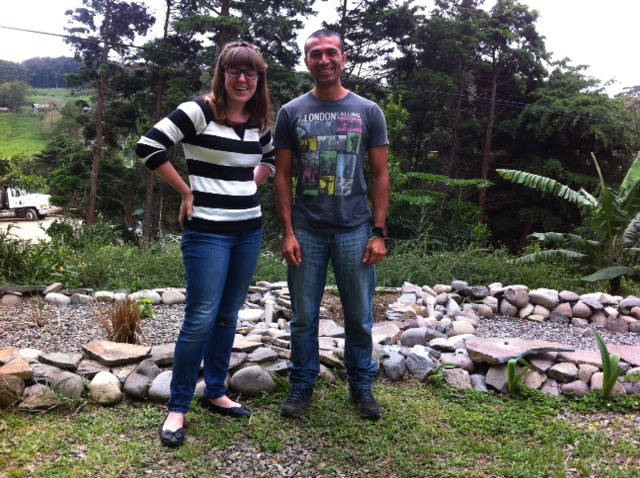
Student spotlight: Shelby Bates --- Foco estudiantil: Shelby Bates
If you stop by the Monteverde Institute’s biogarden, you will notice a special touch that was not there previously: interpretive signs that explain and give importance to conserving water and treating grey water. --- Si pasas por la biojardinera del Instituto Monteverde podrán notar algo nuevo: letreros interpretativos que explican y le dan importancia a la conservación del agua y el manejo de las aguas grises.
Student Spotlight: Shelby Bates, Intern from University of Nebraska-Lincoln
Para español favor de bajar a la próxima sección.
The Institute has had a greywater treatment area for some years but it has been somewhat of a problem and often didn't function. Last summer some of our staff members and students from the University of South Florida simplified and rebuilt it, so it is now doing an excellent job of processing our greywater.
We want others in the area to be able to make and use their own greywater treatment. If you stop by the Monteverde Institute’s biogarden, you will notice a special touch that was not there previously: interpretive signs that explain and give importance to conserving water and treating greywater. All thanks goes to Shelby Bates, a senior at the University of Nebraska who will complete her 10-week internship at the MVI on December 6, and her supervisor Orlando “Fish” Calvo, a Monteverde resident.
Shelby is a multi-talented young woman who fitted into the community very well. She saw the gardens projects and took on the job of helping to interpret the greywater treatment system for our students and for the community, so others can use the system. The treatment ends at what we call a “biogarden,” plants growing in specific layers of gravel that aid in digesting any residue left over from primary treatment and guiding the treated water downhill for use in gardens.
Together with her advisor, Orlando “Fish” Calvo, she created a series of signs to describe how the system works. It is now part of our educational pathway that includes the native plant, medicinal, and vegetable gardens, tree nursery as well as demonstrations of keyhole gardens. Despite living in the tropics, our alternating dry/wet seasons create the needs for conservation and control of water and waste. Shelby explains, “If somebody wanted to implement a biogarden in their own house, hotel or restaurant, they now have a very clear example of how this system functions.”
Shelby recalls that when she applied to work at the Monteverde Institute, she did not originally see her internship directly relating to her education major. “I was looking for an opportunity to finish my college education in which I could learn more about biology and see if I would rather change to a career in the sciences, and so I came to the Institute seeking the chance to learn more about the environment.
“The Institute has been really great in letting me see how I can apply my background to systems which function outside of education that are equally as important to education. So, for example, the Institute focuses more on community education and less on education within schools, but that education within the community is just as important as the work that a teacher might do within a school. It’s been really great to see.”
Since arriving to Monteverde, Shelby has decided to pursue a Master’s in Social Work, which will allow her to better understand different social issues and peoples’ responses to subjects like sustainable development, particularly how to convince others to engage in sustainable behaviors.
You can follow Shelby by reading her blog: www.shelbybatesabroad.wordpress.com /
Or, the Monteverde Institute blog which explains our particular greywater treatment program:
http://monteverde-institute-blog.org/environmental/aguas-grises-greywater
On December 4, 2014, Shelby delivered her report to the community, titled “The Impact of Humans on the Treatment and Production of Greywater.”
Written by: Bob Howe


Foco estudiantil: Shelby Bates, pasante de la Universidad de Nebraska-Lincoln
El instituto ha tenido por algunos años un sistema de manejo de aguas grises, sin embargo estuvo teniendo problemas por algún tiempo. El verano pasado algunos estudiantes de USF y miembros del personal trabajaron duro en simplificar el sistema y re-construirlo, así que actualmente está funcionando bien.
Si pasas por la biojardinera del Instituto Monteverde podrán notar algo nuevo: letreros interpretativos que explican y le dan importancia a la conservación del agua y el manejo de las aguas grises. Todo esto se logró gracias a Shelby Bates, una estudiante de ultimo año de la Universidad de Nebraska que completó su pasantía de 10 semanas el 6 de diciembre y de su supervisor Orlando “Fish” Calvo, un residente de Monteverde.
Shelby es una joven de múltiples talentos que encajó a la comunidad muy bien. Ella vio los proyectos en el jardín y se dio a la tarea de ayudar a interpretar el sistema de aguas grises para el uso de nuestros estudiantes y comunidad, de esta manera otras personas podrían usar el sistema. El tratamiento termina en lo que se llama una “biojardinera” donde las plantas crecer en diferentes niveles de piedras que asisten en “digerir” cualquier residuo que permaneció del tratamiento original y en dirigir el agua cuesta abajo para uso de riego en los jardines.
Junto con su tutor, Orlando “Fish” Calvo, Shelby creó una serie de letreros que describen como funciona el sistema. Ahora estos son parte de nuestra caminata educacional que incluye jardines de plantas nativas y medicinales, huertas, un vivero de árboles y demostraciones de jardines Ojo de Cerradura. Es nuestra fe que este vaya a servir como una modelo de tratamiento de aguas grises para otras zonas de la comunidad Monteverde. A pesar de vivir en los trópicos, el que se alternen las épocas secas con las lluviosas crean la necesidad de trabajar en conservación, control y manejo de aguas. Shelby dice, “si alguien quiere implementar una biojardienra en su casa, hotel o restaurant ahora tienen un ejemplo bastante claro de como este funciona.”
Shelby se recuerda que cuando ella aplico para la pasantía ella no vio una relación directa de su pasantía con sus estudios de Universidad, “yo estaba buscando una oportunidad para terminar mi educación de una manera en la que podría aprender más sobre biología y de esta manera entender si iba a querer cambiar mi carrera a una más relacionada a la ciencias, así que vine al Instituto buscando la oportunidad de aprender más sobre el medio ambiente.
“El Instituto ha sido muy bueno en permitir ver como puedo aplicar mi experiencia a sistemas que funcionan por fuera de lo educativo pero que son igual de importantes para la educación. Así que, por ejemplo, el Instituto se enfoca más en educación a la comunidad, y menos a la educación dentro de las escuelas, pero esa educación dentro de la comunidad es tan importante como el trabajo que un maestro podría hacer en una escuela. Esto ha sido muy bueno poder ver.”
Desde que llegó a Monteverde, Shelby ha decidido buscar una maestría en trabajo social, la cual le permitirá entender de manera mejor problemas sociales y las reacciones de las personas a términos como desarrollo sostenible, particularmente en como convencer a otras personas en engancharse a las prácticas sostenibles.
Pueden encontrar más información de Shelby en su blog: www.shelbybatesabroad.wordpress.com /
O ver la descripción de nuestro sistema de manejo aquí:http://monteverde-institute-blog.org/environmental/aguas-grises-greywater
El 4 de diciembre Shelby hizo una presentación a la comunidad titulado “El impacto de los humanos en el tratamiento y producción de Aguas Grises”.
Escrito por: Bob Howe