
Monteverde: A one-of-a-kind teacher ---- Monteverde: Un maestro único e inimitable
It is an opportunity greater than I had ever imagined it would be, getting to be an intern and yet still gain coordination experience with internships.
--- Es una oportunidad más grande de lo que yo la había imaginado, todo esto de ser pasante y de aun así poder obtener experiencia en coordinación de pasantías.
Monteverde: A one-of-a-kind teacher
By: Ashley Gora, intern from Chicago, IL, USA
(Para Español favor revisar después de las fotos)
It is an opportunity greater than I had ever imagined it would be, getting to be an intern and yet still gain coordination experience with internships. After nine-and-a-half months here this year, and after having interned here in 2012 and 2013 for two months at a time, I’ve learned far more than I ever dreamed I would, and Monteverde never fails to teach me something new each day I spend here via complex musings and emotions. It is my intention in this blog to share three of these with you, dear Reader. And allow me to assure you of the following: If you ever come to Monteverde, whether for an internship or simply to live out your vacation days, I can guarantee that if you quietly let the magical, pulsing life of this natural and human environment whisper to you, you too will leave here changed.
~*~
After a while here, part of you becomes cynical: Why become friends with students and tourists who come and then leave and forget you ever existed? So many people, too many faces and names. Moreover, who do you choose to do life with here, especially considering that you, too, are one of those fleeting faces? And you have to remind yourself, as with the story of the woman launching beached starfish back into the sea, that to that person it matters, to that person your actions, your attitude, your outreach, your nature, all matter, if only for a little while, if only for the duration of that one fleeting moment for that fleeting face.
~*~
Community is important. Community is difficult. More often than not I’d much rather just skip doing the people thing, because people are messy, people take effort, people are broken. Being in community means that, if I’m doing everything that the word “community” implies, I’m feeling something, and sometimes it feels great, and sometimes it doesn’t, and it’s always scary. Being in community means that even though I can choose how vulnerable I want to be, I still have to be vulnerable, period. But as social beings by nature, being in community also is the most beautiful thing life has to give us. It is perfect love imperfectly embodied in the human being. It is the comforting warmth of a strong hug and the sweet tinkling of an unbridled laugh. It is movement and spirit and link. And if I can help you make those links with others, find a group, find community, then I am happy.
~*~
Never have I stayed through the whole rainy season before. Coming out of the dry season, the torrential downpours are a welcome blessing, satiating the parched land, the dust-caked trees. Then, after three months of the same, the emotional toil of a lack of sunshine-filled days kicks in. The misty, eternally-humid air and the gray hue of the overcast sky all begin to wear on the mind. Days pass, weeks, months, and then suddenly it starts to ease when finally you think that the storms will never pass. Mornings are audaciously bright—acrylic paints splashing gaudy dyes onto lush foliage and full-bodied earth and gemstone flowers which daze and quench the thirst of the eyes that had grown too accustomed to darkness. Forest sprite I am, and I escape to the wild world of effervescent color and incomplete, lackadaisical metaphor, fearful that I am hallucinating.
Monteverde: Un maestro único e inimitable
(For English please scroll up).
Por: Ashley Gora, pasante de Chicago, IL, USA
Es una oportunidad más grande de lo que yo la había imaginado, todo esto de ser pasante y de aun así poder obtener experiencia en coordinación de pasantías. Después de nueve meses y medio aquí este año, y después de ser pasante aquí en 2012 y 2013 por dos meses cada vez, he aprendido mucho más de lo que alguna vez soñé que aprendería, y Monteverde sigue sin fallar en enseñarme algo nuevo cada día a través de las contemplaciones y emociones complejas. Es mi intención en este blog compartir tres de estas con usted, querido Lector. Y déjeme asegurarle de lo siguiente: Si alguna vez usted viene a Monteverde, sea para una pasantía o simplemente para pasar sus vacaciones aquí, yo le puedo garantizar que si usted tranquilamente deja que la vida mágica y pulsante de este ambiente humano y natural le susurre, usted también se irá de aquí transformado.
~*~
Después de un tiempo acá, una parte de usted se vuele cínico: ¿Por qué ser amigo de los estudiantes y los turistas que vienen y van si ellos se olvidarán de mi existencia? Tantas personas, tantos nombres y tantas caras. Además, ¿a quién puedo acercarme yo para que me ayude a construir mi vida aquí, tomando en cuenta el hecho de que yo también soy una de esas caras fugaces? Y hay que recordar, que igual como en la historia de la mujer que lanza las estrellas de mar embarrancadas en la playa devuelta al océano, que para aquella persona importa, que para aquella persona sus acciones, su actitud, su extensión, su naturaleza, importan, aunque sea solo por un rato, aunque sea solo por la duración de ese único momento fugaz para esa cara fugaz.
~*~
La comunidad es importante. La comunidad es difícil. La mayoría de las veces prefiero apartarme de las personas, porque las personas con complicadas, las personas requieren un esfuerzo, las personas son liosas. Estar en comunidad significa que, si yo hago todo lo que la palabra “comunidad” implica, yo siento algo, y a veces se siente bien, y a veces no, y siempre da miedo. Estar en comunidad significa que aunque yo puedo elegir qué tan vulnerable quiero ser yo, todavía tengo que ser vulnerable, punto. Pero como somos seres sociales por naturaleza, estar en comunidad también es lo más bello que nos puede dar la vida. Es el amor perfecto encarnado imperfectamente en el ser humano. Es el calor agradable de un fuerte abrazo y el tintineo dulce de la risa desenfrenada. Es movimiento y espíritu y vínculo. Y si yo le puedo ayudar a hacer aquellos vínculos con otras personas, a encontrar un grupo, a encontrar la comunidad, pues estoy feliz.
~*~
Nunca antes me había quedado por la temporada lluviosa entera. Saliendo de la temporada seca, los aguaceros torrenciales son una bendición bienvenida, saciando a la tierra reseca, los árboles cubiertos en polvo. Después de tres meses de lo mismo, el peso emocional que viene con la falta de días llenos de rayos de sol comienza. El aire neblinoso, eternamente húmedo, y las tonalidades grises de un cielo nublado logran con el tiempo desgastar la mente. Pasan los días, las semanas, y los meses, y cuando más se muestran incesables las tormentas, es entonces de repente que llega el alivio. Las mañanas son audazmente brillantes—pinturas acrílicas salpican tintes llamativos sobre el follaje frondoso, la tierra sabrosa, y las flores fragantes como gemas que aturden y aplacan la saciedad de los ojos que se habían acostumbrado desmesuradamente a la oscuridad. Duendecillo de bosque soy yo, y escapo al mundo silvestre de colores efervescentes y metáfora incompleta, lánguida, temiendo que alucino.
The Night of the Bat---La Noche de los Murciélagos
The night of the bat was nothing to be scared of. Truthfully, it was an incredible night. I am so happy we had nice weather and had the luck to meet the expert Dr. Laval and his friends.
Blog 9.7.13 by Lana Panitch Lake Forest Intern
After a day´s work at the Monteverde Institute, my cohorts from Lake Forest and I went to Tramonti´s for a dinner full of pizza (or pixa as they called it here) and laughs. We ordered my favorite type, vegetarian, and some meaty ones as well for the meat-lovers at the table. We demolished three pizzas between the four of us in hardly any time at all. We left very satisfied.

Having Pizza at Tramonti
Soon after, we hiked back up to the Institute to meet up with our Costa Rican “Mommy away from home” (our internship coordinator), Sarah Burbank. An adventure in the forest behind the Institute awaited us. We mounted the stairway, passing the strong, perfumed odor of the Angel’s Trumpets flowers. We entered the Dwight and Rachel Crandell preserve when the sun had just set.
As we approached, we could see with our headlamps a net, almost like a tennis net, stretched between two big trees. Then, we saw three figures…the legendary local bat expert, Dr. Richard LaVal and his assistants, his daughter and son-in-law. Right away, the fun began. Dr. LaVal brought us the first victim…a brown insectivorous bat that belongs to the same family of brown bats that are very common where I live in Chicago, Illinois.
Dr. LaVal explained to us that this bat was clearly an insect bat because it has a simpler nose than fruit bats. He showed us the length and breadth of its wings. The wings are made up of a very fine and smooth skin that is surprisingly strong and durable. I learned that if a wing breaks or tears, it would take five days for it to heal. I feel very thankful for these bats because they eat thousands of insects, such as mosquitoes, every night. What nice pest control!
Then, he brought us a fruit bat. These bats are also very cute, I think, although their noses are more complex, bigger, and uglier than those of the insect bats. The fruit bats are also very important for humans because they help to distribute many types of fruits’ seeds. Some fruit they pollinate, for example, are mangos, peaches, and even almonds! If I were a bat, I would most definitely be a fruit bat. This victim was very small, and calmer than the insect bat. Dr. LaVal thought it was a good candidate for us to hold. Gabe was the first brave soul to hold it, followed by Ashley, Luis, and then me. At first I hesitated…then I had to ask myself, “When will I ever get this opportunity to hold a wild bat again in the future?” The answer was, “Never!” And that was that. I held it carefully, and it was a wonderful experience. My new little friend was soft and its heart beat like a little drum. It was an experience I will never forget.

Lana with a bat, and Richard Laval in the Background.
For the rest of the night, Dr. LaVal showed us many more fruit and insect bats. Surprisingly though, many of them were quite unique. Some were male, some were juvenile, and some were female. The females interested me the most because some were pregnant with big, swollen bellies. Dr. LaVal was good at guessing how much more time they had until delivery. We also got to see lactating females, which meant that they were mothers of pups. What a treat it was to learn and see all of those small details in real life!
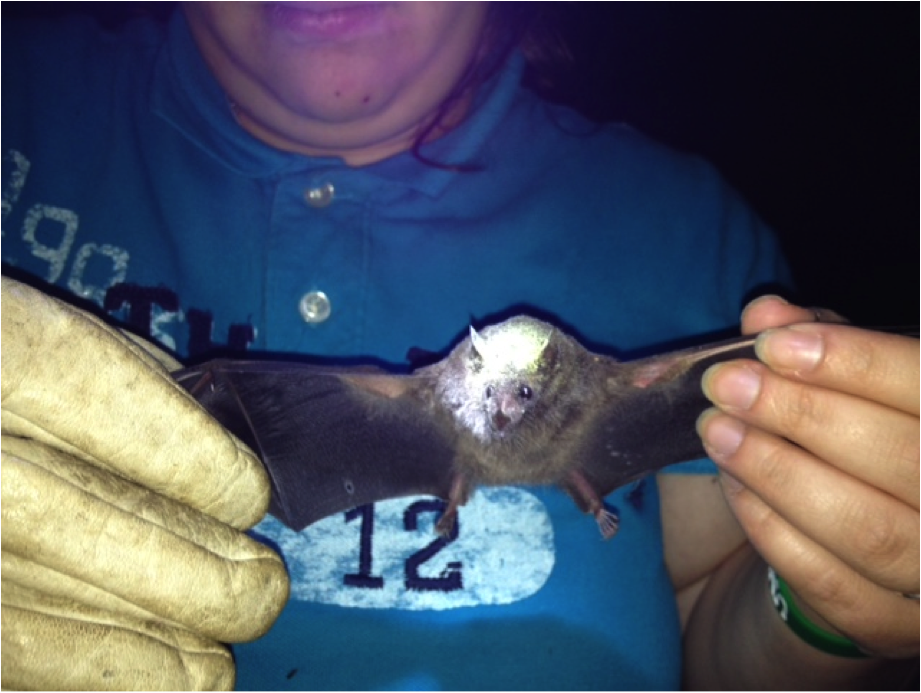
After more than fifteen bats of all shapes, sizes, and life stages, we were getting ready to leave. Suddenly, Kelly LaVal brought us the final bat…a nectar bat! It had pollen on its head! This bat is in the photo below, but the flash makes it a little tricky to see the yellow pollen. This bat was a pleasure and total surprise!
The night of the bat was nothing to be scared of. Truthfully, it was an incredible night. I am so happy we had nice weather and had the luck to meet the expert Dr. Laval and his friends.
-------------------------------------------------------------------------------------------------------------------------------------
En Español:
La Noche de Murciélagos
Después de un día de trabajo en el Instituto Monteverde, mis compañeros de Lake Forest College y yo fuimos a Tramonti´s por una cena llena de pizza (o pixa como se llama aquí) y risas. Pedimos mi tipo favorito, vegetariano, y otras de carnes ricas como salami y salchicha. Nosotros cuatro matamos tres pizzas en poco tiempo, y nos sentimos muy satisfechos.
Luego, nos juntamos con nuestra mamacita de acogida, Sarah Burbank (nuestra coordinadora de pasantías), para una aventura en la selva detrás del instituto. Subimos la escalera, pasando el olor fuerte y perfumado de las flores de las Trompetas de Ángel. Entramos la reserva de Dwight y Rachel Crandell cuando el sol acabó de atardecer.
Vimos con los focos de cabeza una red, casi como una red de tenis, estirado entre dos árboles grandes. Luego, vimos dos hombres…el legendario experto de murciélagos, Dr. Richard Laval, y su asistente, Kelly LaVal. Pronto después, la diversión empezó. Dr. Laval nos trajo el primer victima…un murciélago café e insectívoro que pertenece a la misma familia de murciélagos cafés que son comunes donde yo vivo en Chicago, Illinois.
Dr. Laval nos explicó que este murciélago es claramente un insectívoro porque tiene una nariz más sencilla que los murciélagos de fruta. Nos mostró la longitud de sus alas que son de piel muy fuerte pero muy fina y lisa también. Aprendí que si un ala se rompe, duraría cinco días para curarse. Yo me siento muy agradecida a estos murciélagos porque comen millones de insectos, como mosquitos, ¡cada noche! ¡Que útiles son!

Sosteniendo un murciélago!
Luego, nos trajo un murciélago de fruta. Estos murciélagos también son muy preciosos, yo pienso, aunque tienen narices complejas, grandes, y un poco feas. Los murciélagos de fruta también son muy importantes para los humanos porque ayudan a distribuir las semillas de muchas y muchas frutas que comimos cada día. Si yo fuera un murciélago, pienso que yo sería un murciélago de fruta. Este victima también fue muy pequeño, pero más tranquilo. Por eso, Dr. Laval pensó que sería un buen tipo para nosotros agarrar. Gabe fue el primer valiente agarrarlo, luego Ashley, Luis, y finalmente yo. Me pregunté, ¿Cuándo tendré la oportunidad agarrar un murciélago silvestre en el futuro? Me respondí, ¡nunca!, y eso fue. Lo agarré, y me alegró mucho. El amiguito nuevo fue suave y su corazón latió como un tambor. Fue una experiencia que nunca me olvidaré.
Por el resto de la noche, Dr. Laval nos mostró muchos más murciélagos insectívoros y de fruta. Pero no eran todos los mismos. Algunos eran machos, algunos juveniles, y algunos eran hembras. Las hembras me interesaban mucho porque algunas estaban embarazadas. Tenían panzas llenas e hinchadas. Dr. Laval adivinó cuanto tiempo se las quedaba hasta que dirían la luz. También, había hembras en lactancia, lo que significa que tenían cachorros. Que regalo fue aprender y ver estos detalles en vivo.
Después de más de quince murciélagos, de todos talleres y formas, íbamos a salir. De repente, Kelly nos trajo un murciélago final… ¡un murciélago que come néctar de las flores! ¡Tenía polen en la cabeza! Está en la foto abaja, pero por la luz es un poco difícil ver el polen amarillo. De ninguna manera, ¡fue un placer y sorpresa total!
La noche de murciélagos no fue nada escalofriante. De veras, fue una noche increíble. Me alegro que hacía buen tiempo y que tuvimos la suerte de conocer al experto Dr. Richard Laval y a sus amigos.
– The “Usual” Work Day -- Un día “normal”
Luis Beltrán: It is a bit like doing what my brain had always wanted to do that my body had always avoided trying.--- Monteverde es algo así como un sueño que se salio de su cabeza. Una experiencia única, un azul aún no descrito, un lugar donde el cuerpo se sale de su contexto.
The "Usual" Work Day - by Luis Carlos Beltrán - July 2013

Luis with Morpho Buttherfly
Eventually it reaches the fingertips; in accordance with other parts of the body that have already been deprived of the power of sensation, the fingertips eventually forgive the strain and signal for time to be forgotten as part of anything at all. It is at this point that I work most efficiently… at least perhaps that is how it feels. It is as if I needed to first exhaust myself to the point of losing care for the perception of time before fully acquiring the motivation to do it all. There is however, another factor – when wasps are not furiously flying about all is well, all is enchanting, mesmerizing, hypnotizing, to the point that it does not feel like work anymore, but it does not feel like playtime either. It is a bit of both, and it fluidly alternates between the different shades of each like two flames trying to catch each other shadows. Before heading out to Curi Cancha equipping the right tools is essential. I trade my tennis shoes for rain boots, my necklace becomes a holder for the DBH (Diameter Breast Height) tape, my left shoulder becomes a one-limb circus show as it balances in place a three-meter long metal pole, and my right hand grips a machete perhaps entranced in the belief that it is actually the arm of a reincarnated myrmidon.
At the beginning I must admit I am overwhelmed. The field is vast, order is incomprehensible, the foliage dense, and somewhere a three-wattled bellbird bonks nonchalantly in the dead of silence. My task is to find the marked trees in this plot in Curi Cancha, map them out relative to other trees, and take down their measurements. The key, is finding at least two consecutive trees that still have their tags on. From there the field now has limits and order is apparent. While the foliage is still undoubtedly dense, the nonchalant three-wattled bellbirds now bonk in junction with the delightful lyrics that effervesce form the music player in my pocket in jollification of such precious experiences much like the one that now unfolds right here before me. Key to getting to the trees is a special dance move of the highest order: first one must thrust the arms forward with the machete and metal pole. This signals anything that might be hiding in the bush to skedaddle and make scarce of their presence. Or chase me, really, sometimes they chase. Next, the left foot steps right below and between the machete and pole. Following that, one must now push the machete and pole apart and thrust the weight of the body into the foliage in front. If done correctly, a path should reveal itself, and all that is left now is to chop whatever might be left in the path. Alternatively, if what stands in my way is simply tall grass I take a couple steps back and with some impulse catapult myself into the field of mesophyll and swim my way across. As noted previously, it is an exhausting exercise, but what starts as overwhelming trades winds with the exhilarating. It is then that the sensation of pain and the perception of time lose their right to complain and all that is left is a stubborn focused desire to complete the map and venture over yonder.

So that is my “usual” workday. In essence there is a bit of a mystical aspect to the task. It is a bit like doing what my brain had always wanted to do that my body had always avoided trying. I am very excited to finish the database and map and run statistical analyses to observe what patterns or characteristics we can find that are unique to the trees in Curi Cancha. As an aspiring biologist and renowned head-in-the-clouds explorer, working in Monteverde is an indispensable experience worth adding to my growing storybook of adventures and trials.
Photography: Selena Avendaño

"
Monteverde es algo así como un sueño que se salio de su cabeza. Una experiencia única, un azul aún no descrito, un lugar donde el cuerpo se sale de su contexto."
Eventualmente, aterriza en las puntas de los dedos; de acuerdo con todas las otras partes de un cuerpo depravado de el poder de la sensación, las puntas de los dedos llegan ya a olvidarse del dolor y dan por aviso que ha llegado la hora de olvidarse del pasar del tiempo. Es en esos momentos que me siento trabajar de forma más eficiente… o por lo menos, así es como se siente. Es como si tuviese que exhaustarme hasta el punto de perder la percepción del tiempo como condición especifica para poder adquirir la motivación necesaria para hacerlo todo. Sin embargo, hay otro factor – cuando las avispas no revoletean furiosas en el aire todo esta bien, todo es encantador, todo es un mesmerismo, todo es hipnotizante, y todo es así hasta el punto que el trabajo ya no es trabajo, pero tampoco juego. Es un poco de los dos, un fluido claroscuro que alterna quisquillosa entre opuestos así como dos llamas encendidas de placer por alcanzar primero la sombra de la otra. Antes de salir hacia Curi Cancha se es necesario preparar las herramientas indispensables para el trabajo. Mis tenis los cambio por un par de botas de hule, my collar carga con la responsabilidad de sostener la cinta para medir el diámetro, mi hombro izquierdo balancea un barrote de hierro con tres metros de longitud como perteneciese al cuerpo de un malabarista de la misma forma que mi mano derecha convencida de pertenecer al brazo de un mirmidón, sostiene resplandeciente al machete con su filo.

Luis atrapando mariposas.
Admito sin problema que el principio siempre es abrumador. El campo es vasto, el orden incomprensible, el follaje denso, y en algún lugar distante un pájaro campana toca su canto de campana cómo para matar a un silencio ya muerto. Mi misión es encontrar los árboles marcados con placas metálicas, registrarlas en el mapa en posición relativa a los otros árboles, y tomar las medidas necesarias. La clave es encontrar dos árboles consecutivos que todavía tengan sus placas metálicas. De ahí, ahora el campo vasto tiene sus limites, el orden incomprensible se somete a la realidad mística de la lógica, y aunque el follaje sigue denso, se escucha en la lejanía un pájaro campana que alegre canta al son de Juan Luis Guerra o Carlos Vives, o quién sea que anda cantando bellezas musicales desde el fondo de mi bolsillo. Clave para atravesarse por el campo es un paso de baile muy singular: primero uno debe tirar los brazos con el machete y el barrote hacia delante. Esto ayuda a espantar a cualquier animalucho que ande escondido entre la maleza. O les avisa para que me persigan; muchas veces es así. En todo caso, el paso siguiente es paso izquierdo hacía delante por debajo del barrote y el machete. Para finalizar, se abalanza el cuerpo hacia delante y se esfuerza para abrir los brazos y separar al machete del barrote. Si se hizo correctamente, debería presentársele un camino hacia el árbol deseado. Lo único que falta ahora es cortar lo que no haya respetado el paso de baile forestal usando el filo del machete. Alternativamente, si lo que se presenta al frente mío es un mar de pasto lo único que se puede hacer es nadar. Como pueden notar, es un trabajo que alberga cansancio, pero lo que comienza como abrumador cambia de color por un tono más excitante. Es entonces cuando la sensación de dolor y la percepción del tiempo pierden su lugar y verosímil relevancia, y lo queda es una sensación de enfoque total en la tarea por terminar y una determinación con irrevocable resistencia, y luz, y al final una tacita de café.
Y eso, eso es mi día “normal”. Es realmente asombroso – es como hacer lo que mi cerebro siempre quiso hacer pero que mi cuerpo siempre evadió intentar. Es por eso mismo que ansió terminar el mapa y la recolección de datos para poder realizar las estadísticas necesarias para concluir una investigación hecha bien e impecable. Cómo biólogo aspirante y reconocido hombre-de-las-nubes, estar aquí trabajando en Monteverde es algo así como un sueño que se salio de su cabeza. Una experiencia única, un azul aún no descrito, un lugar donde el cuerpo se sale de su contexto.
Emma and Molly's internship on births in Costa Rica
Emma and Molly's experience during their internship on birthing in the zone.
For two aspiring midwives, finding the perfect internship seemed like it would be challenging in Costa Rica, a place where birth often occurs within a specific system and midwives are rarely used. However, we took our love of everything birth-related and created a project where we could listen to and create relationships with women while conducting prevalent research about the area.
Our project was to create a questionnaire, available in both English and Spanish, that we used as a guideline to interview women about their birth experiences. We interviewed both Tica and non-Tica women who had given birth in Costa Rica within the past six or so years. Our sample was diverse; we talked to women who had given birth at home, in public hospitals and clinics, and in private hospitals and clinics. Our questionnaire included questions about perceptions of different birth professionals, the differences between public and private hospitals, birth interventions, and personal stories.
We discovered interesting themes, some that supported our hypotheses and some that surprised us. The most rewarding aspect of the project was talking to women about something so personal and hearing about the challenges, the beauties, the fears and the hopes about the incredible shared experience of childbirth.
This internship has given us the opportunity to learn relevant Spanish vocabulary that we will need in order to work with Spanish-speaking women in the United States. We have made valuable relationships with women in the Monteverde community through this project that is so important to both of us. We worked with the Monteverde Institute to make sure that our project was conducted ethically and in a specific way that made it possible for us to talk to a diverse group of women from different backgrounds. This experience has opened our eyes to differences between birth options in Costa Rica and in the United States and has further excited us about our future careers as midwives.
by: Emma and Molly
___________________________________________________________________
Como dos posibles futuras parteras, pensamos que sería difícil encontrar una pasantía perfecto en Costa Rica, un lugar donde el parto ocurre en un sistema específico y las parteras casi no se usan. Pero creamos un proyecto en que pudiéramos escuchar a las historias y formar relaciones con mujeres de la zona—un proyecto que involucra nuestra pasión sobre todo lo que tiene que ver con el proceso del parto—a la vez aprovechar de hacer investigaciones interesantes y relevantes sobre la zona.
Para nuestra proyecto creamos un cuestionario, que podíamos usar en ingles o español, que usábamos como guía para entrevistas con mujeres sobre sus experiencias de parto. Hacíamos entrevistas con mujeres Ticas y extranjeras que han dado a luz en Costa Rica en los últimos seis años. Nuestra muestra era diversa; hablamos con mujeres que han dado a luz en casa, en hospitales y clínicas públicas, y hospitales y clínicas privadas. El cuestionario incluyó preguntas sobre percepciones de diferentes tipos de profesionales del parto (parteras, obstetras, enfermeras obstetras), las diferencias entre los hospitales públicos y privados, intervenciones del parto, y historias personales.
Descubrimos temas interesantes, unos que apoyaron nuestras hipótesis y unos que nos sorprendieron. Lo más gratificante era hablar con mujeres sobre algo tan personal y escuchar sus cuentas sobre los retos, las bellezas, los temores y las esperanzas sobre la experiencia increíble del parto, que compartimos las mujeres.
Esta pasantía nos dio la oportunidad aprender vocabulario relevante que necesitaremos para trabajar con mujeres hispanohablantes en los Estados Unidos. Hemos creado relaciones valiosos con las mujeres de la comunidad en este proyecto que es tan importante para nos dos. Trabajamos con el Instituto Monteverde para asegurar que el proyecto era conducido de manera ético y de manera en que era posible que hablemos con un grupo diverso de mujeres de experiencias diferentes. Esta experiencia nos mostró las diferencias entre los opciones del parto en Costa Rica e en los Estados Unidos y nos emocionó más sobre las careras futuras como parteras.
-Emma and Molly
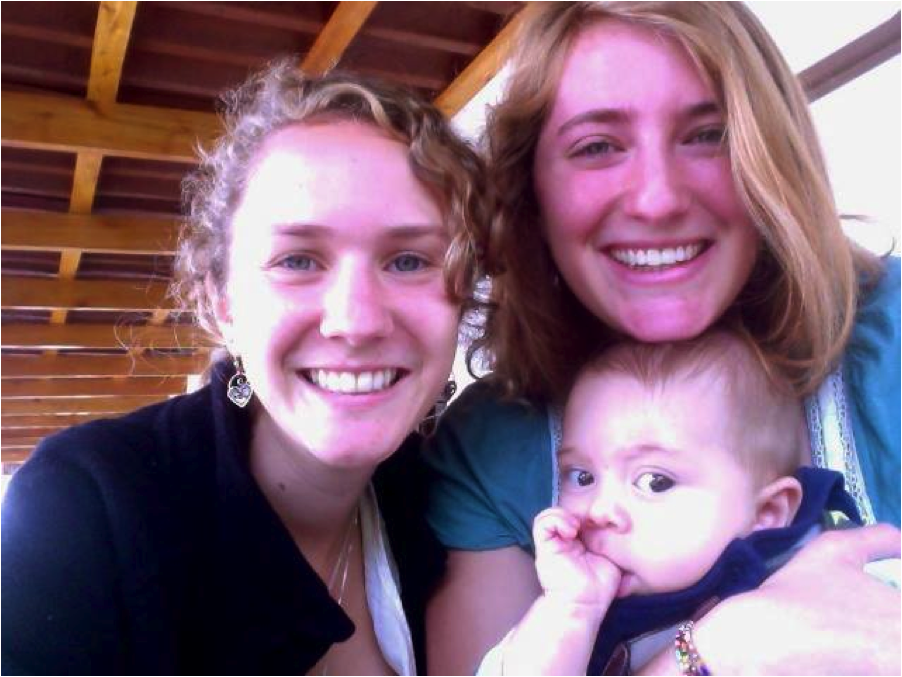
Emma and Molly with baby Santiago during their Internship at the Monteverde Institute.
Oriana nos cuenta como el Instituto cambió su vida: Monteverde Back to the Roots
Vuelta a las raíces, a reconectar con esa parte tierna de ti mismo, con un instinto muy profundo de quien eres, como persona, como mujer, como profesional, incluso como animal de la naturaleza. Simple y llanamente esta es la puerta que se me abrió tras mi estancia en Monteverde y en el Instituto Monteverde.
Monteverde: back to the roots
Canciones que escucho mientras escribo esto:
Ben Howard-Old Pine
Ravid-Lola
Bon Iver-Holocene
Florence and the Machine-Cosmic Love
Vuelta a las raíces, a reconectar con esa parte tierna de ti mismo, con un instinto muy profundo de quien eres, como persona, como mujer, como profesional, incluso como animal de la naturaleza. Simple y llanamente esta es la puerta que se me abrió tras mi estancia en Monteverde y en el Instituto Monteverde.
Médica con vocación en salud pública, salud comunitaria o medicina social, estudiante de antropología, bióloga marina frustrada, escritora y viajera en mi tiempo libre…encontré en el Instituto Monteverde un grupo de gente creativo (especialmente estupendas amigas), un ambiente profesional, volcado en la comunidad y viviendo en el tempo y entornos naturales correcto. De repente, la melodía resonaba como nunca antes dentro del corazón. También por supuesto despertó una desazón increíble: ¡algo no había funcionado hasta ese momento y había cambios y ajustes que hacer en mi vida si quería vivirla…si quería ser feliz!
Los cambios no vinieron inmediatamente. Estuve en Monteverde unos 8 meses entre el año 2004 y 2005. Primero cursé el Methods in Community Health con Nancy Romero-Daza y David Himmelgreen de la Universidad del Sur de Florida y me quedé en el IMV varios meses más ampliando el proyecto del curso: HIV awareness in the community: Women speak, junto con Elsa Batres (antropóloga) que terminó siendo gran amiga (en el 2011 estuve en Seattle, en las Olimpic Mountains visitándola). Después vinieron unos años que trabajé en la Agencia Española de Cooperación Internacional y Desarrollo con varios proyectos de salud en África, para por último especializarme en Medicina Preventiva y Salud Pública, cuatro años de residencia médica que incluían un Máster en Salud Pública (MPH), obteniendo una beca para cursarlo en la Universidad de Harvard.
Aquí es donde las coincidencias empezaron a sumarse rápidamente. Estando en Boston comencé a dedicar algo de mi tiempo libre como voluntaria en el Brookline (MA)-Quezalguaque (Nicaragua) Sister City Project, donde algunos epidemiólogos querían poner en marcha un pequeño estudio de casos y controles en Nicaragua para estudiar factores asociados a una prevalencia elevada de enfermedad renal crónica en hombres jóvenes sin los usuales factores (hipertensión y diabetes) de riesgo para padecer esta enfermedad crónica. Acabé viajando a Costa Rica durante el winter break para que la Dra. Ineke Wesseling (UNA-IRET) –que yo había conocido brevemente durante mi estancia en Monteverde- me pusiera en contacto con el equipo investigador de SALTRA (Red de Salud, Trabajo y Ambiente) de Nicaragua, donde viajé durante la Semana Santa para, ayudada por estas investigadoras de la UNAN-León, poner en marcha la logística de la investigación. Tuvo que pasar otro año para que Daniel Brooks, de la Universidad de Boston me llamara para formar parte de un equipo de investigadores que hemos estado hace cuatro años investigando esta epidemia de enfermedad renal crónica de causas aún desconocidas en un contexto de mediación con trabajadores de la caña de azúcar en Nicaragua[1]. Obviamente toda la experiencia de haber vivido y trabajado en Costa Rica fue de indudable valor durante el trabajo de campo. Las temporadas que he pasado en Centroamérica me han permitido volver a Monteverde en varias ocasiones (gracias Cris y Paty por alojarme!), retomar y reflexionar sobre ese proceso de cambio, además de visitar a viejos amigos y amigas.
Este proceso reflexivo ha sido especialmente fuerte la última vez que he estado en Monteverde (Diciembre 2012). En este proceso de cambio han pasado muchas cosas: me he acercado más a mi familia, a mis amigos, y vivo de una forma un poco más sostenible: en la montaña (en la Sierra de Guadarrama de Madrid, en España), formo parte de una cooperativa de alimentos y productos locales, etc. Otra cosa que ha cambiado es la práctica de deporte como medio para acercarme a la naturaleza: alpinismo, bicicleta de montaña, escalada, esquí de travesía, submarinismo…y mi último descubrimiento: el trail running (o carreras de montaña), una sensación de libertad brutal y de experimentación increíble de los límites del cuerpo…y de la mente! En todo esto pensaba mientras corría de Monteverde a Cañitas pasando por Santa Elena y saludando a viejos amigos que se sorprendían de verme aparecer por la puerta de su casa en zapatillas de correr.
A ellos, a Monteverde y al IMV…mi gratitud, desde el corazón…por cambiar mi vida.
Oriana Ramírez Rubio MD, MPH
PhD candidate (UAM/BU)
oriana_ramirez@yahoo.es
[1] Más detalles en: Ramirez-Rubio O, McClean MD, Amador JJ, Brooks DR. An epidemic of chronic kidney disease in Central America: an overview. J Epidemiol Community Health. 2012 Sep 21. [Epub ahead of print]

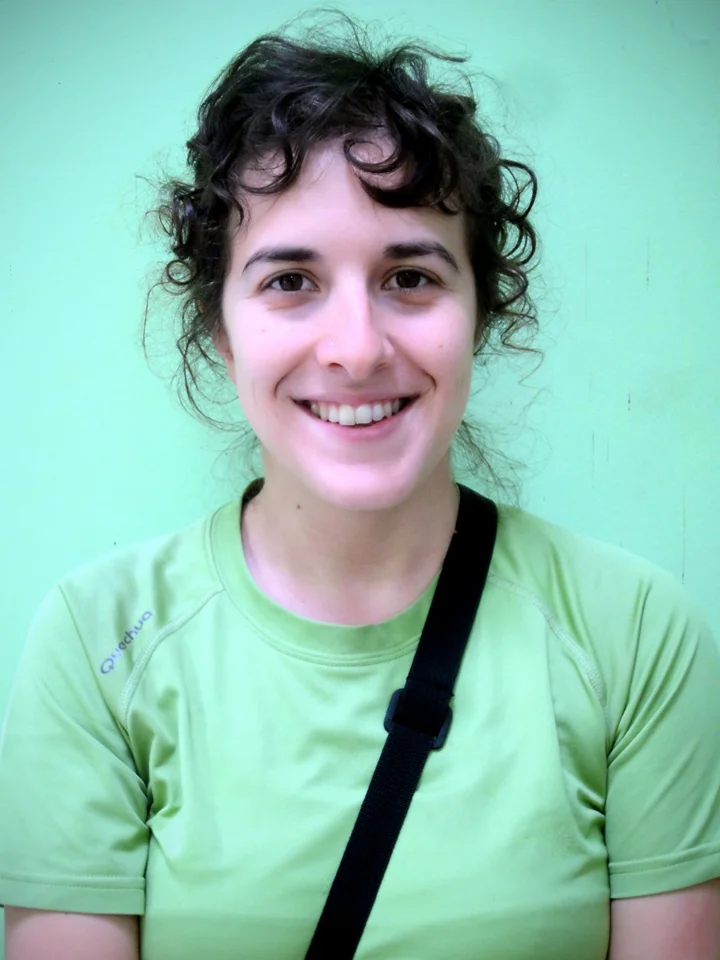
Foto de Oriana disfrutando estar afuera como lo hace hoy día!