
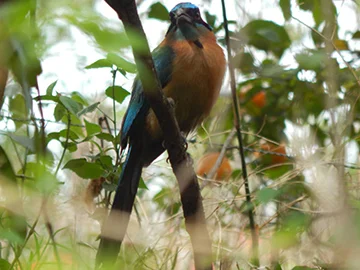
I must have seen the same Blue-Crowned Motmot more than three dozen times … /// Debo haber visto al mismo pájaro péndulo (bobo) más de tres docenas de veces...
I must have seen the same Blue-Crowned Motmot more than three dozen times as I ventured through brush and thicket.../ Debo haber visto al mismo pájaro péndulo más de tres docenas de veces mientras me aventuraba a través de espeso bosque y matorral..
por Luis Beltran
Blog Post Julio 27, 2015 (para español favor de bajar).
I must have seen the same Blue-Crowned Motmot more than three dozen times as I ventured through brush and thicket with Bellbird Biological Corridor Coordinator, Randy Chinchilla, volunteer, Mauricio Belmar, and intern, Brittany Schweiger, searching for missing trees, as if noir detectives hired by the Monteverde Institute. Cumbersome and scattered were the clues key to completing this assignment—an outdated map, missing tags, and misidentified trees—though nothing got in the way as much as that azure plumage. Self-fascinated with its own elongated, auricular raquet tip feather, this Motmot waved its tail from side-to-side, as if sensual hypnotist of the natural world. I must have fallen for the charm more than three dozen times.
Oh, what fascinating colors and what wondrous stage! Learning to identify the plants and animals of Monteverde is to me much like really getting to know your old friends – those companions that have been with you far longer than you can remember. It aches to leave these friends behind, which is part of the reason why I keep returning and returning to Monteverde. Equally invaluable to me is the staff of the Monteverde Institute, the warmth of the local community, and the incredible wealth of knowledge—hidden in leaf litter or canopy cover—just waiting to be discovered. Thank you for allowing me to volunteer with you this year! I will see you next time!
by: Luis Beltran (Lake Forest and Monteverde Institute's Lake Forest).


Debo haber visto al mismo pájaro péndulo más de tres docenas de veces mientras me aventuraba a través de espeso bosque y matorral. En aquellas ocasiones fui bien acompañado por el coordinador del corredor biológico del pájaro campana, Randy Chinchilla, voluntario Mauricio Belmar, y por la pasante Brittany Schweiger; juntos en búsqueda de ciertos árboles desaparecidos, comprometidos en la misión como cuatro detectives botánicos contratados por el Instituto Monteverde. Nuestro objetivo de encontrar y medir los árboles detrás del instituto se veía ofuscado por la falta de un mapa adecuado, árboles sin identificación, y etiquetas extraviadas. Sin embargo, nada presentaba semejante devaneo como aquel azur celeste plumaje. Fascinado por sus propias plumas terminales (alongadas y auriculares como raquetas de cielo), el pájaro péndulo, posado tranquilamente sobre una rama, movía tal vaivén del viento su cola esplendorosa, como sensual hipnotista de los bosques. Debo haber caído por su hechizo más de una docena de veces.
Ah, ¡pero que fascinantes colores y que encantadora escena! Mientras aprendo los nombres de los animales y plantas de Monteverde no logro descartar un sentimiento de amistad usualmente reservado para aquellos amigos fieles desde tiempos antaños. Es doloroso dejar a mis amigos de pluma y hoja, y en parte por eso vuelvo, y vuelvo a Monteverde. Igual de invaluables para mi son todos los que forman parte del Instituto Monteverde, así como la cálida pura vida que se siente en la comunidad local, y por la increíble vastedad de sabiduría—escondida entre hojarasca y torres de madera—esperando a ser descubierta. Muchísimas gracias por darme la oportunidad de trabajar con ustedes una vez más. ¡Nos veremos la próxima vez, Instituto Monteverde! ¡Pura vida!
Por: Luis Beltran (pasante del Instituto y de Lake Forest).
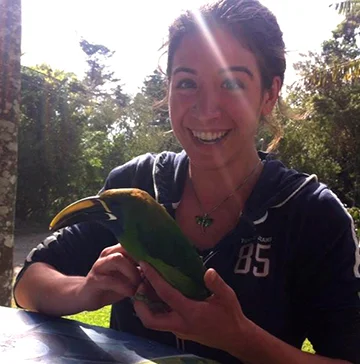
Monteverde: A one-of-a-kind teacher ---- Monteverde: Un maestro único e inimitable
It is an opportunity greater than I had ever imagined it would be, getting to be an intern and yet still gain coordination experience with internships.
--- Es una oportunidad más grande de lo que yo la había imaginado, todo esto de ser pasante y de aun así poder obtener experiencia en coordinación de pasantías.
Monteverde: A one-of-a-kind teacher
By: Ashley Gora, intern from Chicago, IL, USA
(Para Español favor revisar después de las fotos)
It is an opportunity greater than I had ever imagined it would be, getting to be an intern and yet still gain coordination experience with internships. After nine-and-a-half months here this year, and after having interned here in 2012 and 2013 for two months at a time, I’ve learned far more than I ever dreamed I would, and Monteverde never fails to teach me something new each day I spend here via complex musings and emotions. It is my intention in this blog to share three of these with you, dear Reader. And allow me to assure you of the following: If you ever come to Monteverde, whether for an internship or simply to live out your vacation days, I can guarantee that if you quietly let the magical, pulsing life of this natural and human environment whisper to you, you too will leave here changed.
~*~
After a while here, part of you becomes cynical: Why become friends with students and tourists who come and then leave and forget you ever existed? So many people, too many faces and names. Moreover, who do you choose to do life with here, especially considering that you, too, are one of those fleeting faces? And you have to remind yourself, as with the story of the woman launching beached starfish back into the sea, that to that person it matters, to that person your actions, your attitude, your outreach, your nature, all matter, if only for a little while, if only for the duration of that one fleeting moment for that fleeting face.
~*~
Community is important. Community is difficult. More often than not I’d much rather just skip doing the people thing, because people are messy, people take effort, people are broken. Being in community means that, if I’m doing everything that the word “community” implies, I’m feeling something, and sometimes it feels great, and sometimes it doesn’t, and it’s always scary. Being in community means that even though I can choose how vulnerable I want to be, I still have to be vulnerable, period. But as social beings by nature, being in community also is the most beautiful thing life has to give us. It is perfect love imperfectly embodied in the human being. It is the comforting warmth of a strong hug and the sweet tinkling of an unbridled laugh. It is movement and spirit and link. And if I can help you make those links with others, find a group, find community, then I am happy.
~*~
Never have I stayed through the whole rainy season before. Coming out of the dry season, the torrential downpours are a welcome blessing, satiating the parched land, the dust-caked trees. Then, after three months of the same, the emotional toil of a lack of sunshine-filled days kicks in. The misty, eternally-humid air and the gray hue of the overcast sky all begin to wear on the mind. Days pass, weeks, months, and then suddenly it starts to ease when finally you think that the storms will never pass. Mornings are audaciously bright—acrylic paints splashing gaudy dyes onto lush foliage and full-bodied earth and gemstone flowers which daze and quench the thirst of the eyes that had grown too accustomed to darkness. Forest sprite I am, and I escape to the wild world of effervescent color and incomplete, lackadaisical metaphor, fearful that I am hallucinating.
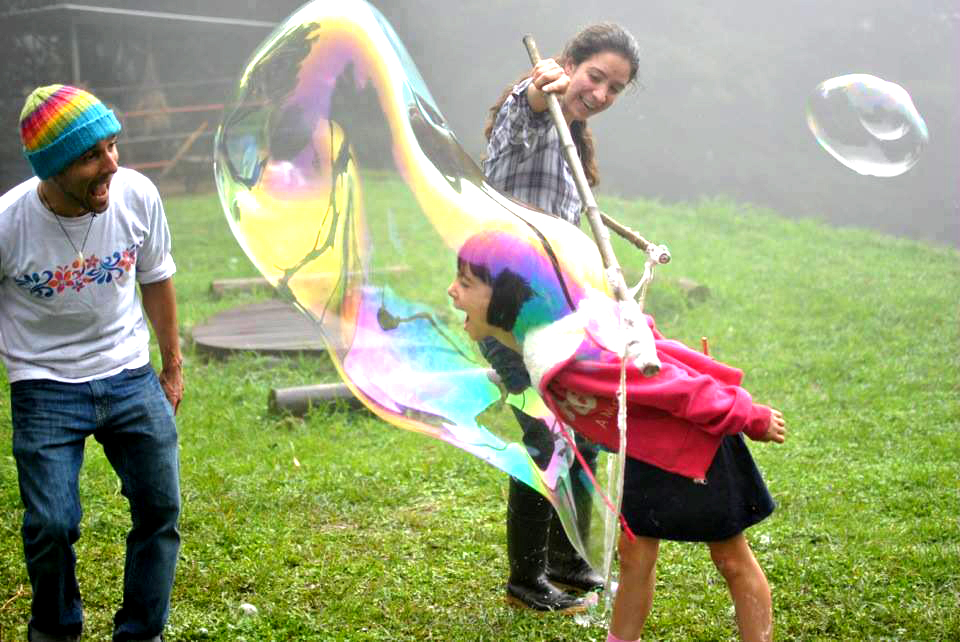
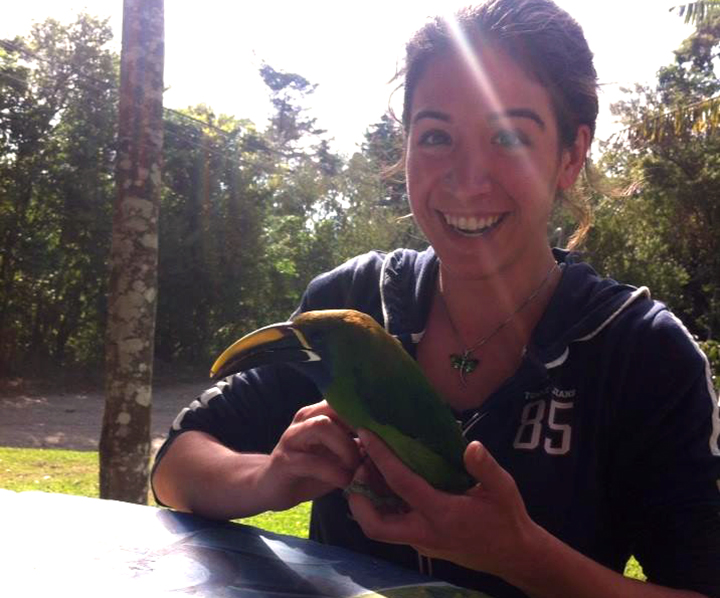
Monteverde: Un maestro único e inimitable
(For English please scroll up).
Por: Ashley Gora, pasante de Chicago, IL, USA
Es una oportunidad más grande de lo que yo la había imaginado, todo esto de ser pasante y de aun así poder obtener experiencia en coordinación de pasantías. Después de nueve meses y medio aquí este año, y después de ser pasante aquí en 2012 y 2013 por dos meses cada vez, he aprendido mucho más de lo que alguna vez soñé que aprendería, y Monteverde sigue sin fallar en enseñarme algo nuevo cada día a través de las contemplaciones y emociones complejas. Es mi intención en este blog compartir tres de estas con usted, querido Lector. Y déjeme asegurarle de lo siguiente: Si alguna vez usted viene a Monteverde, sea para una pasantía o simplemente para pasar sus vacaciones aquí, yo le puedo garantizar que si usted tranquilamente deja que la vida mágica y pulsante de este ambiente humano y natural le susurre, usted también se irá de aquí transformado.
~*~
Después de un tiempo acá, una parte de usted se vuele cínico: ¿Por qué ser amigo de los estudiantes y los turistas que vienen y van si ellos se olvidarán de mi existencia? Tantas personas, tantos nombres y tantas caras. Además, ¿a quién puedo acercarme yo para que me ayude a construir mi vida aquí, tomando en cuenta el hecho de que yo también soy una de esas caras fugaces? Y hay que recordar, que igual como en la historia de la mujer que lanza las estrellas de mar embarrancadas en la playa devuelta al océano, que para aquella persona importa, que para aquella persona sus acciones, su actitud, su extensión, su naturaleza, importan, aunque sea solo por un rato, aunque sea solo por la duración de ese único momento fugaz para esa cara fugaz.
~*~
La comunidad es importante. La comunidad es difícil. La mayoría de las veces prefiero apartarme de las personas, porque las personas con complicadas, las personas requieren un esfuerzo, las personas son liosas. Estar en comunidad significa que, si yo hago todo lo que la palabra “comunidad” implica, yo siento algo, y a veces se siente bien, y a veces no, y siempre da miedo. Estar en comunidad significa que aunque yo puedo elegir qué tan vulnerable quiero ser yo, todavía tengo que ser vulnerable, punto. Pero como somos seres sociales por naturaleza, estar en comunidad también es lo más bello que nos puede dar la vida. Es el amor perfecto encarnado imperfectamente en el ser humano. Es el calor agradable de un fuerte abrazo y el tintineo dulce de la risa desenfrenada. Es movimiento y espíritu y vínculo. Y si yo le puedo ayudar a hacer aquellos vínculos con otras personas, a encontrar un grupo, a encontrar la comunidad, pues estoy feliz.
~*~
Nunca antes me había quedado por la temporada lluviosa entera. Saliendo de la temporada seca, los aguaceros torrenciales son una bendición bienvenida, saciando a la tierra reseca, los árboles cubiertos en polvo. Después de tres meses de lo mismo, el peso emocional que viene con la falta de días llenos de rayos de sol comienza. El aire neblinoso, eternamente húmedo, y las tonalidades grises de un cielo nublado logran con el tiempo desgastar la mente. Pasan los días, las semanas, y los meses, y cuando más se muestran incesables las tormentas, es entonces de repente que llega el alivio. Las mañanas son audazmente brillantes—pinturas acrílicas salpican tintes llamativos sobre el follaje frondoso, la tierra sabrosa, y las flores fragantes como gemas que aturden y aplacan la saciedad de los ojos que se habían acostumbrado desmesuradamente a la oscuridad. Duendecillo de bosque soy yo, y escapo al mundo silvestre de colores efervescentes y metáfora incompleta, lánguida, temiendo que alucino.
The Night of the Bat---La Noche de los Murciélagos
The night of the bat was nothing to be scared of. Truthfully, it was an incredible night. I am so happy we had nice weather and had the luck to meet the expert Dr. Laval and his friends.
Blog 9.7.13 by Lana Panitch Lake Forest Intern
After a day´s work at the Monteverde Institute, my cohorts from Lake Forest and I went to Tramonti´s for a dinner full of pizza (or pixa as they called it here) and laughs. We ordered my favorite type, vegetarian, and some meaty ones as well for the meat-lovers at the table. We demolished three pizzas between the four of us in hardly any time at all. We left very satisfied.

Having Pizza at Tramonti
Soon after, we hiked back up to the Institute to meet up with our Costa Rican “Mommy away from home” (our internship coordinator), Sarah Burbank. An adventure in the forest behind the Institute awaited us. We mounted the stairway, passing the strong, perfumed odor of the Angel’s Trumpets flowers. We entered the Dwight and Rachel Crandell preserve when the sun had just set.
As we approached, we could see with our headlamps a net, almost like a tennis net, stretched between two big trees. Then, we saw three figures…the legendary local bat expert, Dr. Richard LaVal and his assistants, his daughter and son-in-law. Right away, the fun began. Dr. LaVal brought us the first victim…a brown insectivorous bat that belongs to the same family of brown bats that are very common where I live in Chicago, Illinois.
Dr. LaVal explained to us that this bat was clearly an insect bat because it has a simpler nose than fruit bats. He showed us the length and breadth of its wings. The wings are made up of a very fine and smooth skin that is surprisingly strong and durable. I learned that if a wing breaks or tears, it would take five days for it to heal. I feel very thankful for these bats because they eat thousands of insects, such as mosquitoes, every night. What nice pest control!
Then, he brought us a fruit bat. These bats are also very cute, I think, although their noses are more complex, bigger, and uglier than those of the insect bats. The fruit bats are also very important for humans because they help to distribute many types of fruits’ seeds. Some fruit they pollinate, for example, are mangos, peaches, and even almonds! If I were a bat, I would most definitely be a fruit bat. This victim was very small, and calmer than the insect bat. Dr. LaVal thought it was a good candidate for us to hold. Gabe was the first brave soul to hold it, followed by Ashley, Luis, and then me. At first I hesitated…then I had to ask myself, “When will I ever get this opportunity to hold a wild bat again in the future?” The answer was, “Never!” And that was that. I held it carefully, and it was a wonderful experience. My new little friend was soft and its heart beat like a little drum. It was an experience I will never forget.

Lana with a bat, and Richard Laval in the Background.
For the rest of the night, Dr. LaVal showed us many more fruit and insect bats. Surprisingly though, many of them were quite unique. Some were male, some were juvenile, and some were female. The females interested me the most because some were pregnant with big, swollen bellies. Dr. LaVal was good at guessing how much more time they had until delivery. We also got to see lactating females, which meant that they were mothers of pups. What a treat it was to learn and see all of those small details in real life!
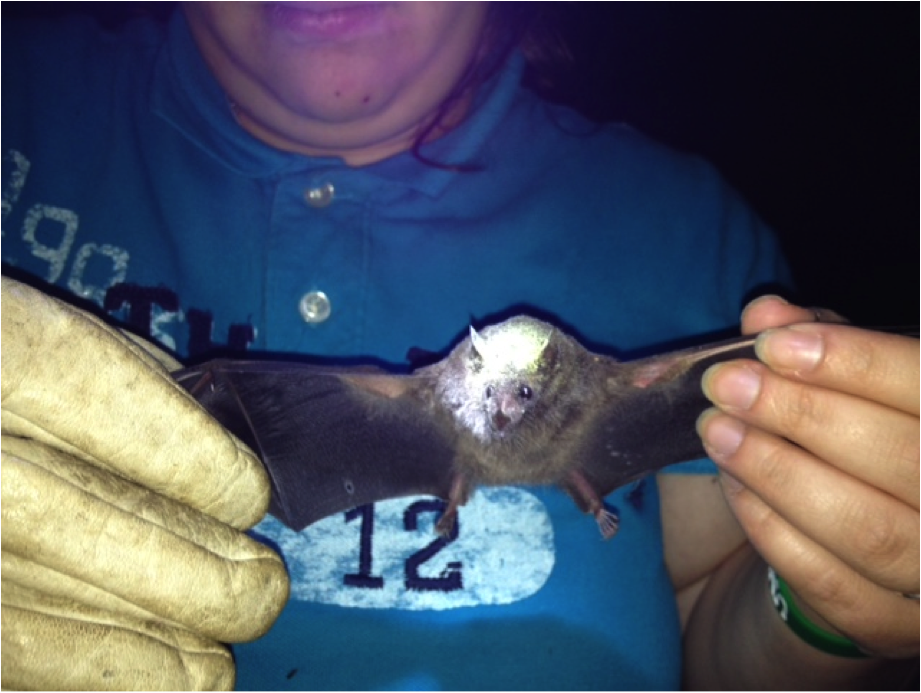
After more than fifteen bats of all shapes, sizes, and life stages, we were getting ready to leave. Suddenly, Kelly LaVal brought us the final bat…a nectar bat! It had pollen on its head! This bat is in the photo below, but the flash makes it a little tricky to see the yellow pollen. This bat was a pleasure and total surprise!
The night of the bat was nothing to be scared of. Truthfully, it was an incredible night. I am so happy we had nice weather and had the luck to meet the expert Dr. Laval and his friends.
-------------------------------------------------------------------------------------------------------------------------------------
En Español:
La Noche de Murciélagos
Después de un día de trabajo en el Instituto Monteverde, mis compañeros de Lake Forest College y yo fuimos a Tramonti´s por una cena llena de pizza (o pixa como se llama aquí) y risas. Pedimos mi tipo favorito, vegetariano, y otras de carnes ricas como salami y salchicha. Nosotros cuatro matamos tres pizzas en poco tiempo, y nos sentimos muy satisfechos.
Luego, nos juntamos con nuestra mamacita de acogida, Sarah Burbank (nuestra coordinadora de pasantías), para una aventura en la selva detrás del instituto. Subimos la escalera, pasando el olor fuerte y perfumado de las flores de las Trompetas de Ángel. Entramos la reserva de Dwight y Rachel Crandell cuando el sol acabó de atardecer.
Vimos con los focos de cabeza una red, casi como una red de tenis, estirado entre dos árboles grandes. Luego, vimos dos hombres…el legendario experto de murciélagos, Dr. Richard Laval, y su asistente, Kelly LaVal. Pronto después, la diversión empezó. Dr. Laval nos trajo el primer victima…un murciélago café e insectívoro que pertenece a la misma familia de murciélagos cafés que son comunes donde yo vivo en Chicago, Illinois.
Dr. Laval nos explicó que este murciélago es claramente un insectívoro porque tiene una nariz más sencilla que los murciélagos de fruta. Nos mostró la longitud de sus alas que son de piel muy fuerte pero muy fina y lisa también. Aprendí que si un ala se rompe, duraría cinco días para curarse. Yo me siento muy agradecida a estos murciélagos porque comen millones de insectos, como mosquitos, ¡cada noche! ¡Que útiles son!

Sosteniendo un murciélago!
Luego, nos trajo un murciélago de fruta. Estos murciélagos también son muy preciosos, yo pienso, aunque tienen narices complejas, grandes, y un poco feas. Los murciélagos de fruta también son muy importantes para los humanos porque ayudan a distribuir las semillas de muchas y muchas frutas que comimos cada día. Si yo fuera un murciélago, pienso que yo sería un murciélago de fruta. Este victima también fue muy pequeño, pero más tranquilo. Por eso, Dr. Laval pensó que sería un buen tipo para nosotros agarrar. Gabe fue el primer valiente agarrarlo, luego Ashley, Luis, y finalmente yo. Me pregunté, ¿Cuándo tendré la oportunidad agarrar un murciélago silvestre en el futuro? Me respondí, ¡nunca!, y eso fue. Lo agarré, y me alegró mucho. El amiguito nuevo fue suave y su corazón latió como un tambor. Fue una experiencia que nunca me olvidaré.
Por el resto de la noche, Dr. Laval nos mostró muchos más murciélagos insectívoros y de fruta. Pero no eran todos los mismos. Algunos eran machos, algunos juveniles, y algunos eran hembras. Las hembras me interesaban mucho porque algunas estaban embarazadas. Tenían panzas llenas e hinchadas. Dr. Laval adivinó cuanto tiempo se las quedaba hasta que dirían la luz. También, había hembras en lactancia, lo que significa que tenían cachorros. Que regalo fue aprender y ver estos detalles en vivo.
Después de más de quince murciélagos, de todos talleres y formas, íbamos a salir. De repente, Kelly nos trajo un murciélago final… ¡un murciélago que come néctar de las flores! ¡Tenía polen en la cabeza! Está en la foto abaja, pero por la luz es un poco difícil ver el polen amarillo. De ninguna manera, ¡fue un placer y sorpresa total!
La noche de murciélagos no fue nada escalofriante. De veras, fue una noche increíble. Me alegro que hacía buen tiempo y que tuvimos la suerte de conocer al experto Dr. Richard Laval y a sus amigos.