
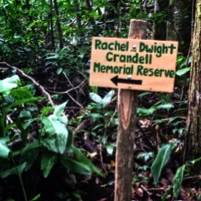
Internship - Rachel and Dwight Crandell Memorial Reserve - Pasantía
With the help of my supervisor, Randy Chinchilla, and some members of the Monteverde Institute we were able to create two maps of the Reserve that showed the path system, some signs and an entranceway to the reserve.
--- Con ayuda de mi supervisor, Randy Chinchilla, y con algunos miembros del Instituto Monteverde se logró crear dos mapas de la Reserva indicando los senderos, algunos rótulos de señalamiento y una entrada en la Reserva.

Signage and mapping of the Rachel and Dwight Crandell Memorial Reserve
by Jacqueline Zamudio
August, 2016
I had the opportunity of living in Monteverde in May through July with the help of the Grace Groner Foundation and Lake Forest College. During this time I did an internship and lived with a family in Cerro Plano.
My internship consisted in creating a basic maps and signs for the Rachel and Dwight Crandell Memorial Reserve. Before this the Reserve had some signs that could be found on the paths however, with time this signs had become damaged.
Crandell Memorial Reserve and paths
Also, the Institute did not have an up-to-date map, so, with the help of my supervisor, Randy Chinchilla, and some members of the Monteverde Institute we were able to update the Reserve maps by showing the location of the paths and signs as well as the Reserve limits.
Combining field work with Geographical Information System (GIS) techniques we determined the location and distance of the three paths that make up the Reserve: Bioluminosa Path, Bellbird Path, and Fungi Path. The following maps show the paths and the Reserve's limits.
Crandell Memorial Reserve and neighbouring properties.
The sign making part of the project was done in several steps. First we had to decide where we were going to put up the signs and what kind they were going to be. For this we took GPS points. After getting all the GPS points and deciding on the types of signs, we worked on several designs to determine the materials that would be necessary. After getting all the necessary materials, the signs were made. Finally, and with the help of the MVI’s staff, the signs were put alongside the paths. The following are pictures of the final Project.


Before and after: These signs indicate the way to get to the Reserve. (Before and after placing the sign).
Before and after photos. ---
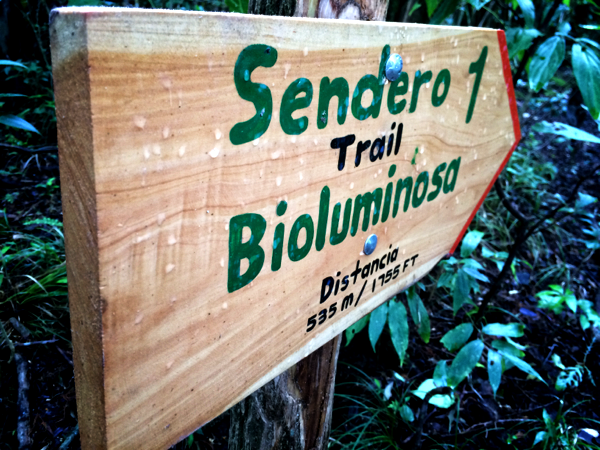
These are some of the signs pointing out the different paths. These signs show the path name and distance in meters and feet.

It’s also possible to find signs in each path that indicate the exit and end of path.
Finally, we build a small entrance way to the Reserve. The purpose of this small project was to create an entrance that would have several functions, the main one being for people to easily identify the way to enter the Reserve. The structure was also built in a way that it would prevent the entrance of bicycles, motorcycles and vehicles. On it, it's possible to observe the path map, information tables about the Crandell’s, biological registration forms, rules and logos. To build this entrance first we needed the design, then we got all the materials and finally we built it.
The following are pictures of how the entrance used to be, and how it is now.
These three projects were done in two months. Also during this time I was living with a family in Cerro Plano. Living with a family was also one of the things that made my experience in Costa Rica unique. Living with the family and being part of the community gave me the opportunity to learn about the Costa Rican culture which interested me. The Monteverde Institute and the Monteverde community gave me the opportunity to learn about Costa Rica while I helped out the community with my Project at the Rachel and Dwight Crandell Memorial Reserve.

Rotulación y mapeo en la Rachel & Dwight Crandell Memorial Reserve
Por Jacqueline Zamudio
Agosto 25, 2016
Entre los meses de mayo y julio , con ayuda de Grace Groner Foundation de Lake Forest College, tuve la oportunidad de vivir en Monteverde por dos meses. Durante ese tiempo realicé una pasantía mientras vivía con una familia en Cerro Plano.
Reserva Crandell y sus senderos.
La pasantía consistía en crear cartografía básica y rotulación para la Reserva Rachel & Dwight Crandell. Anteriormente la Reserva contaba con unos pequeños rótulos que se encontraban en los senderos. Sin embrago, con el paso del tiempo los rótulos se fueron dañando. Además el Instituto Monteverde no contaba con un mapeo actualizado. Con ayuda de mi supervisor, Randy Chinchilla, y con algunos miembros del Instituto Monteverde se lograron crear y actualizar los mapas de la Reserva indicando información de los senderos, de los rótulos de señalamiento y del punto de acceso y fin de la Reserva.
Combinando trabajo de campo con técnicas de los Sistemas de Información Geográfica (GIS en inglés) se determinó la ubicación y distancia de los tres senderos que conforman la reserva: Sendero Bioluminosa, el Sendero Pájaro Campana y el Sendero Fungi. Los siguientes mapas muestran los senderos que se pueden encontrar en la Reserva.
Este mapa muestra los límites de la Reserva y las propiedades vecinas.
Como se mencionó anteriormente, además del mapeo de los senderos también se hicieron algunos rótulos de señalamiento. Para este proyecto se tomaron varios pasos. Primero se decidió donde se iba a colocar cada rótulo y qué tipo de rótulo. Para este paso se tomaron puntos de GPS. Después de haber obtenido los puntos finales de GPS y los tipos de rótulos, se hicieron algunos diseños determinando los materiales que se necesitarían. Después de haber obtenido todos los materiales necesarios, se hicieron los rótulos. Por último, con ayuda de algunos miembros del Instituto Monteverde, se colocaron los rótulos en los senderos. Estas son algunas fotografías del producto final.

Antes y después:
Estos rótulos indican el camino que se puede tomar para llegar a la Reserva.
Antes y después:
Estos son rótulos indicando los senderos. En estos rótulos se indica el nombre del sendero y la distancia en metros y pies.
También se pueden encontrar rótulos en cada sendero indicando la salida y fin del sendero.
Por último, se construyó una pequeña entrada en la Reserva. El propósito de este pequeño proyecto era poder construir una entrada que tuviera varias funciones. La función principal era que las personas puedan identificar la entrada a los senderos con más facilidad. La entrada también se construyó de una manera que impide el paso de bicicletas, motocicletas o vehículos. La entrada también cuenta con un mapa de los senderos y algunas tablas con información sobre los Crandell, registros biológicos, algunas reglas y los logos. Para la construcción de esta entrada primero se obtuvo un diseño, después se determinaron los materiales, y finalmente llevó a cabo toda la construcción.
Aquí se puede apreciar cómo era la entrada anteriormente y como es ahora.
Estos tres proyectos se pudieron llevar a cabo en dos meses. Durante esos dos meses estuve viviendo con una familia en Cerro Plano. Vivir con una familia fue una de las cosas que también hizo mi estancia en Costa Rica única. Vivir con una familia y ser parte de la comunidad me dio la oportunidad de aprender sobre la cultura de Costa Rica lo cual me interesaba aprender. El Instituto Monteverde y la comunidad de Monteverde me dio la oportunidad de aprender sobre Costa Rica mientras ayudaba a la comunidad con mi proyecto en Rachel and Dwight Crandell Memorial Reserve.
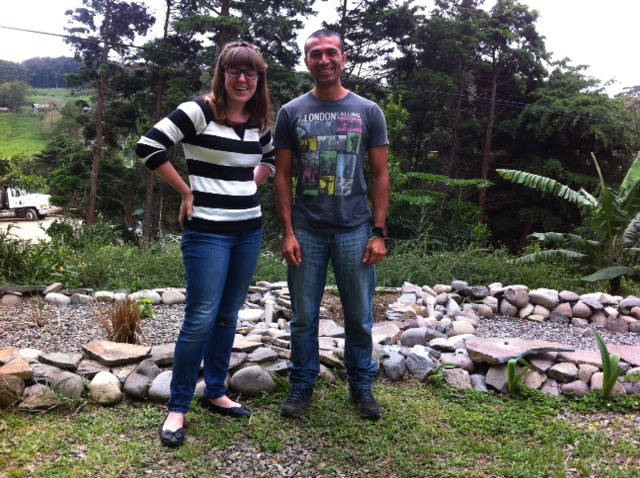
Student spotlight: Shelby Bates --- Foco estudiantil: Shelby Bates
If you stop by the Monteverde Institute’s biogarden, you will notice a special touch that was not there previously: interpretive signs that explain and give importance to conserving water and treating grey water. --- Si pasas por la biojardinera del Instituto Monteverde podrán notar algo nuevo: letreros interpretativos que explican y le dan importancia a la conservación del agua y el manejo de las aguas grises.
Student Spotlight: Shelby Bates, Intern from University of Nebraska-Lincoln
Para español favor de bajar a la próxima sección.
The Institute has had a greywater treatment area for some years but it has been somewhat of a problem and often didn't function. Last summer some of our staff members and students from the University of South Florida simplified and rebuilt it, so it is now doing an excellent job of processing our greywater.
We want others in the area to be able to make and use their own greywater treatment. If you stop by the Monteverde Institute’s biogarden, you will notice a special touch that was not there previously: interpretive signs that explain and give importance to conserving water and treating greywater. All thanks goes to Shelby Bates, a senior at the University of Nebraska who will complete her 10-week internship at the MVI on December 6, and her supervisor Orlando “Fish” Calvo, a Monteverde resident.
Shelby is a multi-talented young woman who fitted into the community very well. She saw the gardens projects and took on the job of helping to interpret the greywater treatment system for our students and for the community, so others can use the system. The treatment ends at what we call a “biogarden,” plants growing in specific layers of gravel that aid in digesting any residue left over from primary treatment and guiding the treated water downhill for use in gardens.
Together with her advisor, Orlando “Fish” Calvo, she created a series of signs to describe how the system works. It is now part of our educational pathway that includes the native plant, medicinal, and vegetable gardens, tree nursery as well as demonstrations of keyhole gardens. Despite living in the tropics, our alternating dry/wet seasons create the needs for conservation and control of water and waste. Shelby explains, “If somebody wanted to implement a biogarden in their own house, hotel or restaurant, they now have a very clear example of how this system functions.”
Shelby recalls that when she applied to work at the Monteverde Institute, she did not originally see her internship directly relating to her education major. “I was looking for an opportunity to finish my college education in which I could learn more about biology and see if I would rather change to a career in the sciences, and so I came to the Institute seeking the chance to learn more about the environment.
“The Institute has been really great in letting me see how I can apply my background to systems which function outside of education that are equally as important to education. So, for example, the Institute focuses more on community education and less on education within schools, but that education within the community is just as important as the work that a teacher might do within a school. It’s been really great to see.”
Since arriving to Monteverde, Shelby has decided to pursue a Master’s in Social Work, which will allow her to better understand different social issues and peoples’ responses to subjects like sustainable development, particularly how to convince others to engage in sustainable behaviors.
You can follow Shelby by reading her blog: www.shelbybatesabroad.wordpress.com /
Or, the Monteverde Institute blog which explains our particular greywater treatment program:
http://monteverde-institute-blog.org/environmental/aguas-grises-greywater
On December 4, 2014, Shelby delivered her report to the community, titled “The Impact of Humans on the Treatment and Production of Greywater.”
Written by: Bob Howe


Foco estudiantil: Shelby Bates, pasante de la Universidad de Nebraska-Lincoln
El instituto ha tenido por algunos años un sistema de manejo de aguas grises, sin embargo estuvo teniendo problemas por algún tiempo. El verano pasado algunos estudiantes de USF y miembros del personal trabajaron duro en simplificar el sistema y re-construirlo, así que actualmente está funcionando bien.
Si pasas por la biojardinera del Instituto Monteverde podrán notar algo nuevo: letreros interpretativos que explican y le dan importancia a la conservación del agua y el manejo de las aguas grises. Todo esto se logró gracias a Shelby Bates, una estudiante de ultimo año de la Universidad de Nebraska que completó su pasantía de 10 semanas el 6 de diciembre y de su supervisor Orlando “Fish” Calvo, un residente de Monteverde.
Shelby es una joven de múltiples talentos que encajó a la comunidad muy bien. Ella vio los proyectos en el jardín y se dio a la tarea de ayudar a interpretar el sistema de aguas grises para el uso de nuestros estudiantes y comunidad, de esta manera otras personas podrían usar el sistema. El tratamiento termina en lo que se llama una “biojardinera” donde las plantas crecer en diferentes niveles de piedras que asisten en “digerir” cualquier residuo que permaneció del tratamiento original y en dirigir el agua cuesta abajo para uso de riego en los jardines.
Junto con su tutor, Orlando “Fish” Calvo, Shelby creó una serie de letreros que describen como funciona el sistema. Ahora estos son parte de nuestra caminata educacional que incluye jardines de plantas nativas y medicinales, huertas, un vivero de árboles y demostraciones de jardines Ojo de Cerradura. Es nuestra fe que este vaya a servir como una modelo de tratamiento de aguas grises para otras zonas de la comunidad Monteverde. A pesar de vivir en los trópicos, el que se alternen las épocas secas con las lluviosas crean la necesidad de trabajar en conservación, control y manejo de aguas. Shelby dice, “si alguien quiere implementar una biojardienra en su casa, hotel o restaurant ahora tienen un ejemplo bastante claro de como este funciona.”
Shelby se recuerda que cuando ella aplico para la pasantía ella no vio una relación directa de su pasantía con sus estudios de Universidad, “yo estaba buscando una oportunidad para terminar mi educación de una manera en la que podría aprender más sobre biología y de esta manera entender si iba a querer cambiar mi carrera a una más relacionada a la ciencias, así que vine al Instituto buscando la oportunidad de aprender más sobre el medio ambiente.
“El Instituto ha sido muy bueno en permitir ver como puedo aplicar mi experiencia a sistemas que funcionan por fuera de lo educativo pero que son igual de importantes para la educación. Así que, por ejemplo, el Instituto se enfoca más en educación a la comunidad, y menos a la educación dentro de las escuelas, pero esa educación dentro de la comunidad es tan importante como el trabajo que un maestro podría hacer en una escuela. Esto ha sido muy bueno poder ver.”
Desde que llegó a Monteverde, Shelby ha decidido buscar una maestría en trabajo social, la cual le permitirá entender de manera mejor problemas sociales y las reacciones de las personas a términos como desarrollo sostenible, particularmente en como convencer a otras personas en engancharse a las prácticas sostenibles.
Pueden encontrar más información de Shelby en su blog: www.shelbybatesabroad.wordpress.com /
O ver la descripción de nuestro sistema de manejo aquí:http://monteverde-institute-blog.org/environmental/aguas-grises-greywater
El 4 de diciembre Shelby hizo una presentación a la comunidad titulado “El impacto de los humanos en el tratamiento y producción de Aguas Grises”.
Escrito por: Bob Howe
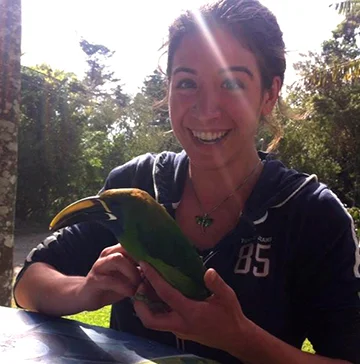
Monteverde: A one-of-a-kind teacher ---- Monteverde: Un maestro único e inimitable
It is an opportunity greater than I had ever imagined it would be, getting to be an intern and yet still gain coordination experience with internships.
--- Es una oportunidad más grande de lo que yo la había imaginado, todo esto de ser pasante y de aun así poder obtener experiencia en coordinación de pasantías.
Monteverde: A one-of-a-kind teacher
By: Ashley Gora, intern from Chicago, IL, USA
(Para Español favor revisar después de las fotos)
It is an opportunity greater than I had ever imagined it would be, getting to be an intern and yet still gain coordination experience with internships. After nine-and-a-half months here this year, and after having interned here in 2012 and 2013 for two months at a time, I’ve learned far more than I ever dreamed I would, and Monteverde never fails to teach me something new each day I spend here via complex musings and emotions. It is my intention in this blog to share three of these with you, dear Reader. And allow me to assure you of the following: If you ever come to Monteverde, whether for an internship or simply to live out your vacation days, I can guarantee that if you quietly let the magical, pulsing life of this natural and human environment whisper to you, you too will leave here changed.
~*~
After a while here, part of you becomes cynical: Why become friends with students and tourists who come and then leave and forget you ever existed? So many people, too many faces and names. Moreover, who do you choose to do life with here, especially considering that you, too, are one of those fleeting faces? And you have to remind yourself, as with the story of the woman launching beached starfish back into the sea, that to that person it matters, to that person your actions, your attitude, your outreach, your nature, all matter, if only for a little while, if only for the duration of that one fleeting moment for that fleeting face.
~*~
Community is important. Community is difficult. More often than not I’d much rather just skip doing the people thing, because people are messy, people take effort, people are broken. Being in community means that, if I’m doing everything that the word “community” implies, I’m feeling something, and sometimes it feels great, and sometimes it doesn’t, and it’s always scary. Being in community means that even though I can choose how vulnerable I want to be, I still have to be vulnerable, period. But as social beings by nature, being in community also is the most beautiful thing life has to give us. It is perfect love imperfectly embodied in the human being. It is the comforting warmth of a strong hug and the sweet tinkling of an unbridled laugh. It is movement and spirit and link. And if I can help you make those links with others, find a group, find community, then I am happy.
~*~
Never have I stayed through the whole rainy season before. Coming out of the dry season, the torrential downpours are a welcome blessing, satiating the parched land, the dust-caked trees. Then, after three months of the same, the emotional toil of a lack of sunshine-filled days kicks in. The misty, eternally-humid air and the gray hue of the overcast sky all begin to wear on the mind. Days pass, weeks, months, and then suddenly it starts to ease when finally you think that the storms will never pass. Mornings are audaciously bright—acrylic paints splashing gaudy dyes onto lush foliage and full-bodied earth and gemstone flowers which daze and quench the thirst of the eyes that had grown too accustomed to darkness. Forest sprite I am, and I escape to the wild world of effervescent color and incomplete, lackadaisical metaphor, fearful that I am hallucinating.
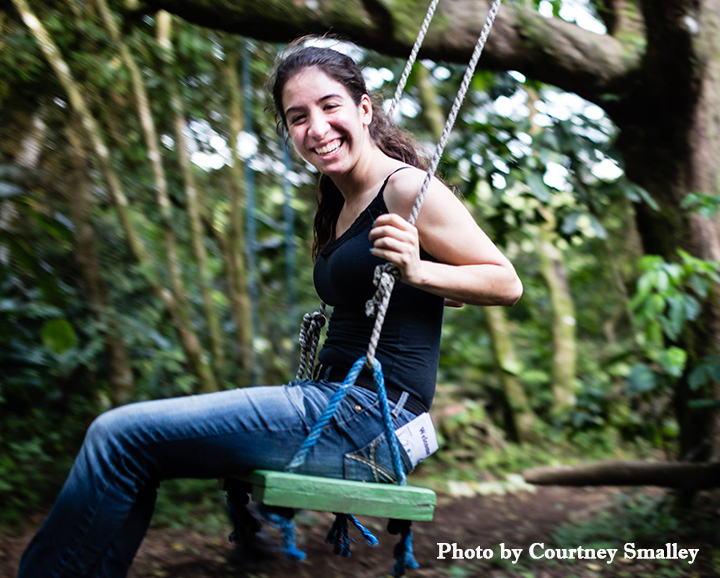
Monteverde: Un maestro único e inimitable
(For English please scroll up).
Por: Ashley Gora, pasante de Chicago, IL, USA
Es una oportunidad más grande de lo que yo la había imaginado, todo esto de ser pasante y de aun así poder obtener experiencia en coordinación de pasantías. Después de nueve meses y medio aquí este año, y después de ser pasante aquí en 2012 y 2013 por dos meses cada vez, he aprendido mucho más de lo que alguna vez soñé que aprendería, y Monteverde sigue sin fallar en enseñarme algo nuevo cada día a través de las contemplaciones y emociones complejas. Es mi intención en este blog compartir tres de estas con usted, querido Lector. Y déjeme asegurarle de lo siguiente: Si alguna vez usted viene a Monteverde, sea para una pasantía o simplemente para pasar sus vacaciones aquí, yo le puedo garantizar que si usted tranquilamente deja que la vida mágica y pulsante de este ambiente humano y natural le susurre, usted también se irá de aquí transformado.
~*~
Después de un tiempo acá, una parte de usted se vuele cínico: ¿Por qué ser amigo de los estudiantes y los turistas que vienen y van si ellos se olvidarán de mi existencia? Tantas personas, tantos nombres y tantas caras. Además, ¿a quién puedo acercarme yo para que me ayude a construir mi vida aquí, tomando en cuenta el hecho de que yo también soy una de esas caras fugaces? Y hay que recordar, que igual como en la historia de la mujer que lanza las estrellas de mar embarrancadas en la playa devuelta al océano, que para aquella persona importa, que para aquella persona sus acciones, su actitud, su extensión, su naturaleza, importan, aunque sea solo por un rato, aunque sea solo por la duración de ese único momento fugaz para esa cara fugaz.
~*~
La comunidad es importante. La comunidad es difícil. La mayoría de las veces prefiero apartarme de las personas, porque las personas con complicadas, las personas requieren un esfuerzo, las personas son liosas. Estar en comunidad significa que, si yo hago todo lo que la palabra “comunidad” implica, yo siento algo, y a veces se siente bien, y a veces no, y siempre da miedo. Estar en comunidad significa que aunque yo puedo elegir qué tan vulnerable quiero ser yo, todavía tengo que ser vulnerable, punto. Pero como somos seres sociales por naturaleza, estar en comunidad también es lo más bello que nos puede dar la vida. Es el amor perfecto encarnado imperfectamente en el ser humano. Es el calor agradable de un fuerte abrazo y el tintineo dulce de la risa desenfrenada. Es movimiento y espíritu y vínculo. Y si yo le puedo ayudar a hacer aquellos vínculos con otras personas, a encontrar un grupo, a encontrar la comunidad, pues estoy feliz.
~*~
Nunca antes me había quedado por la temporada lluviosa entera. Saliendo de la temporada seca, los aguaceros torrenciales son una bendición bienvenida, saciando a la tierra reseca, los árboles cubiertos en polvo. Después de tres meses de lo mismo, el peso emocional que viene con la falta de días llenos de rayos de sol comienza. El aire neblinoso, eternamente húmedo, y las tonalidades grises de un cielo nublado logran con el tiempo desgastar la mente. Pasan los días, las semanas, y los meses, y cuando más se muestran incesables las tormentas, es entonces de repente que llega el alivio. Las mañanas son audazmente brillantes—pinturas acrílicas salpican tintes llamativos sobre el follaje frondoso, la tierra sabrosa, y las flores fragantes como gemas que aturden y aplacan la saciedad de los ojos que se habían acostumbrado desmesuradamente a la oscuridad. Duendecillo de bosque soy yo, y escapo al mundo silvestre de colores efervescentes y metáfora incompleta, lánguida, temiendo que alucino.