
Monteverde: A one-of-a-kind teacher ---- Monteverde: Un maestro único e inimitable
It is an opportunity greater than I had ever imagined it would be, getting to be an intern and yet still gain coordination experience with internships.
--- Es una oportunidad más grande de lo que yo la había imaginado, todo esto de ser pasante y de aun así poder obtener experiencia en coordinación de pasantías.
Monteverde: A one-of-a-kind teacher
By: Ashley Gora, intern from Chicago, IL, USA
(Para Español favor revisar después de las fotos)
It is an opportunity greater than I had ever imagined it would be, getting to be an intern and yet still gain coordination experience with internships. After nine-and-a-half months here this year, and after having interned here in 2012 and 2013 for two months at a time, I’ve learned far more than I ever dreamed I would, and Monteverde never fails to teach me something new each day I spend here via complex musings and emotions. It is my intention in this blog to share three of these with you, dear Reader. And allow me to assure you of the following: If you ever come to Monteverde, whether for an internship or simply to live out your vacation days, I can guarantee that if you quietly let the magical, pulsing life of this natural and human environment whisper to you, you too will leave here changed.
~*~
After a while here, part of you becomes cynical: Why become friends with students and tourists who come and then leave and forget you ever existed? So many people, too many faces and names. Moreover, who do you choose to do life with here, especially considering that you, too, are one of those fleeting faces? And you have to remind yourself, as with the story of the woman launching beached starfish back into the sea, that to that person it matters, to that person your actions, your attitude, your outreach, your nature, all matter, if only for a little while, if only for the duration of that one fleeting moment for that fleeting face.
~*~
Community is important. Community is difficult. More often than not I’d much rather just skip doing the people thing, because people are messy, people take effort, people are broken. Being in community means that, if I’m doing everything that the word “community” implies, I’m feeling something, and sometimes it feels great, and sometimes it doesn’t, and it’s always scary. Being in community means that even though I can choose how vulnerable I want to be, I still have to be vulnerable, period. But as social beings by nature, being in community also is the most beautiful thing life has to give us. It is perfect love imperfectly embodied in the human being. It is the comforting warmth of a strong hug and the sweet tinkling of an unbridled laugh. It is movement and spirit and link. And if I can help you make those links with others, find a group, find community, then I am happy.
~*~
Never have I stayed through the whole rainy season before. Coming out of the dry season, the torrential downpours are a welcome blessing, satiating the parched land, the dust-caked trees. Then, after three months of the same, the emotional toil of a lack of sunshine-filled days kicks in. The misty, eternally-humid air and the gray hue of the overcast sky all begin to wear on the mind. Days pass, weeks, months, and then suddenly it starts to ease when finally you think that the storms will never pass. Mornings are audaciously bright—acrylic paints splashing gaudy dyes onto lush foliage and full-bodied earth and gemstone flowers which daze and quench the thirst of the eyes that had grown too accustomed to darkness. Forest sprite I am, and I escape to the wild world of effervescent color and incomplete, lackadaisical metaphor, fearful that I am hallucinating.
Monteverde: Un maestro único e inimitable
(For English please scroll up).
Por: Ashley Gora, pasante de Chicago, IL, USA
Es una oportunidad más grande de lo que yo la había imaginado, todo esto de ser pasante y de aun así poder obtener experiencia en coordinación de pasantías. Después de nueve meses y medio aquí este año, y después de ser pasante aquí en 2012 y 2013 por dos meses cada vez, he aprendido mucho más de lo que alguna vez soñé que aprendería, y Monteverde sigue sin fallar en enseñarme algo nuevo cada día a través de las contemplaciones y emociones complejas. Es mi intención en este blog compartir tres de estas con usted, querido Lector. Y déjeme asegurarle de lo siguiente: Si alguna vez usted viene a Monteverde, sea para una pasantía o simplemente para pasar sus vacaciones aquí, yo le puedo garantizar que si usted tranquilamente deja que la vida mágica y pulsante de este ambiente humano y natural le susurre, usted también se irá de aquí transformado.
~*~
Después de un tiempo acá, una parte de usted se vuele cínico: ¿Por qué ser amigo de los estudiantes y los turistas que vienen y van si ellos se olvidarán de mi existencia? Tantas personas, tantos nombres y tantas caras. Además, ¿a quién puedo acercarme yo para que me ayude a construir mi vida aquí, tomando en cuenta el hecho de que yo también soy una de esas caras fugaces? Y hay que recordar, que igual como en la historia de la mujer que lanza las estrellas de mar embarrancadas en la playa devuelta al océano, que para aquella persona importa, que para aquella persona sus acciones, su actitud, su extensión, su naturaleza, importan, aunque sea solo por un rato, aunque sea solo por la duración de ese único momento fugaz para esa cara fugaz.
~*~
La comunidad es importante. La comunidad es difícil. La mayoría de las veces prefiero apartarme de las personas, porque las personas con complicadas, las personas requieren un esfuerzo, las personas son liosas. Estar en comunidad significa que, si yo hago todo lo que la palabra “comunidad” implica, yo siento algo, y a veces se siente bien, y a veces no, y siempre da miedo. Estar en comunidad significa que aunque yo puedo elegir qué tan vulnerable quiero ser yo, todavía tengo que ser vulnerable, punto. Pero como somos seres sociales por naturaleza, estar en comunidad también es lo más bello que nos puede dar la vida. Es el amor perfecto encarnado imperfectamente en el ser humano. Es el calor agradable de un fuerte abrazo y el tintineo dulce de la risa desenfrenada. Es movimiento y espíritu y vínculo. Y si yo le puedo ayudar a hacer aquellos vínculos con otras personas, a encontrar un grupo, a encontrar la comunidad, pues estoy feliz.
~*~
Nunca antes me había quedado por la temporada lluviosa entera. Saliendo de la temporada seca, los aguaceros torrenciales son una bendición bienvenida, saciando a la tierra reseca, los árboles cubiertos en polvo. Después de tres meses de lo mismo, el peso emocional que viene con la falta de días llenos de rayos de sol comienza. El aire neblinoso, eternamente húmedo, y las tonalidades grises de un cielo nublado logran con el tiempo desgastar la mente. Pasan los días, las semanas, y los meses, y cuando más se muestran incesables las tormentas, es entonces de repente que llega el alivio. Las mañanas son audazmente brillantes—pinturas acrílicas salpican tintes llamativos sobre el follaje frondoso, la tierra sabrosa, y las flores fragantes como gemas que aturden y aplacan la saciedad de los ojos que se habían acostumbrado desmesuradamente a la oscuridad. Duendecillo de bosque soy yo, y escapo al mundo silvestre de colores efervescentes y metáfora incompleta, lánguida, temiendo que alucino.
Emma and Molly's internship on births in Costa Rica
Emma and Molly's experience during their internship on birthing in the zone.
For two aspiring midwives, finding the perfect internship seemed like it would be challenging in Costa Rica, a place where birth often occurs within a specific system and midwives are rarely used. However, we took our love of everything birth-related and created a project where we could listen to and create relationships with women while conducting prevalent research about the area.
Our project was to create a questionnaire, available in both English and Spanish, that we used as a guideline to interview women about their birth experiences. We interviewed both Tica and non-Tica women who had given birth in Costa Rica within the past six or so years. Our sample was diverse; we talked to women who had given birth at home, in public hospitals and clinics, and in private hospitals and clinics. Our questionnaire included questions about perceptions of different birth professionals, the differences between public and private hospitals, birth interventions, and personal stories.
We discovered interesting themes, some that supported our hypotheses and some that surprised us. The most rewarding aspect of the project was talking to women about something so personal and hearing about the challenges, the beauties, the fears and the hopes about the incredible shared experience of childbirth.
This internship has given us the opportunity to learn relevant Spanish vocabulary that we will need in order to work with Spanish-speaking women in the United States. We have made valuable relationships with women in the Monteverde community through this project that is so important to both of us. We worked with the Monteverde Institute to make sure that our project was conducted ethically and in a specific way that made it possible for us to talk to a diverse group of women from different backgrounds. This experience has opened our eyes to differences between birth options in Costa Rica and in the United States and has further excited us about our future careers as midwives.
by: Emma and Molly
___________________________________________________________________
Como dos posibles futuras parteras, pensamos que sería difícil encontrar una pasantía perfecto en Costa Rica, un lugar donde el parto ocurre en un sistema específico y las parteras casi no se usan. Pero creamos un proyecto en que pudiéramos escuchar a las historias y formar relaciones con mujeres de la zona—un proyecto que involucra nuestra pasión sobre todo lo que tiene que ver con el proceso del parto—a la vez aprovechar de hacer investigaciones interesantes y relevantes sobre la zona.
Para nuestra proyecto creamos un cuestionario, que podíamos usar en ingles o español, que usábamos como guía para entrevistas con mujeres sobre sus experiencias de parto. Hacíamos entrevistas con mujeres Ticas y extranjeras que han dado a luz en Costa Rica en los últimos seis años. Nuestra muestra era diversa; hablamos con mujeres que han dado a luz en casa, en hospitales y clínicas públicas, y hospitales y clínicas privadas. El cuestionario incluyó preguntas sobre percepciones de diferentes tipos de profesionales del parto (parteras, obstetras, enfermeras obstetras), las diferencias entre los hospitales públicos y privados, intervenciones del parto, y historias personales.
Descubrimos temas interesantes, unos que apoyaron nuestras hipótesis y unos que nos sorprendieron. Lo más gratificante era hablar con mujeres sobre algo tan personal y escuchar sus cuentas sobre los retos, las bellezas, los temores y las esperanzas sobre la experiencia increíble del parto, que compartimos las mujeres.
Esta pasantía nos dio la oportunidad aprender vocabulario relevante que necesitaremos para trabajar con mujeres hispanohablantes en los Estados Unidos. Hemos creado relaciones valiosos con las mujeres de la comunidad en este proyecto que es tan importante para nos dos. Trabajamos con el Instituto Monteverde para asegurar que el proyecto era conducido de manera ético y de manera en que era posible que hablemos con un grupo diverso de mujeres de experiencias diferentes. Esta experiencia nos mostró las diferencias entre los opciones del parto en Costa Rica e en los Estados Unidos y nos emocionó más sobre las careras futuras como parteras.
-Emma and Molly
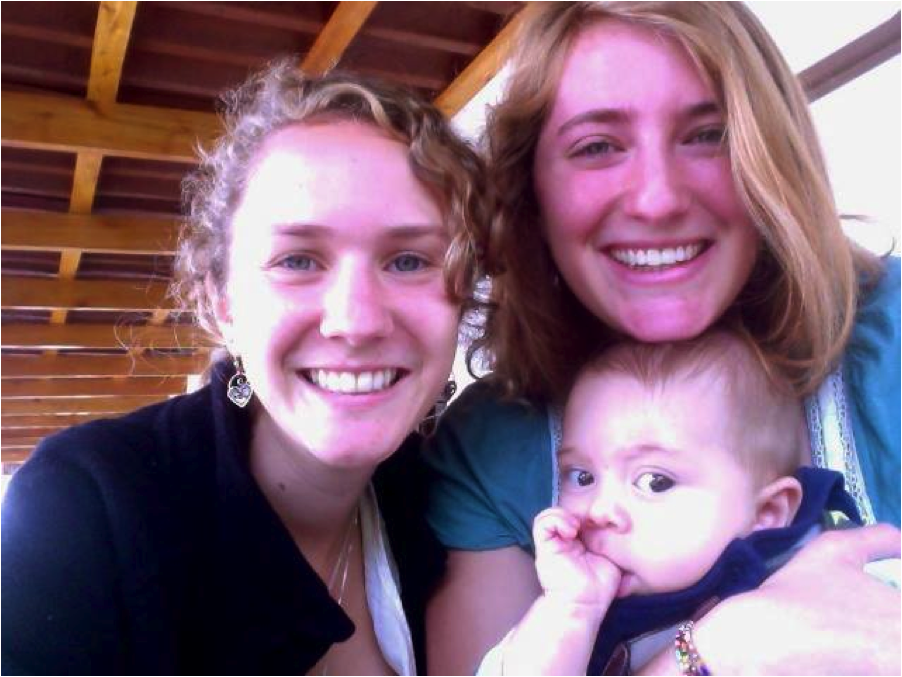
Emma and Molly with baby Santiago during their Internship at the Monteverde Institute.