
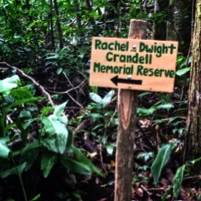
Internship - Rachel and Dwight Crandell Memorial Reserve - Pasantía
With the help of my supervisor, Randy Chinchilla, and some members of the Monteverde Institute we were able to create two maps of the Reserve that showed the path system, some signs and an entranceway to the reserve.
--- Con ayuda de mi supervisor, Randy Chinchilla, y con algunos miembros del Instituto Monteverde se logró crear dos mapas de la Reserva indicando los senderos, algunos rótulos de señalamiento y una entrada en la Reserva.

Signage and mapping of the Rachel and Dwight Crandell Memorial Reserve
by Jacqueline Zamudio
August, 2016
I had the opportunity of living in Monteverde in May through July with the help of the Grace Groner Foundation and Lake Forest College. During this time I did an internship and lived with a family in Cerro Plano.
My internship consisted in creating a basic maps and signs for the Rachel and Dwight Crandell Memorial Reserve. Before this the Reserve had some signs that could be found on the paths however, with time this signs had become damaged.
Crandell Memorial Reserve and paths
Also, the Institute did not have an up-to-date map, so, with the help of my supervisor, Randy Chinchilla, and some members of the Monteverde Institute we were able to update the Reserve maps by showing the location of the paths and signs as well as the Reserve limits.
Combining field work with Geographical Information System (GIS) techniques we determined the location and distance of the three paths that make up the Reserve: Bioluminosa Path, Bellbird Path, and Fungi Path. The following maps show the paths and the Reserve's limits.
Crandell Memorial Reserve and neighbouring properties.
The sign making part of the project was done in several steps. First we had to decide where we were going to put up the signs and what kind they were going to be. For this we took GPS points. After getting all the GPS points and deciding on the types of signs, we worked on several designs to determine the materials that would be necessary. After getting all the necessary materials, the signs were made. Finally, and with the help of the MVI’s staff, the signs were put alongside the paths. The following are pictures of the final Project.


Before and after: These signs indicate the way to get to the Reserve. (Before and after placing the sign).
Before and after photos. ---
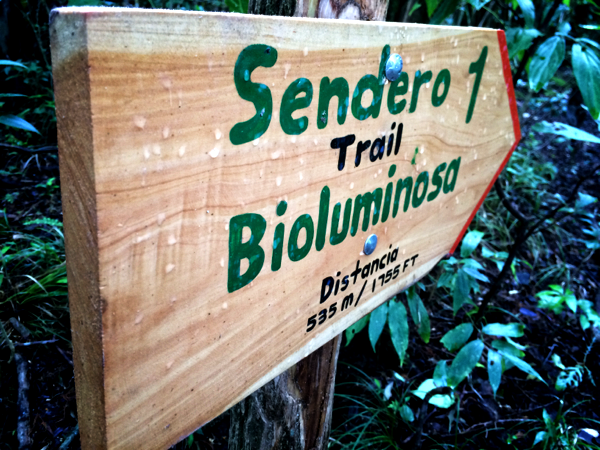
These are some of the signs pointing out the different paths. These signs show the path name and distance in meters and feet.

It’s also possible to find signs in each path that indicate the exit and end of path.
Finally, we build a small entrance way to the Reserve. The purpose of this small project was to create an entrance that would have several functions, the main one being for people to easily identify the way to enter the Reserve. The structure was also built in a way that it would prevent the entrance of bicycles, motorcycles and vehicles. On it, it's possible to observe the path map, information tables about the Crandell’s, biological registration forms, rules and logos. To build this entrance first we needed the design, then we got all the materials and finally we built it.
The following are pictures of how the entrance used to be, and how it is now.
These three projects were done in two months. Also during this time I was living with a family in Cerro Plano. Living with a family was also one of the things that made my experience in Costa Rica unique. Living with the family and being part of the community gave me the opportunity to learn about the Costa Rican culture which interested me. The Monteverde Institute and the Monteverde community gave me the opportunity to learn about Costa Rica while I helped out the community with my Project at the Rachel and Dwight Crandell Memorial Reserve.

Rotulación y mapeo en la Rachel & Dwight Crandell Memorial Reserve
Por Jacqueline Zamudio
Agosto 25, 2016
Entre los meses de mayo y julio , con ayuda de Grace Groner Foundation de Lake Forest College, tuve la oportunidad de vivir en Monteverde por dos meses. Durante ese tiempo realicé una pasantía mientras vivía con una familia en Cerro Plano.
Reserva Crandell y sus senderos.
La pasantía consistía en crear cartografía básica y rotulación para la Reserva Rachel & Dwight Crandell. Anteriormente la Reserva contaba con unos pequeños rótulos que se encontraban en los senderos. Sin embrago, con el paso del tiempo los rótulos se fueron dañando. Además el Instituto Monteverde no contaba con un mapeo actualizado. Con ayuda de mi supervisor, Randy Chinchilla, y con algunos miembros del Instituto Monteverde se lograron crear y actualizar los mapas de la Reserva indicando información de los senderos, de los rótulos de señalamiento y del punto de acceso y fin de la Reserva.
Combinando trabajo de campo con técnicas de los Sistemas de Información Geográfica (GIS en inglés) se determinó la ubicación y distancia de los tres senderos que conforman la reserva: Sendero Bioluminosa, el Sendero Pájaro Campana y el Sendero Fungi. Los siguientes mapas muestran los senderos que se pueden encontrar en la Reserva.
Este mapa muestra los límites de la Reserva y las propiedades vecinas.
Como se mencionó anteriormente, además del mapeo de los senderos también se hicieron algunos rótulos de señalamiento. Para este proyecto se tomaron varios pasos. Primero se decidió donde se iba a colocar cada rótulo y qué tipo de rótulo. Para este paso se tomaron puntos de GPS. Después de haber obtenido los puntos finales de GPS y los tipos de rótulos, se hicieron algunos diseños determinando los materiales que se necesitarían. Después de haber obtenido todos los materiales necesarios, se hicieron los rótulos. Por último, con ayuda de algunos miembros del Instituto Monteverde, se colocaron los rótulos en los senderos. Estas son algunas fotografías del producto final.

Antes y después:
Estos rótulos indican el camino que se puede tomar para llegar a la Reserva.
Antes y después:
Estos son rótulos indicando los senderos. En estos rótulos se indica el nombre del sendero y la distancia en metros y pies.
También se pueden encontrar rótulos en cada sendero indicando la salida y fin del sendero.
Por último, se construyó una pequeña entrada en la Reserva. El propósito de este pequeño proyecto era poder construir una entrada que tuviera varias funciones. La función principal era que las personas puedan identificar la entrada a los senderos con más facilidad. La entrada también se construyó de una manera que impide el paso de bicicletas, motocicletas o vehículos. La entrada también cuenta con un mapa de los senderos y algunas tablas con información sobre los Crandell, registros biológicos, algunas reglas y los logos. Para la construcción de esta entrada primero se obtuvo un diseño, después se determinaron los materiales, y finalmente llevó a cabo toda la construcción.
Aquí se puede apreciar cómo era la entrada anteriormente y como es ahora.
Estos tres proyectos se pudieron llevar a cabo en dos meses. Durante esos dos meses estuve viviendo con una familia en Cerro Plano. Vivir con una familia fue una de las cosas que también hizo mi estancia en Costa Rica única. Vivir con una familia y ser parte de la comunidad me dio la oportunidad de aprender sobre la cultura de Costa Rica lo cual me interesaba aprender. El Instituto Monteverde y la comunidad de Monteverde me dio la oportunidad de aprender sobre Costa Rica mientras ayudaba a la comunidad con mi proyecto en Rachel and Dwight Crandell Memorial Reserve.
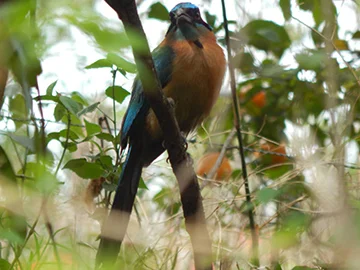
I must have seen the same Blue-Crowned Motmot more than three dozen times … /// Debo haber visto al mismo pájaro péndulo (bobo) más de tres docenas de veces...
I must have seen the same Blue-Crowned Motmot more than three dozen times as I ventured through brush and thicket.../ Debo haber visto al mismo pájaro péndulo más de tres docenas de veces mientras me aventuraba a través de espeso bosque y matorral..
por Luis Beltran
Blog Post Julio 27, 2015 (para español favor de bajar).
I must have seen the same Blue-Crowned Motmot more than three dozen times as I ventured through brush and thicket with Bellbird Biological Corridor Coordinator, Randy Chinchilla, volunteer, Mauricio Belmar, and intern, Brittany Schweiger, searching for missing trees, as if noir detectives hired by the Monteverde Institute. Cumbersome and scattered were the clues key to completing this assignment—an outdated map, missing tags, and misidentified trees—though nothing got in the way as much as that azure plumage. Self-fascinated with its own elongated, auricular raquet tip feather, this Motmot waved its tail from side-to-side, as if sensual hypnotist of the natural world. I must have fallen for the charm more than three dozen times.
Oh, what fascinating colors and what wondrous stage! Learning to identify the plants and animals of Monteverde is to me much like really getting to know your old friends – those companions that have been with you far longer than you can remember. It aches to leave these friends behind, which is part of the reason why I keep returning and returning to Monteverde. Equally invaluable to me is the staff of the Monteverde Institute, the warmth of the local community, and the incredible wealth of knowledge—hidden in leaf litter or canopy cover—just waiting to be discovered. Thank you for allowing me to volunteer with you this year! I will see you next time!
by: Luis Beltran (Lake Forest and Monteverde Institute's Lake Forest).


Debo haber visto al mismo pájaro péndulo más de tres docenas de veces mientras me aventuraba a través de espeso bosque y matorral. En aquellas ocasiones fui bien acompañado por el coordinador del corredor biológico del pájaro campana, Randy Chinchilla, voluntario Mauricio Belmar, y por la pasante Brittany Schweiger; juntos en búsqueda de ciertos árboles desaparecidos, comprometidos en la misión como cuatro detectives botánicos contratados por el Instituto Monteverde. Nuestro objetivo de encontrar y medir los árboles detrás del instituto se veía ofuscado por la falta de un mapa adecuado, árboles sin identificación, y etiquetas extraviadas. Sin embargo, nada presentaba semejante devaneo como aquel azur celeste plumaje. Fascinado por sus propias plumas terminales (alongadas y auriculares como raquetas de cielo), el pájaro péndulo, posado tranquilamente sobre una rama, movía tal vaivén del viento su cola esplendorosa, como sensual hipnotista de los bosques. Debo haber caído por su hechizo más de una docena de veces.
Ah, ¡pero que fascinantes colores y que encantadora escena! Mientras aprendo los nombres de los animales y plantas de Monteverde no logro descartar un sentimiento de amistad usualmente reservado para aquellos amigos fieles desde tiempos antaños. Es doloroso dejar a mis amigos de pluma y hoja, y en parte por eso vuelvo, y vuelvo a Monteverde. Igual de invaluables para mi son todos los que forman parte del Instituto Monteverde, así como la cálida pura vida que se siente en la comunidad local, y por la increíble vastedad de sabiduría—escondida entre hojarasca y torres de madera—esperando a ser descubierta. Muchísimas gracias por darme la oportunidad de trabajar con ustedes una vez más. ¡Nos veremos la próxima vez, Instituto Monteverde! ¡Pura vida!
Por: Luis Beltran (pasante del Instituto y de Lake Forest).
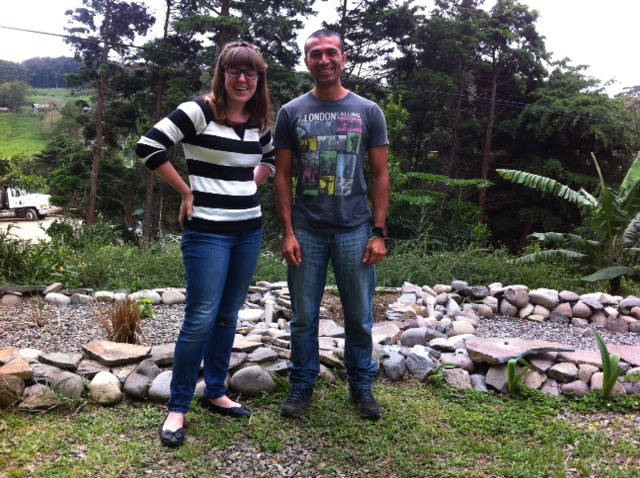
Student spotlight: Shelby Bates --- Foco estudiantil: Shelby Bates
If you stop by the Monteverde Institute’s biogarden, you will notice a special touch that was not there previously: interpretive signs that explain and give importance to conserving water and treating grey water. --- Si pasas por la biojardinera del Instituto Monteverde podrán notar algo nuevo: letreros interpretativos que explican y le dan importancia a la conservación del agua y el manejo de las aguas grises.
Student Spotlight: Shelby Bates, Intern from University of Nebraska-Lincoln
Para español favor de bajar a la próxima sección.
The Institute has had a greywater treatment area for some years but it has been somewhat of a problem and often didn't function. Last summer some of our staff members and students from the University of South Florida simplified and rebuilt it, so it is now doing an excellent job of processing our greywater.
We want others in the area to be able to make and use their own greywater treatment. If you stop by the Monteverde Institute’s biogarden, you will notice a special touch that was not there previously: interpretive signs that explain and give importance to conserving water and treating greywater. All thanks goes to Shelby Bates, a senior at the University of Nebraska who will complete her 10-week internship at the MVI on December 6, and her supervisor Orlando “Fish” Calvo, a Monteverde resident.
Shelby is a multi-talented young woman who fitted into the community very well. She saw the gardens projects and took on the job of helping to interpret the greywater treatment system for our students and for the community, so others can use the system. The treatment ends at what we call a “biogarden,” plants growing in specific layers of gravel that aid in digesting any residue left over from primary treatment and guiding the treated water downhill for use in gardens.
Together with her advisor, Orlando “Fish” Calvo, she created a series of signs to describe how the system works. It is now part of our educational pathway that includes the native plant, medicinal, and vegetable gardens, tree nursery as well as demonstrations of keyhole gardens. Despite living in the tropics, our alternating dry/wet seasons create the needs for conservation and control of water and waste. Shelby explains, “If somebody wanted to implement a biogarden in their own house, hotel or restaurant, they now have a very clear example of how this system functions.”
Shelby recalls that when she applied to work at the Monteverde Institute, she did not originally see her internship directly relating to her education major. “I was looking for an opportunity to finish my college education in which I could learn more about biology and see if I would rather change to a career in the sciences, and so I came to the Institute seeking the chance to learn more about the environment.
“The Institute has been really great in letting me see how I can apply my background to systems which function outside of education that are equally as important to education. So, for example, the Institute focuses more on community education and less on education within schools, but that education within the community is just as important as the work that a teacher might do within a school. It’s been really great to see.”
Since arriving to Monteverde, Shelby has decided to pursue a Master’s in Social Work, which will allow her to better understand different social issues and peoples’ responses to subjects like sustainable development, particularly how to convince others to engage in sustainable behaviors.
You can follow Shelby by reading her blog: www.shelbybatesabroad.wordpress.com /
Or, the Monteverde Institute blog which explains our particular greywater treatment program:
http://monteverde-institute-blog.org/environmental/aguas-grises-greywater
On December 4, 2014, Shelby delivered her report to the community, titled “The Impact of Humans on the Treatment and Production of Greywater.”
Written by: Bob Howe


Foco estudiantil: Shelby Bates, pasante de la Universidad de Nebraska-Lincoln
El instituto ha tenido por algunos años un sistema de manejo de aguas grises, sin embargo estuvo teniendo problemas por algún tiempo. El verano pasado algunos estudiantes de USF y miembros del personal trabajaron duro en simplificar el sistema y re-construirlo, así que actualmente está funcionando bien.
Si pasas por la biojardinera del Instituto Monteverde podrán notar algo nuevo: letreros interpretativos que explican y le dan importancia a la conservación del agua y el manejo de las aguas grises. Todo esto se logró gracias a Shelby Bates, una estudiante de ultimo año de la Universidad de Nebraska que completó su pasantía de 10 semanas el 6 de diciembre y de su supervisor Orlando “Fish” Calvo, un residente de Monteverde.
Shelby es una joven de múltiples talentos que encajó a la comunidad muy bien. Ella vio los proyectos en el jardín y se dio a la tarea de ayudar a interpretar el sistema de aguas grises para el uso de nuestros estudiantes y comunidad, de esta manera otras personas podrían usar el sistema. El tratamiento termina en lo que se llama una “biojardinera” donde las plantas crecer en diferentes niveles de piedras que asisten en “digerir” cualquier residuo que permaneció del tratamiento original y en dirigir el agua cuesta abajo para uso de riego en los jardines.
Junto con su tutor, Orlando “Fish” Calvo, Shelby creó una serie de letreros que describen como funciona el sistema. Ahora estos son parte de nuestra caminata educacional que incluye jardines de plantas nativas y medicinales, huertas, un vivero de árboles y demostraciones de jardines Ojo de Cerradura. Es nuestra fe que este vaya a servir como una modelo de tratamiento de aguas grises para otras zonas de la comunidad Monteverde. A pesar de vivir en los trópicos, el que se alternen las épocas secas con las lluviosas crean la necesidad de trabajar en conservación, control y manejo de aguas. Shelby dice, “si alguien quiere implementar una biojardienra en su casa, hotel o restaurant ahora tienen un ejemplo bastante claro de como este funciona.”
Shelby se recuerda que cuando ella aplico para la pasantía ella no vio una relación directa de su pasantía con sus estudios de Universidad, “yo estaba buscando una oportunidad para terminar mi educación de una manera en la que podría aprender más sobre biología y de esta manera entender si iba a querer cambiar mi carrera a una más relacionada a la ciencias, así que vine al Instituto buscando la oportunidad de aprender más sobre el medio ambiente.
“El Instituto ha sido muy bueno en permitir ver como puedo aplicar mi experiencia a sistemas que funcionan por fuera de lo educativo pero que son igual de importantes para la educación. Así que, por ejemplo, el Instituto se enfoca más en educación a la comunidad, y menos a la educación dentro de las escuelas, pero esa educación dentro de la comunidad es tan importante como el trabajo que un maestro podría hacer en una escuela. Esto ha sido muy bueno poder ver.”
Desde que llegó a Monteverde, Shelby ha decidido buscar una maestría en trabajo social, la cual le permitirá entender de manera mejor problemas sociales y las reacciones de las personas a términos como desarrollo sostenible, particularmente en como convencer a otras personas en engancharse a las prácticas sostenibles.
Pueden encontrar más información de Shelby en su blog: www.shelbybatesabroad.wordpress.com /
O ver la descripción de nuestro sistema de manejo aquí:http://monteverde-institute-blog.org/environmental/aguas-grises-greywater
El 4 de diciembre Shelby hizo una presentación a la comunidad titulado “El impacto de los humanos en el tratamiento y producción de Aguas Grises”.
Escrito por: Bob Howe
Monteverde: A one-of-a-kind teacher ---- Monteverde: Un maestro único e inimitable
It is an opportunity greater than I had ever imagined it would be, getting to be an intern and yet still gain coordination experience with internships.
--- Es una oportunidad más grande de lo que yo la había imaginado, todo esto de ser pasante y de aun así poder obtener experiencia en coordinación de pasantías.
Monteverde: A one-of-a-kind teacher
By: Ashley Gora, intern from Chicago, IL, USA
(Para Español favor revisar después de las fotos)
It is an opportunity greater than I had ever imagined it would be, getting to be an intern and yet still gain coordination experience with internships. After nine-and-a-half months here this year, and after having interned here in 2012 and 2013 for two months at a time, I’ve learned far more than I ever dreamed I would, and Monteverde never fails to teach me something new each day I spend here via complex musings and emotions. It is my intention in this blog to share three of these with you, dear Reader. And allow me to assure you of the following: If you ever come to Monteverde, whether for an internship or simply to live out your vacation days, I can guarantee that if you quietly let the magical, pulsing life of this natural and human environment whisper to you, you too will leave here changed.
~*~
After a while here, part of you becomes cynical: Why become friends with students and tourists who come and then leave and forget you ever existed? So many people, too many faces and names. Moreover, who do you choose to do life with here, especially considering that you, too, are one of those fleeting faces? And you have to remind yourself, as with the story of the woman launching beached starfish back into the sea, that to that person it matters, to that person your actions, your attitude, your outreach, your nature, all matter, if only for a little while, if only for the duration of that one fleeting moment for that fleeting face.
~*~
Community is important. Community is difficult. More often than not I’d much rather just skip doing the people thing, because people are messy, people take effort, people are broken. Being in community means that, if I’m doing everything that the word “community” implies, I’m feeling something, and sometimes it feels great, and sometimes it doesn’t, and it’s always scary. Being in community means that even though I can choose how vulnerable I want to be, I still have to be vulnerable, period. But as social beings by nature, being in community also is the most beautiful thing life has to give us. It is perfect love imperfectly embodied in the human being. It is the comforting warmth of a strong hug and the sweet tinkling of an unbridled laugh. It is movement and spirit and link. And if I can help you make those links with others, find a group, find community, then I am happy.
~*~
Never have I stayed through the whole rainy season before. Coming out of the dry season, the torrential downpours are a welcome blessing, satiating the parched land, the dust-caked trees. Then, after three months of the same, the emotional toil of a lack of sunshine-filled days kicks in. The misty, eternally-humid air and the gray hue of the overcast sky all begin to wear on the mind. Days pass, weeks, months, and then suddenly it starts to ease when finally you think that the storms will never pass. Mornings are audaciously bright—acrylic paints splashing gaudy dyes onto lush foliage and full-bodied earth and gemstone flowers which daze and quench the thirst of the eyes that had grown too accustomed to darkness. Forest sprite I am, and I escape to the wild world of effervescent color and incomplete, lackadaisical metaphor, fearful that I am hallucinating.
Monteverde: Un maestro único e inimitable
(For English please scroll up).
Por: Ashley Gora, pasante de Chicago, IL, USA
Es una oportunidad más grande de lo que yo la había imaginado, todo esto de ser pasante y de aun así poder obtener experiencia en coordinación de pasantías. Después de nueve meses y medio aquí este año, y después de ser pasante aquí en 2012 y 2013 por dos meses cada vez, he aprendido mucho más de lo que alguna vez soñé que aprendería, y Monteverde sigue sin fallar en enseñarme algo nuevo cada día a través de las contemplaciones y emociones complejas. Es mi intención en este blog compartir tres de estas con usted, querido Lector. Y déjeme asegurarle de lo siguiente: Si alguna vez usted viene a Monteverde, sea para una pasantía o simplemente para pasar sus vacaciones aquí, yo le puedo garantizar que si usted tranquilamente deja que la vida mágica y pulsante de este ambiente humano y natural le susurre, usted también se irá de aquí transformado.
~*~
Después de un tiempo acá, una parte de usted se vuele cínico: ¿Por qué ser amigo de los estudiantes y los turistas que vienen y van si ellos se olvidarán de mi existencia? Tantas personas, tantos nombres y tantas caras. Además, ¿a quién puedo acercarme yo para que me ayude a construir mi vida aquí, tomando en cuenta el hecho de que yo también soy una de esas caras fugaces? Y hay que recordar, que igual como en la historia de la mujer que lanza las estrellas de mar embarrancadas en la playa devuelta al océano, que para aquella persona importa, que para aquella persona sus acciones, su actitud, su extensión, su naturaleza, importan, aunque sea solo por un rato, aunque sea solo por la duración de ese único momento fugaz para esa cara fugaz.
~*~
La comunidad es importante. La comunidad es difícil. La mayoría de las veces prefiero apartarme de las personas, porque las personas con complicadas, las personas requieren un esfuerzo, las personas son liosas. Estar en comunidad significa que, si yo hago todo lo que la palabra “comunidad” implica, yo siento algo, y a veces se siente bien, y a veces no, y siempre da miedo. Estar en comunidad significa que aunque yo puedo elegir qué tan vulnerable quiero ser yo, todavía tengo que ser vulnerable, punto. Pero como somos seres sociales por naturaleza, estar en comunidad también es lo más bello que nos puede dar la vida. Es el amor perfecto encarnado imperfectamente en el ser humano. Es el calor agradable de un fuerte abrazo y el tintineo dulce de la risa desenfrenada. Es movimiento y espíritu y vínculo. Y si yo le puedo ayudar a hacer aquellos vínculos con otras personas, a encontrar un grupo, a encontrar la comunidad, pues estoy feliz.
~*~
Nunca antes me había quedado por la temporada lluviosa entera. Saliendo de la temporada seca, los aguaceros torrenciales son una bendición bienvenida, saciando a la tierra reseca, los árboles cubiertos en polvo. Después de tres meses de lo mismo, el peso emocional que viene con la falta de días llenos de rayos de sol comienza. El aire neblinoso, eternamente húmedo, y las tonalidades grises de un cielo nublado logran con el tiempo desgastar la mente. Pasan los días, las semanas, y los meses, y cuando más se muestran incesables las tormentas, es entonces de repente que llega el alivio. Las mañanas son audazmente brillantes—pinturas acrílicas salpican tintes llamativos sobre el follaje frondoso, la tierra sabrosa, y las flores fragantes como gemas que aturden y aplacan la saciedad de los ojos que se habían acostumbrado desmesuradamente a la oscuridad. Duendecillo de bosque soy yo, y escapo al mundo silvestre de colores efervescentes y metáfora incompleta, lánguida, temiendo que alucino.
Agenda: Goucher MtHolyoke Simposium 201
Aquí pueden ver la agenda del simposio de los estudiantes de Goucher-MtHolyoke
Sixth Final Presentations
Development and Social Change in Costa Rica
Saturday, April 12th 2014
Monteverde Institute Auditorium
& the
Sixth Final Presentations
Environmental Sustainability & Human Health and Development in the Tropics
Monday, April 14th 2014
Monteverde Institute Auditorium
Please click on photos for agenda - Favor gaga "click" en las fotos para la agenda


The Night of the Bat---La Noche de los Murciélagos
The night of the bat was nothing to be scared of. Truthfully, it was an incredible night. I am so happy we had nice weather and had the luck to meet the expert Dr. Laval and his friends.
Blog 9.7.13 by Lana Panitch Lake Forest Intern
After a day´s work at the Monteverde Institute, my cohorts from Lake Forest and I went to Tramonti´s for a dinner full of pizza (or pixa as they called it here) and laughs. We ordered my favorite type, vegetarian, and some meaty ones as well for the meat-lovers at the table. We demolished three pizzas between the four of us in hardly any time at all. We left very satisfied.

Having Pizza at Tramonti
Soon after, we hiked back up to the Institute to meet up with our Costa Rican “Mommy away from home” (our internship coordinator), Sarah Burbank. An adventure in the forest behind the Institute awaited us. We mounted the stairway, passing the strong, perfumed odor of the Angel’s Trumpets flowers. We entered the Dwight and Rachel Crandell preserve when the sun had just set.
As we approached, we could see with our headlamps a net, almost like a tennis net, stretched between two big trees. Then, we saw three figures…the legendary local bat expert, Dr. Richard LaVal and his assistants, his daughter and son-in-law. Right away, the fun began. Dr. LaVal brought us the first victim…a brown insectivorous bat that belongs to the same family of brown bats that are very common where I live in Chicago, Illinois.
Dr. LaVal explained to us that this bat was clearly an insect bat because it has a simpler nose than fruit bats. He showed us the length and breadth of its wings. The wings are made up of a very fine and smooth skin that is surprisingly strong and durable. I learned that if a wing breaks or tears, it would take five days for it to heal. I feel very thankful for these bats because they eat thousands of insects, such as mosquitoes, every night. What nice pest control!
Then, he brought us a fruit bat. These bats are also very cute, I think, although their noses are more complex, bigger, and uglier than those of the insect bats. The fruit bats are also very important for humans because they help to distribute many types of fruits’ seeds. Some fruit they pollinate, for example, are mangos, peaches, and even almonds! If I were a bat, I would most definitely be a fruit bat. This victim was very small, and calmer than the insect bat. Dr. LaVal thought it was a good candidate for us to hold. Gabe was the first brave soul to hold it, followed by Ashley, Luis, and then me. At first I hesitated…then I had to ask myself, “When will I ever get this opportunity to hold a wild bat again in the future?” The answer was, “Never!” And that was that. I held it carefully, and it was a wonderful experience. My new little friend was soft and its heart beat like a little drum. It was an experience I will never forget.

Lana with a bat, and Richard Laval in the Background.
For the rest of the night, Dr. LaVal showed us many more fruit and insect bats. Surprisingly though, many of them were quite unique. Some were male, some were juvenile, and some were female. The females interested me the most because some were pregnant with big, swollen bellies. Dr. LaVal was good at guessing how much more time they had until delivery. We also got to see lactating females, which meant that they were mothers of pups. What a treat it was to learn and see all of those small details in real life!
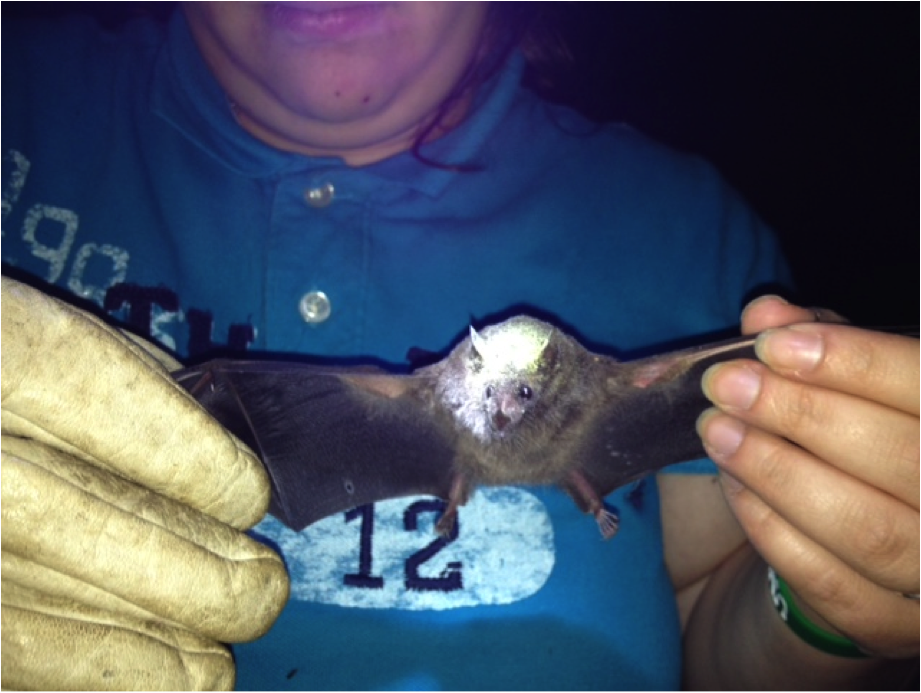
After more than fifteen bats of all shapes, sizes, and life stages, we were getting ready to leave. Suddenly, Kelly LaVal brought us the final bat…a nectar bat! It had pollen on its head! This bat is in the photo below, but the flash makes it a little tricky to see the yellow pollen. This bat was a pleasure and total surprise!
The night of the bat was nothing to be scared of. Truthfully, it was an incredible night. I am so happy we had nice weather and had the luck to meet the expert Dr. Laval and his friends.
-------------------------------------------------------------------------------------------------------------------------------------
En Español:
La Noche de Murciélagos
Después de un día de trabajo en el Instituto Monteverde, mis compañeros de Lake Forest College y yo fuimos a Tramonti´s por una cena llena de pizza (o pixa como se llama aquí) y risas. Pedimos mi tipo favorito, vegetariano, y otras de carnes ricas como salami y salchicha. Nosotros cuatro matamos tres pizzas en poco tiempo, y nos sentimos muy satisfechos.
Luego, nos juntamos con nuestra mamacita de acogida, Sarah Burbank (nuestra coordinadora de pasantías), para una aventura en la selva detrás del instituto. Subimos la escalera, pasando el olor fuerte y perfumado de las flores de las Trompetas de Ángel. Entramos la reserva de Dwight y Rachel Crandell cuando el sol acabó de atardecer.
Vimos con los focos de cabeza una red, casi como una red de tenis, estirado entre dos árboles grandes. Luego, vimos dos hombres…el legendario experto de murciélagos, Dr. Richard Laval, y su asistente, Kelly LaVal. Pronto después, la diversión empezó. Dr. Laval nos trajo el primer victima…un murciélago café e insectívoro que pertenece a la misma familia de murciélagos cafés que son comunes donde yo vivo en Chicago, Illinois.
Dr. Laval nos explicó que este murciélago es claramente un insectívoro porque tiene una nariz más sencilla que los murciélagos de fruta. Nos mostró la longitud de sus alas que son de piel muy fuerte pero muy fina y lisa también. Aprendí que si un ala se rompe, duraría cinco días para curarse. Yo me siento muy agradecida a estos murciélagos porque comen millones de insectos, como mosquitos, ¡cada noche! ¡Que útiles son!

Sosteniendo un murciélago!
Luego, nos trajo un murciélago de fruta. Estos murciélagos también son muy preciosos, yo pienso, aunque tienen narices complejas, grandes, y un poco feas. Los murciélagos de fruta también son muy importantes para los humanos porque ayudan a distribuir las semillas de muchas y muchas frutas que comimos cada día. Si yo fuera un murciélago, pienso que yo sería un murciélago de fruta. Este victima también fue muy pequeño, pero más tranquilo. Por eso, Dr. Laval pensó que sería un buen tipo para nosotros agarrar. Gabe fue el primer valiente agarrarlo, luego Ashley, Luis, y finalmente yo. Me pregunté, ¿Cuándo tendré la oportunidad agarrar un murciélago silvestre en el futuro? Me respondí, ¡nunca!, y eso fue. Lo agarré, y me alegró mucho. El amiguito nuevo fue suave y su corazón latió como un tambor. Fue una experiencia que nunca me olvidaré.
Por el resto de la noche, Dr. Laval nos mostró muchos más murciélagos insectívoros y de fruta. Pero no eran todos los mismos. Algunos eran machos, algunos juveniles, y algunos eran hembras. Las hembras me interesaban mucho porque algunas estaban embarazadas. Tenían panzas llenas e hinchadas. Dr. Laval adivinó cuanto tiempo se las quedaba hasta que dirían la luz. También, había hembras en lactancia, lo que significa que tenían cachorros. Que regalo fue aprender y ver estos detalles en vivo.
Después de más de quince murciélagos, de todos talleres y formas, íbamos a salir. De repente, Kelly nos trajo un murciélago final… ¡un murciélago que come néctar de las flores! ¡Tenía polen en la cabeza! Está en la foto abaja, pero por la luz es un poco difícil ver el polen amarillo. De ninguna manera, ¡fue un placer y sorpresa total!
La noche de murciélagos no fue nada escalofriante. De veras, fue una noche increíble. Me alegro que hacía buen tiempo y que tuvimos la suerte de conocer al experto Dr. Richard Laval y a sus amigos.
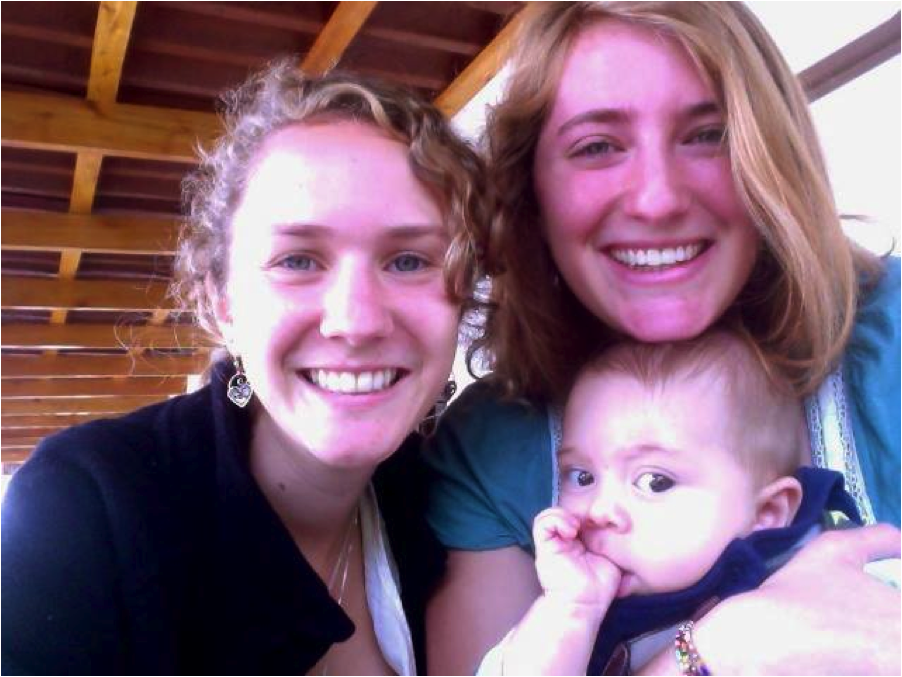
Emma and Molly's internship on births in Costa Rica
Emma and Molly's experience during their internship on birthing in the zone.
For two aspiring midwives, finding the perfect internship seemed like it would be challenging in Costa Rica, a place where birth often occurs within a specific system and midwives are rarely used. However, we took our love of everything birth-related and created a project where we could listen to and create relationships with women while conducting prevalent research about the area.
Our project was to create a questionnaire, available in both English and Spanish, that we used as a guideline to interview women about their birth experiences. We interviewed both Tica and non-Tica women who had given birth in Costa Rica within the past six or so years. Our sample was diverse; we talked to women who had given birth at home, in public hospitals and clinics, and in private hospitals and clinics. Our questionnaire included questions about perceptions of different birth professionals, the differences between public and private hospitals, birth interventions, and personal stories.
We discovered interesting themes, some that supported our hypotheses and some that surprised us. The most rewarding aspect of the project was talking to women about something so personal and hearing about the challenges, the beauties, the fears and the hopes about the incredible shared experience of childbirth.
This internship has given us the opportunity to learn relevant Spanish vocabulary that we will need in order to work with Spanish-speaking women in the United States. We have made valuable relationships with women in the Monteverde community through this project that is so important to both of us. We worked with the Monteverde Institute to make sure that our project was conducted ethically and in a specific way that made it possible for us to talk to a diverse group of women from different backgrounds. This experience has opened our eyes to differences between birth options in Costa Rica and in the United States and has further excited us about our future careers as midwives.
by: Emma and Molly
___________________________________________________________________
Como dos posibles futuras parteras, pensamos que sería difícil encontrar una pasantía perfecto en Costa Rica, un lugar donde el parto ocurre en un sistema específico y las parteras casi no se usan. Pero creamos un proyecto en que pudiéramos escuchar a las historias y formar relaciones con mujeres de la zona—un proyecto que involucra nuestra pasión sobre todo lo que tiene que ver con el proceso del parto—a la vez aprovechar de hacer investigaciones interesantes y relevantes sobre la zona.
Para nuestra proyecto creamos un cuestionario, que podíamos usar en ingles o español, que usábamos como guía para entrevistas con mujeres sobre sus experiencias de parto. Hacíamos entrevistas con mujeres Ticas y extranjeras que han dado a luz en Costa Rica en los últimos seis años. Nuestra muestra era diversa; hablamos con mujeres que han dado a luz en casa, en hospitales y clínicas públicas, y hospitales y clínicas privadas. El cuestionario incluyó preguntas sobre percepciones de diferentes tipos de profesionales del parto (parteras, obstetras, enfermeras obstetras), las diferencias entre los hospitales públicos y privados, intervenciones del parto, y historias personales.
Descubrimos temas interesantes, unos que apoyaron nuestras hipótesis y unos que nos sorprendieron. Lo más gratificante era hablar con mujeres sobre algo tan personal y escuchar sus cuentas sobre los retos, las bellezas, los temores y las esperanzas sobre la experiencia increíble del parto, que compartimos las mujeres.
Esta pasantía nos dio la oportunidad aprender vocabulario relevante que necesitaremos para trabajar con mujeres hispanohablantes en los Estados Unidos. Hemos creado relaciones valiosos con las mujeres de la comunidad en este proyecto que es tan importante para nos dos. Trabajamos con el Instituto Monteverde para asegurar que el proyecto era conducido de manera ético y de manera en que era posible que hablemos con un grupo diverso de mujeres de experiencias diferentes. Esta experiencia nos mostró las diferencias entre los opciones del parto en Costa Rica e en los Estados Unidos y nos emocionó más sobre las careras futuras como parteras.
-Emma and Molly
Emma and Molly with baby Santiago during their Internship at the Monteverde Institute.
The Institute and Living Routes Program- El programa del Instituto y Living Routes
About the Living Routes program of the Monteverde Institute- sobre el programa de Living Routes del Instituto Monteverde
"The Living Routes Program: Tropical Ecology, Development, and Social Justice began as a spring pilot project in the Spring of 2011; since 2011-2013, it has been offered fall and spring semesters. Living Routes, a non-profit organization focused on intentional communities and located in Amherst, MA, has a number of international programs. While the University of Massachusetts, Amherst grants academic credit for the courses, the program is open enrollment and has drawn students from many different universities and colleges, including Stanford, Sarah Lawrence, Cornell, Smith, the University of Vanderbilt, etc..
The Program in Monteverde urges students to "explore how international and national trends and policies have affected local sustainable development, environmental conservation and social justice efforts" This Program stresses experiential learning, community building, and personal sustainability (including yoga). Students take four courses: Ecological Relationships in the Tropics (primarily a field course), Community Service Learning in Costa Rica: Theory and Practice (also a field course that involves a heavy internship component), Sustainable Development and Social Justice, and Spanish Language and Costa Rican Culture (students pick appropriate language level). While classes are held at MVI and in forest reserves, much service learning (such as creating material for a rural school) and personal knowledge comes from the small agricultural community of San Luis where students live with a local family."
By: Leslie Burlingame
The Monteverde Institute has as one its goals to offer an integrated education to our students, which includes an active participation in the community. This involvement allows mutual learning experiences where our students learn from the community they live in and the community learns from our students.
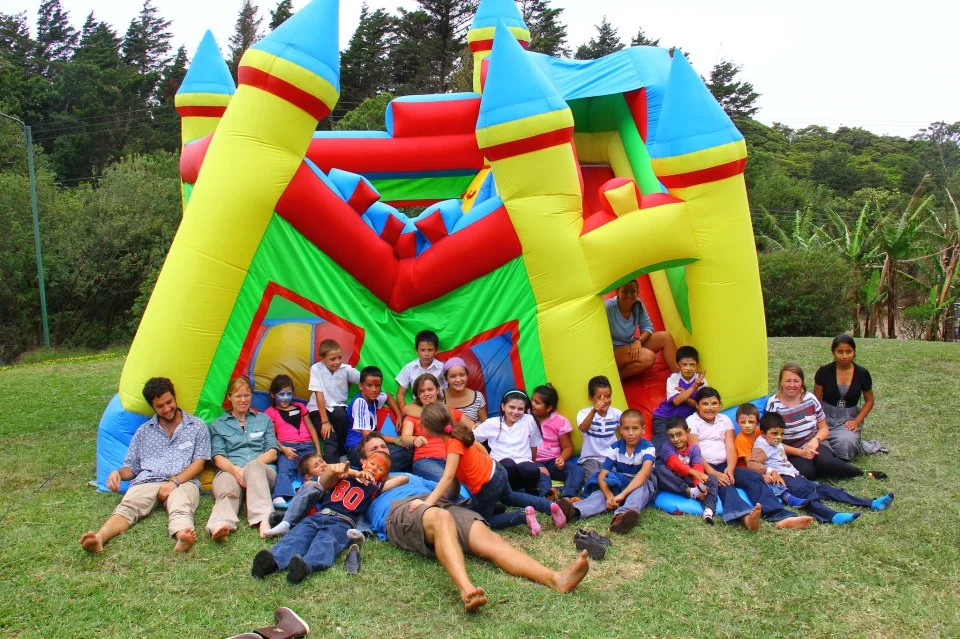
As an example, last semester our students from the Living Routes program who live with homestay families in San Luis, worked on projects in both schools (Alto y Bajo), also worked in permaculture projects in Finca la Querencia and helped establish an ecology program for schools in the Monteverde Butterfly Farm.
In the last year, two of our students were really impressed with the community and decided to offer extra support once the program was finished: Lauren Wallace donated funds for an English program in the San Luis schools and Emily Barbour decided to finance the entire tuition for the final year at the Creativa (CFS) for a San Luis student.
tuition for the final year at the Creativa (CFS) for a San Luis student.
Our students leave with positive and transformative experiences and we would like to thank the community for helping to make this possible.
This video was made by one Sarah Fletcher about her internship and the butterfly farm:
http://www.youtube.com/watch?v=t221X7FGgmc&feature=youtu.be
El Instituto Monteverde tiene como una de sus metas ofrecer una educación integral a nuestros estudiantes donde se incluye una participación activa en la comunidad. Esto tiene como fin que haya un aprendizaje mutuo: los estudiantes aprenden de la comunidad y la comunidad de los estudiantes..
A modo de ejemplo el semestre pasado nuestros estudiantes del programa de Living Routes que se hospedan con familias en San Luis, trabajaron con las escuelas del Alto y Bajo, además hicieron unos proyectos de permacultura en Finca la Carencia y ayudaron a establecer el programa de ecología para las escuelas del Mariposario Monteverde.
El año pasado dos de nuestros estudiantes quedaron realmente impresionadas con la comunidad, y decidieron apoyar un poco más una vez que terminaron el proyecto, Lauren Wallace dono fondos para un programa de ingles para las escuelas de San Luis, y Emily Barbour que decidió financiar el ultimo año de estudio en la Escuela Creativa (CFS) a un estudiante de San Luis.
Nuestros estudiantes salen con experiencias muy lindas y queremos agradecer a la comunidad ayudar hacer esto, por compartir con ellos.

Living Routes students chilling with kids from San Luis Monteverde
Oriana nos cuenta como el Instituto cambió su vida: Monteverde Back to the Roots
Vuelta a las raíces, a reconectar con esa parte tierna de ti mismo, con un instinto muy profundo de quien eres, como persona, como mujer, como profesional, incluso como animal de la naturaleza. Simple y llanamente esta es la puerta que se me abrió tras mi estancia en Monteverde y en el Instituto Monteverde.
Monteverde: back to the roots
Canciones que escucho mientras escribo esto:
Ben Howard-Old Pine
Ravid-Lola
Bon Iver-Holocene
Florence and the Machine-Cosmic Love
Vuelta a las raíces, a reconectar con esa parte tierna de ti mismo, con un instinto muy profundo de quien eres, como persona, como mujer, como profesional, incluso como animal de la naturaleza. Simple y llanamente esta es la puerta que se me abrió tras mi estancia en Monteverde y en el Instituto Monteverde.
Médica con vocación en salud pública, salud comunitaria o medicina social, estudiante de antropología, bióloga marina frustrada, escritora y viajera en mi tiempo libre…encontré en el Instituto Monteverde un grupo de gente creativo (especialmente estupendas amigas), un ambiente profesional, volcado en la comunidad y viviendo en el tempo y entornos naturales correcto. De repente, la melodía resonaba como nunca antes dentro del corazón. También por supuesto despertó una desazón increíble: ¡algo no había funcionado hasta ese momento y había cambios y ajustes que hacer en mi vida si quería vivirla…si quería ser feliz!
Los cambios no vinieron inmediatamente. Estuve en Monteverde unos 8 meses entre el año 2004 y 2005. Primero cursé el Methods in Community Health con Nancy Romero-Daza y David Himmelgreen de la Universidad del Sur de Florida y me quedé en el IMV varios meses más ampliando el proyecto del curso: HIV awareness in the community: Women speak, junto con Elsa Batres (antropóloga) que terminó siendo gran amiga (en el 2011 estuve en Seattle, en las Olimpic Mountains visitándola). Después vinieron unos años que trabajé en la Agencia Española de Cooperación Internacional y Desarrollo con varios proyectos de salud en África, para por último especializarme en Medicina Preventiva y Salud Pública, cuatro años de residencia médica que incluían un Máster en Salud Pública (MPH), obteniendo una beca para cursarlo en la Universidad de Harvard.
Aquí es donde las coincidencias empezaron a sumarse rápidamente. Estando en Boston comencé a dedicar algo de mi tiempo libre como voluntaria en el Brookline (MA)-Quezalguaque (Nicaragua) Sister City Project, donde algunos epidemiólogos querían poner en marcha un pequeño estudio de casos y controles en Nicaragua para estudiar factores asociados a una prevalencia elevada de enfermedad renal crónica en hombres jóvenes sin los usuales factores (hipertensión y diabetes) de riesgo para padecer esta enfermedad crónica. Acabé viajando a Costa Rica durante el winter break para que la Dra. Ineke Wesseling (UNA-IRET) –que yo había conocido brevemente durante mi estancia en Monteverde- me pusiera en contacto con el equipo investigador de SALTRA (Red de Salud, Trabajo y Ambiente) de Nicaragua, donde viajé durante la Semana Santa para, ayudada por estas investigadoras de la UNAN-León, poner en marcha la logística de la investigación. Tuvo que pasar otro año para que Daniel Brooks, de la Universidad de Boston me llamara para formar parte de un equipo de investigadores que hemos estado hace cuatro años investigando esta epidemia de enfermedad renal crónica de causas aún desconocidas en un contexto de mediación con trabajadores de la caña de azúcar en Nicaragua[1]. Obviamente toda la experiencia de haber vivido y trabajado en Costa Rica fue de indudable valor durante el trabajo de campo. Las temporadas que he pasado en Centroamérica me han permitido volver a Monteverde en varias ocasiones (gracias Cris y Paty por alojarme!), retomar y reflexionar sobre ese proceso de cambio, además de visitar a viejos amigos y amigas.
Este proceso reflexivo ha sido especialmente fuerte la última vez que he estado en Monteverde (Diciembre 2012). En este proceso de cambio han pasado muchas cosas: me he acercado más a mi familia, a mis amigos, y vivo de una forma un poco más sostenible: en la montaña (en la Sierra de Guadarrama de Madrid, en España), formo parte de una cooperativa de alimentos y productos locales, etc. Otra cosa que ha cambiado es la práctica de deporte como medio para acercarme a la naturaleza: alpinismo, bicicleta de montaña, escalada, esquí de travesía, submarinismo…y mi último descubrimiento: el trail running (o carreras de montaña), una sensación de libertad brutal y de experimentación increíble de los límites del cuerpo…y de la mente! En todo esto pensaba mientras corría de Monteverde a Cañitas pasando por Santa Elena y saludando a viejos amigos que se sorprendían de verme aparecer por la puerta de su casa en zapatillas de correr.
A ellos, a Monteverde y al IMV…mi gratitud, desde el corazón…por cambiar mi vida.
Oriana Ramírez Rubio MD, MPH
PhD candidate (UAM/BU)
oriana_ramirez@yahoo.es
[1] Más detalles en: Ramirez-Rubio O, McClean MD, Amador JJ, Brooks DR. An epidemic of chronic kidney disease in Central America: an overview. J Epidemiol Community Health. 2012 Sep 21. [Epub ahead of print]

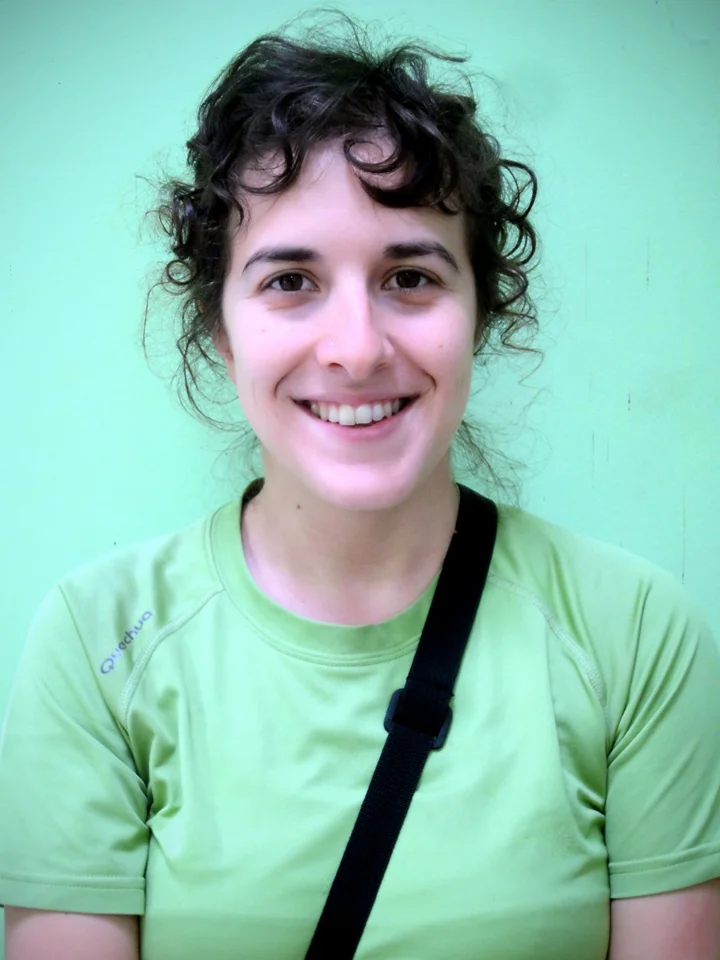
Foto de Oriana disfrutando estar afuera como lo hace hoy día!