
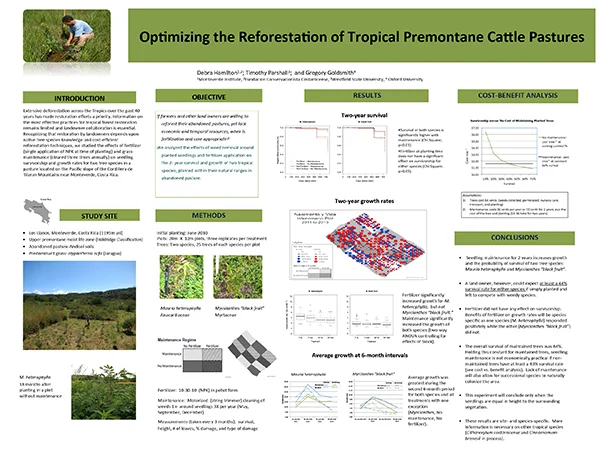
Poster: “ Optimizing the reforestation of tropical premontane cattle pasture through fertilization and grass maintenance”.
At the 26th International Congress for Conservation Biology in Baltimore, Debra Hamilton (Monteverde Institute), Tim Parshall (Westfield State University) and Greg Goldsmith (Oxford University) presented a poster entitled “ Optimizing the reforestation of tropical premontane cattle pasture through fertilization and grass maintenance”.
Poster: “ Optimizing the reforestation of tropical premontane cattle pasture through fertilization and grass maintenance”.
Afiche:
“Optimizando la reforestación de portrero tropical premontano a través de fertilización y mantenimiento”.
English: At the 26th International Congress for Conservation Biology in Baltimore, Debra Hamilton (Monteverde Institute), Tim Parshall (Westfield State University) and Greg Goldsmith (Oxford University) presented a poster entitled “ Optimizing the reforestation of tropical premontane cattle pasture through fertilization and grass maintenance”.
While the results of the two-year investigation demonstrate that grass maintenance significantly increased the survivorship and growth of planted seedlings, the application of fertilizer (10-30-10) at the time of planting had no effect on survivorship. Fertilizer application at time of planting did increase growth rates for one of the two tree species in the experiment.
More importantly, >44% of seedlings of both tree species (Mauria heterophylla (Cirri) and Myrsianthes “black fruit”) survived whether the seedlings received grass competition removal or not. Reforestation, therefore, should not necessarily be discouraged if a landowner does not have the economic resources to maintain the seedlings free of grass. This research is continuing to examine additional species and grass types.
Español:
En los 26th Congreso Internacional para Biología de la Conservación en Baltimore, Debra Hamilton (Instituto Monteverde), Tim Parshall (Westfield State University) y Greg Goldsmith (Oxford University) presentó un poster titulado “Optimizando la reforestación de portrero tropical premontano a través de fertilización y mantenimiento”.
Mientras que los resultados de la investigación de dos años demuestran que mantenimiento de pastos aumentó significativamente la supervivencia y crecimiento de los arbolitos, la aplicación de fertilizante (10/30/10) en el momento de la siembra no tuvo efecto sobre la supervivencia. La aplicación de fertilizantes en el momento de la plantación aumentar las tasas de crecimiento de una de las dos especies en el experimento.
Más importante aún, > 44% de las plántulas de ambas especies arbóreas (Mauria heterophylla (Cirri) y Myrsianthes "black fruit") sobrevivieron si los arbolitos recibieron mantenimiento o no. Por lo tanto, no necesariamente deben desanimarse si un terrateniente no tiene los recursos económicos para mantener las plantas de semillero libres de hierba. Esta investigación continúa para examinar otras especies de arboles y tipos de pastos.
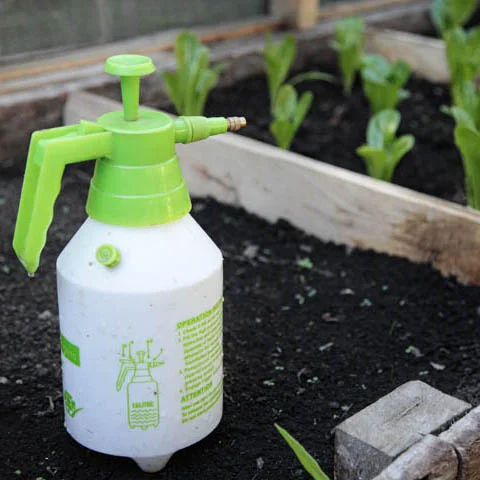
Synthetic and Organic Lettuce Fertilizers- Fertilizantes orgánicos y sintéticos
We are always trying to down grade costs. Farmers, especially, who focus on maximizing their yields and profits for the labor, energy, and supplies they put in, need reliable, cost-efficient sources of fertilizer.
We invite you to read this work made by our EAP Spring student Sarah Vetter. This was made on a two week research, if you would like more information on the article (or you want to read the full article) you can to write to: info@mvinsitute.org
Lettuce Growth in Response to Weather & Soil Nutrients & pH
Sara L. Vetter -Department of Environmental Science - University of California, Los Angeles -EAP Tropical Biology and Conservation Program, Spring 2013
ABSTRACT
Organic fertilizers can prove just as efficient as or even better in aiding in plant growth than synthetic fertilizers. I observed how lettuce seedlings would differ in growth of leaf width and length between treatments with and without the two types of fertilizers. I looked at nutrient and pH content of each treatment before and after planting, and analyzed the effects of weather on leaf production. For organic fertilizer I utilized vermi-compost cow manure, regular cow manure, and goat manure, products of a local La Cruz de Abangares farm. For synthetic fertilizer, I chose Urea and 10-30-10, ones commonly used by farmers of the same area. I measured leaf growth of the largest leaf of each seedling for each treatment for each area. For the indoor plot the seedlings of the vermi-compost cow manure treatment grew significantly taller (4.25 cm) than those of the goat manure (1.81 cm) and the control (2.12 cm). I found seedlings of the 10-30-10 treatment (4.06 cm) to have grown significantly more than goat manure as well. For the outdoor plot, goat manure (2.08 cm) and Urea (1.85 cm) showed a significantly greater change in width than the 10-30-10 treatment (0.75 cm). The vermi-compost treatment appeared to have had good soil structure and perhaps undetected reserves of micronutrients released by earth worms. For the outdoor plot the goat manure treatment may have had undetected nitrogen and salt reserves, while the Urea treatment high nitrogen content. Weather may have influenced the release of nutrients in some treatments in a way that caused seedling growth to differ in the indoor and outdoor plots. A partially unifying factor in the results between the outdoor and indoor plots appears to have been the presence of nitrogen in the starting treatment.

Photo for illustrative purposes/ Foto para uso ilustrativo.
RESUMEN
Los fertilizantes orgánicos pueden ser igual de eficaces o incluso mejores que los fertilizantes sintéticos en ayudar en el crecimiento de plantas. Estudié diferencias en el crecimiento de plántulas de lechuga en cuanto a la anchura de la hoja y la longitud entre los tratamientos con y sin los dos tipos de fertilizantes. Medí los nutrientes y el contenido de pH de cada tratamiento antes y después de la siembra, y analicé los efectos del clima en la producción de la hoja. Para obtener fertilizante orgánico utilicé estiércol de vaca ya compostado por lombrices, estiércol de vaca regular, y estiércol de cabra, productos de una finca en La Cruz de Abangares. Por fertilizantes sintéticos, elegí Urea y 10-30-10, utilizadas por los agricultores de la misma zona. Medí crecimiento de la hoja de la hoja más grande de cada planta para cada tratamiento para cada área. Para la parcela del interior las plántulas del vermi-compost de estiércol de vaca crecieron significativamente más altas (4,25 cm) que las del estiércol de cabra (1,81 cm) y el control (2,12 cm). Las del tratamiento 10-30-10 (4,06 cm) crecieron más que las de estiércol de cabra también. Para la parcela al aire libre, el estiércol de cabra (2,08 cm) y urea (1,85 cm) mostraron un cambio significativamente mayor en anchura que el tratamiento 10-30-10 (0,75 cm). El tratamiento vermi-compost parecía haber tenido una buena estructura del suelo y reservas de micronutrientes tal vez no detectados en la prueba. En la parcela exterior del tratamiento del estiércol de cabra puede haber tenido de nitrógeno y reservas de sal que no se detectaron, mientras urea presentó un alto contenido en nitrógeno. El clima puede haber influido en la liberación de nutrientes en algunos tratamientos de una manera que hizo que el crecimiento de plántulas difiriera en las parcelas cubiertas y al aire libre. Un factor unificador parcialmente en los resultados entre las parcelas al aire libre y de interior parece haber sido la presencia de nitrógeno en el tratamiento inicial.


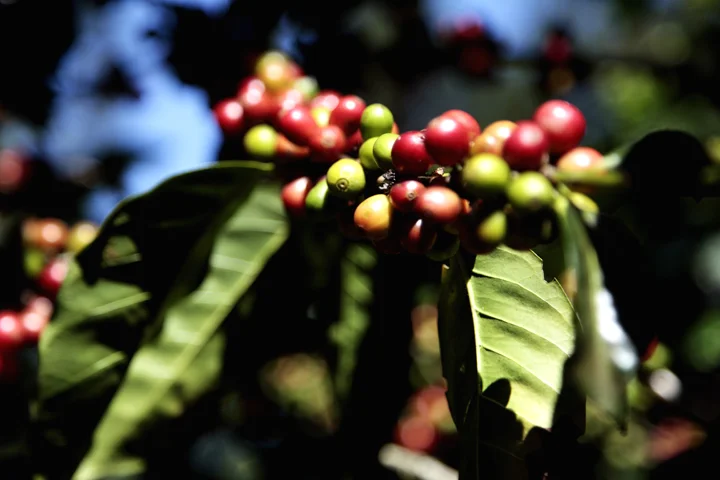
Combating Coffee Rust (Hemileia vastatrix)- Combatiendo la Roya
Combating Coffee Rust: Coffee Rust (Hemileia vastatrix) damages coffee leaves and leads to defoliation, and can seriously reduce yields. While chemical fungicides have been effective, they introduce dangers to human health and the environment. Naturally occurring hyperparasitic fungi do not present the same risks, and may be a more sustainable alternative.
Coffee Rust (Hemileia vastatrix) damages coffee leaves and leads to defoliation, and can seriously reduce yields. While chemical fungicides have been effective, they introduce dangers to human health and the environment. Naturally occurring hyperparasitic fungi do not present the same risks, and may be a more sustainable alternative. We studied two such parasites: Trichoderma asperellum and Lecanicillium lecanii. We compared the effects of the two fungi on rust-infected trees in a coffee plantation. Trees sprayed with L. lecanii experienced 50% fewer necrotic lesions and 40% less discoloration than those treated with T. asperellum. We also conducted a lab experiment where we applied each fungus directly on leaves infected with H. vastatrix and found that L. lecanii colonized 25% more leaves than T. asperellum. Our results indicate that L. lecanii controls rust infections more effectively than T. asperellum.
RESUMEN
La Roya (Hemileia vastatrix)
daña las hojas del café, lleva a la defoliación y puede reducir
considerablemente los rendimientos. Si bien los fungicidas químicos han sido
eficaces, introducen peligros para la salud humana y el medio ambiente.
Los hongos hiperparasíticos que ocurren naturalmente no presentan
los mismos riesgos, y puede ser una alternativa más sostenible. Estudiamos dos
de esos parásitos: Trichoderma
asperellum y Lecanicillium lecanii. Comparamos los efectos de los dos
hongos en plantas de café afectadas con roya. Los árboles rociados con L. lecanii experimentaron un menor aumentar de
lesiones necróticas(50%) y 40% menos decoloración de hojas que Trichoderma asperellum o
el control. También llevamos a cabo un experimento de laboratorio donde
aplicamos cada hongo directamente en hojas infectado con H. vastatrix, y encontramos que L. lecanii colonizó más hojas (25%) que T. asperellum. Nuestros
resultados indican que L.
lecanii controla las
infecciones de roya más eficazmente que T. asperellum.
BY:
Jonathan Martindill, University of California, Davis- Land, Air, and Water Resources
AND:
Sydney Fozard ,University of California, Santa Barbara -Ecology, Evolution, and Marine Biology
EAP Tropical Community Ecology, Spring 2013 -7 June 2013
For complete report write to/ Para el reporte completo escriban a: info@mvinstitute.org


