
Promoviendo el uso de plantas nativas - PRONATIVAS - Promoting native plant species
Las áreas boscosas presentan una gran diversidad en términos de composición, pero no debemos ni podemos olvidar de relacionar todas las áreas urbanas y rurales tanto privadas como públicas en las que el ser humano se desenvuelve, ligándolas respetuosamente con las áreas naturales del país y región.
--- Forested areas represent a large diversity when it comes to their composition, however we should not forget to relate all urban and rural areas, both public and private, in which humans exist, linking them in a respectful way with the natural areas of the country and region.

Diversas iniciativas a nivel nacional, regional y local hacen de este país un lugar privilegiado. Las áreas boscosas presentan una gran diversidad en términos de composición, pero no debemos ni podemos olvidar de relacionar todas las áreas urbanas y rurales tanto privadas como públicas en las que el ser humano se desenvuelve, ligándolas respetuosamente con las áreas naturales del país y región.
Se debe apoyar a la naturaleza como si misma, fuera de nuestro control absoluto e intentar entenderla un poco mejor, pero sobre todo se debe respetarla desde su base. Por lo que temas como el uso de especies nativas, la relación de las mismas con el entorno, el uso del agua para riego, la no extracción de plantas de los bosques, la adecuada utilización de métodos de reproducción de plantas nativas, la no utilización y eliminación de plantas no nativas-agresivas-problemáticas, son factores que forman parte de la base de esta organización: ProNativas, cuya misión es crear conciencia sobre estos y otros temas relativos.
Somos una organización sin fines de lucro que pretende educar a todas las personas en general sobre la importancia del uso y adecuada reproducción de especies de plantas nativas con carácter ornamental y su utilización en nuestras creaciones paisajísticas tanto de zonas urbanas y rurales como privadas y públicas. Todas estas creaciones que como individuos sociales debemos desarrollar buscando beneficios sensitivos, naturales y morales. Esto utilizando criterios sostenibles y respetuosos con el medio ambiente y todos sus componentes económicos, naturales y sociales.
Una iniciativa de la Bióloga local de la zona de Monteverde, Willow Zuchowski, autora de sendos libros relacionados con el tema y con una gran pasión y entrega bajo estos principios adoptados por la organización. Persona que junto con Lorenzo Vargas se han mantenido en pie de esfuerzo y lucha, de manera comprometida con la ideología de la organización.
Para mayor información puede acceder nuestra página web www.pronativascr.org en donde encontrará bastante información sobre el tema, igualmente contactarnos por correo electrónico (negrinif@gmail.com), o por teléfono directamente (8825-8424 cel: Felipe Negrini)
por: Felipe Negrini Sanjuan
ProNativas
*Nota de la editora:
Monteverde tiene dos viveros de Pronativas donde se reproducen las plantas nativas de manera sostenible, una en Bajo del Tigre (Bosque Eterno de los Niños) y una en el Instituto Monteverde. Si gustan plantas para sus jardines en la localidad de Monteverde pueden contactarse con Pronativas para coordinar.


The different and diverse initiatives that take place on a national, regional and local level allow this country to be a privileged one. Forested areas represent a large diversity when it comes to their composition, however we should not forget to relate all urban and rural areas, both public and private, in which humans exist, linking them in a respectful way with the natural areas of the country and region.
Nature should be supported as it is, out of our total control, and we should try to be more understanding of it, but above all, respect it as it is. This is why this organization’s mission, Pronativas, has to do with creating awareness on themes such as the use of native species of plants, the relationship they have with their surrounding areas, the use of water in plant irrigation, the non-extraction of plants from the forest, the adequate use of native plant reproduction, and the non-use and elimination of non-native aggressive plants.
We are a non-for-profit organization that aims to educate all people in general about the importance of the use and adequate reproduction of native plant species with ornamental potential and characteristics and their use in landscaping creations in urban and rural, private and public, areas. All these creations that as social individuals we should develop in looking for benefits that are sensitive, natural and ethical. This can be accomplished by using criteria that is sustainable and respectful with our environment and all its economical, natural and social components.
This is an initiative started by a biologist residing in the Monteverde zone, Willow Zuchowski, author of several books related to the subject, and with a great passion and dedication to these principles that have been adopted by the organization. She has, along the side of Lorenzo Vargas, struggled to maintain the ideology of the organization.
For more information you can visit our website www.pronativascr.org where you can get plenty of data on these themes, you can also reach us through e-mail (negrinif@gmail.com), or by telephone (506- 8825-8424 Felipe Negrini).
by: Felipe Negrini Sanjuan
ProNativas
*Note from the editor:
Monteverde has two Pronativas greenhouses where native plants are grown in a sustainable manner, one in Bajo de Tigre (Children’s Eternal Rainforest) and one at the Monteverde Institute. If you would like plants for gardens in the Monteverde area please contact Pronativas in order to coordinate.
Combating Coffee Rust (Hemileia vastatrix)- Combatiendo la Roya
Combating Coffee Rust: Coffee Rust (Hemileia vastatrix) damages coffee leaves and leads to defoliation, and can seriously reduce yields. While chemical fungicides have been effective, they introduce dangers to human health and the environment. Naturally occurring hyperparasitic fungi do not present the same risks, and may be a more sustainable alternative.
Coffee Rust (Hemileia vastatrix) damages coffee leaves and leads to defoliation, and can seriously reduce yields. While chemical fungicides have been effective, they introduce dangers to human health and the environment. Naturally occurring hyperparasitic fungi do not present the same risks, and may be a more sustainable alternative. We studied two such parasites: Trichoderma asperellum and Lecanicillium lecanii. We compared the effects of the two fungi on rust-infected trees in a coffee plantation. Trees sprayed with L. lecanii experienced 50% fewer necrotic lesions and 40% less discoloration than those treated with T. asperellum. We also conducted a lab experiment where we applied each fungus directly on leaves infected with H. vastatrix and found that L. lecanii colonized 25% more leaves than T. asperellum. Our results indicate that L. lecanii controls rust infections more effectively than T. asperellum.
RESUMEN
La Roya (Hemileia vastatrix)
daña las hojas del café, lleva a la defoliación y puede reducir
considerablemente los rendimientos. Si bien los fungicidas químicos han sido
eficaces, introducen peligros para la salud humana y el medio ambiente.
Los hongos hiperparasíticos que ocurren naturalmente no presentan
los mismos riesgos, y puede ser una alternativa más sostenible. Estudiamos dos
de esos parásitos: Trichoderma
asperellum y Lecanicillium lecanii. Comparamos los efectos de los dos
hongos en plantas de café afectadas con roya. Los árboles rociados con L. lecanii experimentaron un menor aumentar de
lesiones necróticas(50%) y 40% menos decoloración de hojas que Trichoderma asperellum o
el control. También llevamos a cabo un experimento de laboratorio donde
aplicamos cada hongo directamente en hojas infectado con H. vastatrix, y encontramos que L. lecanii colonizó más hojas (25%) que T. asperellum. Nuestros
resultados indican que L.
lecanii controla las
infecciones de roya más eficazmente que T. asperellum.
BY:
Jonathan Martindill, University of California, Davis- Land, Air, and Water Resources
AND:
Sydney Fozard ,University of California, Santa Barbara -Ecology, Evolution, and Marine Biology
EAP Tropical Community Ecology, Spring 2013 -7 June 2013
For complete report write to/ Para el reporte completo escriban a: info@mvinstitute.org


Hugelkultur in Monteverde
Hugelkulture in Monteverde guidelines.
We cannot talk about sustainability without including the fundamental theme of agriculture, growing that which we eat. With this in mind and with a great amount of effort form our students; the Monteverde Institute is testing different vegetable-garden types in our campus. So far we have an example of HugelKulture and a Keyhole garden in progress. Both of these projects follow sustainable guidelines and have their bases on Permaculture practices.
Here you can find a "how to" guideline built by one of our interns, Peter Wells.
Hugelkultur in Monteverde
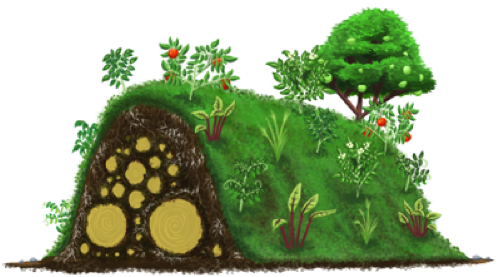
A Hugelkultur is raised bed that mimics forest decomposition. This technique is native to Austria where is has been used for hundreds for years, for more information on this system, research the work of Sepp Holzer and his Permaculture farm in the Alps. With good construction and adequate precipitation, a hugelkultur is a self sustaining system. With occasional maintenance, it requires no additional fertilizer, chemicals, irrigation, or tillage. Here is how to make one.

Sample of a Hugelkulture Garden

Start with a couple of large, rotting trees or logs as a base.

2 Pile smaller deadwood and branches on top. Let sit in rain or soak to help retain moisture.

3 Cover with compost (manure is a plus).

3.5 Cover the mound in good soil and finally, leaves or straw.

The mound can be any length and as high as two meters
This system 3 major functions:
It is a water reserve in times of drought.
It is a beneficial harbor for microbial, fungal, insect, and animal life.
It is a nutrient mine for the plants that grow on it and drastically improves soil health.
Peter Wells, 2013. Instituto Monteverde.
Video sustainable agriculture/ Video agricultura sostenible
Student project- Proyecto estudiantil
