
Salud Comunitaria 2018
El Programa de Salud Comunitaria, tiene la meta de motivar a las familias a producir o consumir lo que se produce localmente; e igualmente que las empresas y negocios compren y apoyen la producción de la zona de Monteverde.
The Community Health Program has the goal of motivating families to produce or consume what is produced locally; and also that companies and businesses buy and support the production of the Monteverde area.


¡Producir y comprar productos locales orgánicos, beneficia su salud!
El Programa de Salud Comunitaria, tiene la meta de motivar a las familias a producir o consumir lo que se produce localmente; e igualmente que las empresas y negocios compren y apoyen la producción de la zona de Monteverde. De esa manera podemos promover la producción sostenible que beneficia la salud de quienes consumimos estos productos, así como el ambiente y la economía de productores y negocios que venden alimentos de estas huertas orgánicas.
Alianza… En el 2018, avanzamos en alianza con Hotel Belmar se desarrollaron talleres de huertas orgánicas, impartidos por su experto en agricultura sostenible Gerardo Calderón, así como el apoyo de Richard Garro del Departamento de Sostenibilidad. Con estos talleres buscamos difundir el conocimiento, las técnicas y experiencias de agricultores y expertos/as, para que más y más personas-familias produzcan en sus huertas orgánicas. Es uno de los caminos para garantizar la seguridad alimenticia en el Distrito.

El año pasado ejecutamos seis talleres….
Mis primeros pasos en la producción de huertas caseras: como iniciar una huerta orgánica.
Creación de Huertas Caseras bio-Intensivas (tradicional- suelo)
Manejo de Desechos orgánicos por medio de compostaje: importancia de los micro organismos y proceso de preparación.
Huertas Orgánicas y Control de Plagas: abono foliar y bio-controladores orgánicos.
Creando Equilibrio: relación entre nutrición, salud de la planta y salud humana.
Gastronomia Sostenible: explorando diferentes maneras de preparar alimentos saludables y producidos localmente.
Algo de lo que Aprendimos:
“(…) Debemos cambiar un poco la mentalidad sobre quê entendemos como plagas y enfermedades antes de intervenir en una huerta, porque si queremos erradicar totalmente insectos que se alimenten o micro organismos que se alimenten de las plantas, vamos a tener una batalla casi que a muerte con la naturaleza, porque en la naturaleza debe existir todo y debe existir un equilibrio”. (Taller control de plagas y bio-controladores: Gerardo Calderón, Hotel Belmar)


Producing and buying organic local products, benefits your health!
The Community Health Program has the goal of motivating families to produce or consume locally; but also that our companies and businesses buy and support the production of the Monteverde area. In this way we can promote sustainable production that benefits the health of our families, the environment and the economy of producers and businesses that sell food from local organic gardens.
Alliance ... In 2018, we partnered with Hotel Belmar to provide a series of organic garden workshops. These were taught by the expert in sustainable agriculture, Gerardo Calderón, with support of Richard Garro of the Department of Sustainability. With these workshops we seek to spread the knowledge, techniques and experiences of farmers, so that more and more people-families produce organic vegetables in their gardens. It is one of the ways to ensure food safety in the District.

Last year we ejecuted six workshops ...
My first steps in the production of home gardens: how to start an organic garden.
Creation of Bio-Intensive Homegardens (traditional- soil)
Management of organic waste through composting: importance of micro organisms and preparation process.
Organic Vegetables and Pest Control: foliar fertilizer and organic bio-controllers.
Creating Balance: relationship between nutrition, plant health and human health.
Sustainable Gastronomy: exploring different ways to prepare healthy and locally produced foods.
Some of what we learned:
"(...) We must change our mentality about what we understand as pests and diseases before intervening in our gardens. If we want to completely eradicate insects or micro organisms that feed on plants, we are going to have a battle almost to death with nature. In nature, everything exists and must exist in balance ". (Pest control and bio-control workshop: Gerardo Calderón, Hotel Belmar)

VOLUNTARIOS TRABAJANDO EN SENDERO PACÍFICO
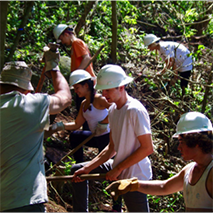
Así, estos jóvenes de entre 18 y 23 años estuvieron trabajando en conjunto con el Instituto Monteverde y la Asociación de Desarrollo Integral de San Luis en el mantenimiento del sendero Montecielo y la construcción de un sendero que conecta el Montecielo en forma de circuito (loop).
Solo en español (In Spanish only)
Por: Randy Chinchilla - Coordinador SIG y Reforestación del Instituto Monteverde
La Universidad Peppedine (Malibú, California) abrió sus puertas en 1937 con dos objetivos en mente: “Primero, la formación académica en las artes liberales; segundo, la de construir en el estudiante una vida como Cristo, un amor por la iglesia y una pasión por las almas de la humanidad ". En Pepperdine, el aprendizaje superior se alinea con un propósito superior. Al integrar el servicio, el culto y la responsabilidad social con un riguroso estudio académico, creamos una comunidad que nutre el corazón, el alma, la fortaleza y la mente.

Figura 1. Grupo de voluntarios de la Universidad Pepperdine. Fotografía de Nathaniel Scrimshaw. Febrero 2018.
Por segundo año consecutivo, 11 estudiantes de distintas carreras, liderados por Alexander Valenti decidieron aprovechar su semana de vacaciones de primavera (spring break) y viajar a Monteverde, CR a realizar trabajo un trabajo voluntario. El trabajo se realizó en uno de los senderos del proyecto Sendero Pacífico (Figura 1). El Sendero Pacífico es una red de senderos de acceso libre situados entre el bosque nuboso de Monteverde y el Golfo de Nicoya en el Corredor Biológico Pájaro Campana. Los senderos atraviesan una variedad de zonas ecológicas de vida, usos de suelo y comunidades. La visión del Sendero Pacífico es vincular los bosques y comunidades rurales a lo largo de la pendiente del Pacífico de Costa Rica.
Así, estos jóvenes de entre 18 y 23 años estuvieron trabajando en conjunto con el Instituto Monteverde y la Asociación de Desarrollo Integral de San Luis en el mantenimiento del sendero Montecielo y la construcción de un sendero que conecta el Montecielo en forma de circuito (loop). El coordinador del proyecto Nathaniel Scrimshaw, la voluntaria Rachel Cheatham y el local Danilo Garro orientaron a los estudiantes con las tareas que debían realizar; construcción de gradas o escalones y comenzar la construcción de un circuito que conecta con un mirador hacia el valle de San Luis y termina en el mismo sendero Montecielo.
El sendero Montecielo es de excursión, su función es facilitar el acceso de los visitantes a lugares que tengan un especial valor escénico o ecológico. Éstos deben estar muy bien diseñados —tanto en su trazado como en sus características técnicas— y señalizados de manera que sean seguros y no produzcan impactos negativos en el medio ambiente. El sendero requiere de gradas o escalones en varias secciones. Las gradas son usadas en pendientes fuertes o moderadas para proveer tracción y disminuir la erosión del suelo (Figura 2). Se construyeron un total de 21 nuevas gradas.


Figura 2. Elaboración de gradas en sendero Montecielo. Fotografía de Randy Chinchilla. Febrero 2018

Otra de las actividades consistió en trabajar el sendero nuevo en forma de loop del sendero Montecielo. Para ello, los voluntarios dedicaron tres días realizando movimientos de tierra con pico y pala, moviendo piedras, cortando raíces y aplanando el terreno. El trabajo fue exhaustivo y se logró avanzar hasta el mirador al valle de San Luis (Figura 3). Aproximadamente se trabajaron 500 metros siguiendo el contorno de la montaña. Cabe destacar que la pendiente aumentaba su inclinación conforme nos acercábamos al mirador (Figuras 3 y 4).


Figuras 3 y 4. Construcción de sendero nuevo hacia el mirador, sendero Montecielo. Fotografías por Nathaniel Scrimshaw.
El voluntario terminó realizando una caminata guiada por Rachel Cheatham y Daniela Quesada con el fin de que los estudiantes pudieran comprender el alcance del Sendero Pacífico y su importancia para la conservación y el desarrollo de las comunidades dentro del Corredor Biológico Pájaro Campana.
Participantes
Randy Chinchilla, coordinador IMV
Nathaniel Scrimshaw, coordinador Sendero Pacífico
Rachel Cheatham, ADI-SL
Danilo Garro, ADI-SL
Estudiantes:
Alex Valenti -Braden Ritchey- Channa Steinmetz- Gabrielle Lux -Hannah Robert- Holly Sullivan- Jeremiah Jones- Kylie Smith - Megan Offutt - Sydnie Greger- Tracie Loo

Fotografía por Daniela Quesada
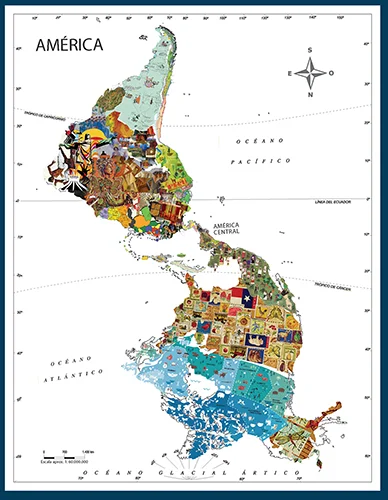
Seminario sobre Decolonialidad. ¿Pero qué es decolonialidad?
Cuando hablamos de decolonialidad, y esta es una palabra que se escucha cada vez más entre nosotros, queremos dar cuenta de una manera crítica de ser-pensar ante las estructuras heredadas del poder colonial.
Entrevista con Francisco Burgos:
Seminario sobre Decolonialidad.
¿Pero qué es decolonialidad?
¿Quién es Francisco Burgos?
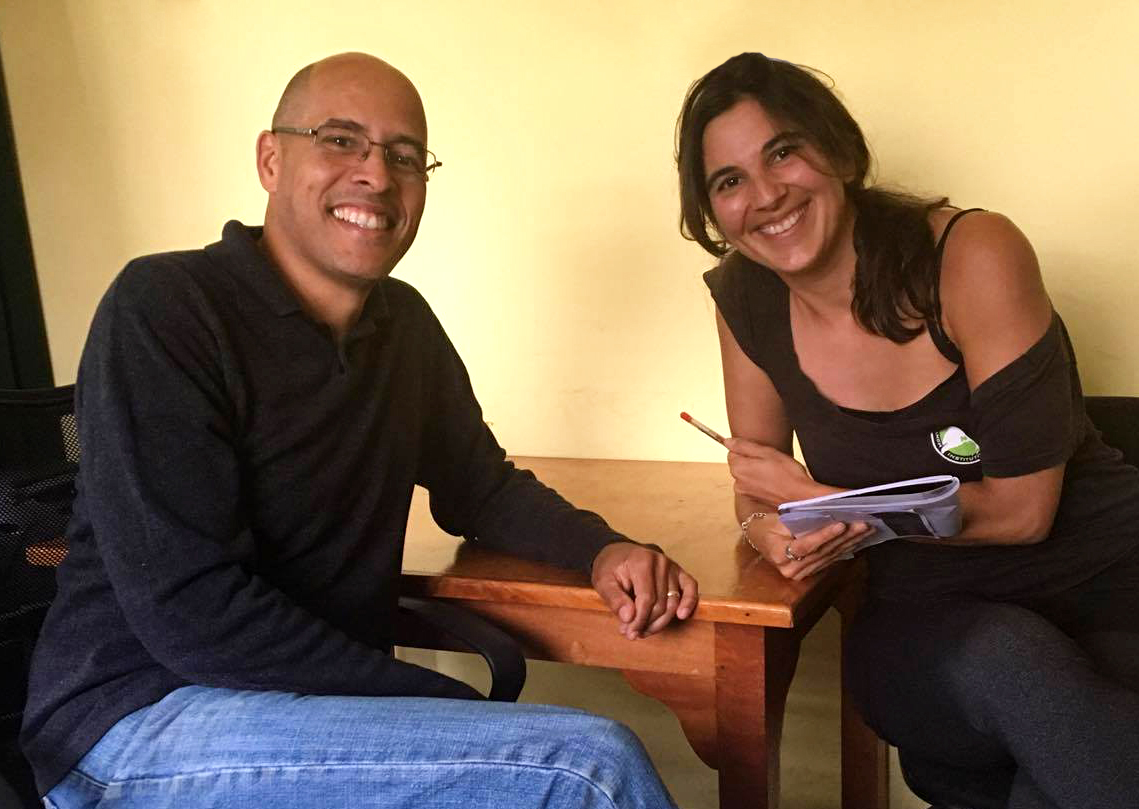
Entrevista de nuestra editora, Selena Avendaño, con Francisco Burgos director del CIC.
Francisco Burgos es el director del Centro de Iniciativas Comunitarias (CIC) del Instituto Monteverde (IMV). El CIC está orientado a la identificación e implementación de programas comunitarios de desarrollo local, abarcando las áreas de educación, recreación, estilos de vida saludables, intercambio cultural, ciencia ciudadana, sistema de información geográfica, entre otras.
Francisco, vive en Monteverde desde hace el 2012, posee un doctorado en educación y participa de diversos procesos colectivos en nuestra comunidad. Uno de sus más recientes proyectos consiste en organizar un seminario sobre decolonialidad en la zona de Monteverde, pero con un enfoque regional que trasciende las fronteras nacionales. Le hicimos una pequeña entrevista para aprender más sobre este proyecto.
¿Nos puede explicar un poco sobre qué es decolonialidad?
Cuando hablamos de decolonialidad, y esta es una palabra que se escucha cada vez más entre nosotros, queremos dar cuenta de una manera crítica de ser-pensar ante las estructuras heredadas del poder colonial. En tal sentido, la decolonialidad propone otra visión de mundo que es alternativa a la tan familiarizada visión construida sobre la clasificación racial, y donde ser europeo-anglosajón se contrapone con aire de superioridad a lo-no-europeo-anglosajón. Desde la decolonialidad entonces, se busca construir una nueva forma de relacionarnos con la vida, nuestra manera de conocer, de ser, de organizarnos, no para promover patrones caracterizados por vínculos de dominadores-dominados, sino para juntos y juntas articular e ir-siendo gestores del buen vivir. Esto desde la cotidianidad, en todo lo que nos toca y en todos nuestros vínculos con las demás personas y con la naturaleza.
¿Por qué cree que es importante hablar de esto hoy día?

Bueno, aquí hay mucho que decir. Pienso que, hoy más que nunca, se hace necesario abrirnos a descubrir quienes realmente somos, nuestro sentido de ser-estar en el mundo, nuestra historia y la manera en que queremos transformarla para asegurar un mundo de buena convivencia, ecológico y sustentable. Sé que esto suena muy soñador y quizás irrealizable, pues, cuando escuchamos las barbaridades en las que estamos inmersos como humanidad, el panorama resulta muy aterrador. Si uno piensa, por ejemplo, en los conflictos en medio oriente, en la creciente y rampante desigualdad económica, en la tragedia cotidiana de muchas personas que no tienen acceso a agua potable, a alimentación, a salud básica, a educación; en los conflictos de poder y represión que viven muchos de nuestros pueblos, así como en la gran voracidad del modelo socio-económico dominante; una pensaría que no hay razones para tener esperanza en la vida sobre este planeta. La decolonialidad es como un salvavidas que nos ayuda a mirar-sentir estas realidades de forma crítica. Al hacerlo, no montamos una queja absurda o diálogo entre sordos, sino que identificamos alternativas de resistencia, de construcción colectiva que van generando cambios significativos en la vida cotidiana. Estas alternativas promueven y articulan otras visiones del ser, del saber, del poder, de la naturaleza en la que se puede construir ese otro mundo posible y tan necesario. Es por eso que la decolonialidad tiene una vigencia esencial en nuestros días.
¿Por qué hacer el Seminario en Monteverde?
Existe una tendencia muy colonial, aunque mucha gente no necesariamente se da cuenta de ello, de realizar experiencias significativas para la creación de conocimientos desde los centros de dominio. Esto responde a la perspectiva del sistema-mundo, en la cual las decisiones sobre lo qué se debe saber, el cómo debemos ser, incluso cuáles valores son los que se deben vivir, son temas definidos por el ‘Norte global’, para usar una terminología familiar. Es decir, que quienes vivimos en el ‘Sur global’ somos simplemente definidos en todo lo que somos, hacemos y vivimos en base a los patrones que otros han decididos. Para ponerlo a nuestra escala, en nuestros pueblos todo se decide en las capitales, las cuales representan los centros de poder local como replicas de esa dinámica entre centro-periferia.
Nuestra intención al realizar el Seminario en Monteverde es apostar a la coherencia de promover y reconocer la construcción de saberes, no ya desde los centros de poder sino desde la periferia. Sé que hay mucho trabajo que hacer en este sentido, pues, los patrones coloniales están tan metidos en nosotros que se nos dificulta, por ejemplo, pensar que las cosas pueden ser de otra manera. Cuando digo esto, pienso en cosas muy concretas como la educación, las actividades económicas, culturales, entre muchas más.
Tener el Seminario en Monteverde es un primer paso para plantar semillas de diálogos en nuestras comunidades en torno a temas que, generalmente, se quedan por fuera en el debate público, pero que están presentes en nuestro diario vivir.
¿Cuáles son tus expectativas del Seminario?
Me gustaría ver que gente local aproveche y se sume a los lenguajeos que promueve el Seminario. Para facilitar esto, las instituciones organizadoras, entre ellas la Universidad Técnica Nacional, la Universidad de Costa Rica – Sede Pacífico, la Universidad La Salle, Prescott College y el Instituto Monteverde han ofrecido becas que aseguran la inclusión y diversidad entre quienes participan.
A la vez, espero que este sea un espacio que nos permita ir avanzando en la construcción de redes para bien de nuestras comunidades. Que nos ayude a pensar-actuar de manera íntegra y a afianzar valores de respeto, convivencia, sentido de pertenencia ecológica y cuidado mutuo, sin el fantasma tan presente de relaciones caracterizadas por la clasificación racial y patrones de poder patriarcales.
Finalmente, me gustaría que el Seminario sea una plataforma que fomente la curiosidad y la creatividad para responder a nuestras problemáticas cotidianas con sentido de pertenencia, con autonomía, pero una autonomía que se percibe y vive ligada en todo su sentido ecológico. Es decir, donde todo lo humano se vive como parte integral de la naturaleza.
Si quieren participar de la conferencia o tienen interés en ella favor de visitar: www.seminariodecolonialidad.com
Información del seminario, www.seminariodecolonialidad.com
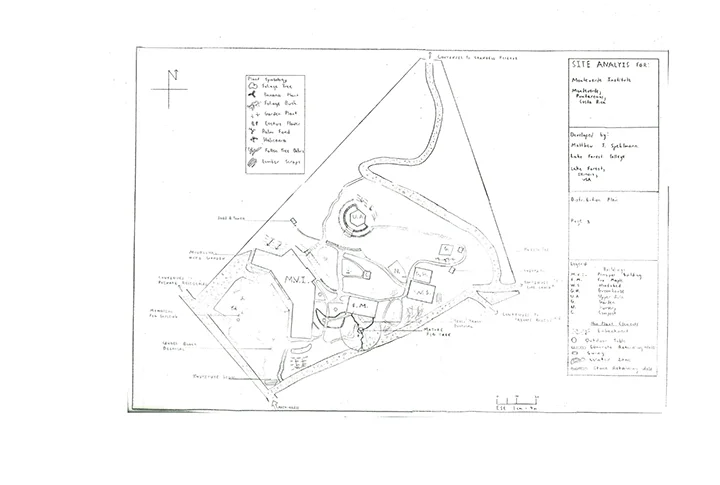
MASTER PLAN: EFFORTS TOWARD SUSTAINABLE LAND USE MVI
By: Matthew Spehlmann - Monteverde Institute
An internship courtesy of the Grace Elizabeth Groner Foundation in conjunction with Lake Forest College.
Abstract
The efficiency of land use on the Monteverde Institute grounds plays a significant role in the overall degree of sustainability of the Monteverde community at large. For this reason, creating a master plan to guide the use of land is of primary concern to Institute land users.
Introduction
Landscape architecture has taken on many definitions over the course of my internship. At its core, my internship has moved from obtaining information about the natural environment surrounding Monteverde, to gathering impressions of the Monteverde Institute from the nearby community, to plotting the infrastructural layout of the Institute grounds. All said and done, the purpose of my internship has been to get the ball rolling, to put it colloquially, in terms of efficient land use on the Institute grounds. The physical manifestation of this goal takes form as a landscape master plan.
The master plan serves as a guide for future projects that deal with land development on the Institute grounds. Essentially, Monteverde´s unique environment, input from the community regarding desired directions of land use on the Institute grounds, and personal analysis gleaned from the creation of an accurate distribution plan have been blended together into an end product that should be phenomenally helpful in coordinating land use projects on Institute grounds. Communication between different users of the Institute property based on an agreed upon representation of the property is a great step towards coordinated land use and, ultimately, efficient land use.
Study Area and Methods
Early in my internship, research on Monteverde´s unique natural environment was crucial in order to gain an appreciation of the land on which the Institute is situated. For instance, Nadkarni and Wheelwright´s (2000) text, Monteverde, provided ample insight into aspects such as climate, vegetation, soil characteristics as well as other elements pertinent to my eventual work regarding low-impact land use in the region. Furthermore, Wolf Guindon´s narrative, Walking with wolf, written by Chornook (2008) gave a story of man´s quest to live off of the land while leaving as light a footprint as possible. Together the two texts served to familiarize me with the atmosphere the Institute operated in: the Institute acts in some ways as a mediator in the struggle to preserve the extraordinary wildlife of the region while catering to a tourist demand that has negative impacts on the very environment that inspires the demand.
Points of interest at the MVI.
After acquainting myself to the dilemma faced by Monteverde and the surrounding communities, I took up pencil and paper and set out to meet face-to-face with different members of the community. The meetings were unofficial interviews in which I recorded the interviewees´ impressions of the Institute and its land use. Interviewees ranged from staff at the Institute to Quaker practitioners living as far as San Luis. At that point in my internship, I was more of a social architect, as the interviews served to construct a mental image of what the Institute was in the minds of the community.


With an understanding of where the Institute stood in terms of its physical location and with the community´s perception of the Institute in my mind, I began my work on the immediate property of the Institute campus. Armed with a tape measure I sent out among the campus taking note of the triangulated positions of every structure and feature that may be relevant to future projects. The process lasted weeks. Generally, I bounced from the office where I had a developing map draft on a large scale plan to the grounds where I would store measurement notes on a clip board to be transferred back to the office at a later point in time.
Finally, the required measurements were taken and the final step of formalizing the drafts went underway. My supervisor closely guided me along the way as we moved from border design to texturing elements such as gravel roads to adding special interest layers. It is the distribution plan with its special interest layers that provide the bulk of the end products.
Results
The product that has arisen out of my literature study constitutes a small portion of the overall end product. Essentially, I have condensed scientific and social literature down to the most relevant information regarding land use on Institute grounds. This boiling down of information is found in my final presentation PowerPoint. Furthermore, the pertinent information that I felt was necessary in introducing the land use predicament special to Monteverde contains reference pages to sections in texts that elaborate on a finer scale the environmental or social issue to which I refer to in the presentation. The inclusion of reference pages will help future special interest projects cut time on the research stage of their project.
Concerning the interviews, I have compiled many reports of how the Institute is seen by the community. Most of all, the interview reports serve as a checkup on how narrowly the Institute is conforming to its desired goal of being a sustainable voice in the area. The information from the reports has been charted several different ways. The analysis of the reports can be found in the discussion section.
However, the ultimate gift to the Institute resulting from my internship is the distribution plan and its subsequent layers. The distribution plan details the layout of the property, again complete with all elements pertinent to future land use projects. On top of the distribution plan can be placed four special interest layers (more layers can be drafted in order to analyze different aspects of the property that may become of interest when future projects are being considered). However, the four current layers detail access and circulation routes, water ways and flood zones, forest zones, and special features to the Institute that add character to the land while having minimal impact.
These maps will be the first maps that accurately communicate where land use has occurred and potential areas for future land use. Due to this, interns, workers, the community, and any other party interested in the lands on the Institute grounds will share the same understanding of the property on which the Institute is situated. The implications of the final products gain significance upon the review of a trained eye.
Discussion
Upon analysis of the interview reports, I found that the community desires that the Institute serve as a recreation center that emphasizes the nature present in Monteverde. As a recreation center, the Institute would provide the community with a space for activities as well as down-time pursuits such as chatting or reading. Most of the members of the community I spoke with were older and thus recognized that it will be the younger generation who will soon be responsible for staying committed to sustainability. Due to this, members expressed a palpable hope that drawing the community onto the Institute campus will inspire a respect for the land in the youth of the region.
At first glance of the Institute maps, one might simply locate herself according to the other features of the property. Though maps serve to locate and contextualize the user according to her immediate location, the maps and ensuing analysis serve a larger purpose. Efforts towards sustainable land use can be significantly more efficient when users of the land share a common goal for subsequent land use. There have been several projects carried out by single groups of interns only to be neglected when the interns leave the Institute. The land used is then neglected as well and left to future interns to deal with wondering how to convert the land to their specific needs. Instead of having discordant users develop parcels of land for their select interest, an accurate map can serve to coordinate land use over the long run ensuring at the least a consistent use of land.
The Institute is a gem in terms of property value. The difficulty in maintaining the gleam of the gem results from a population of users that sees the land as per select members´ individual, current interests. What belies sustainability is jumbled land use due to failures of carrying out long term visions. I mentioned this master plan was a way of getting the ball rolling in a sustainable direction. Yet, like past projects, the biggest threat to the success of this project is the lack of follow-through by a future intern. The ball may be rolling, but the friction of noncompliance has been a formidable force.
Acknowledgements
Necessary to thank for this opportunity is the Grace Elizabeth Groner Foundation. Without their funding and oversight, this internship opportunity would not have been possible. The Foundation´s association with Lake Forest College enabled my participation in this internship.
Furthermore, the direct supervision of primary coordinators Ashley Gora and Felipe Negrini required hours of time and a bundle of patience in mending my mind from an economic orientation to one of a landscape architect´s. I would like to thank them for their support over the course of my research.
The Monteverde Institute, the community of Santa Elena and nearby towns, and all others who I cannot name person by person deserve my thanks, as they were extremely open and accommodating to the needs of my internship. It was a pleasure to have met those with whom I worked.
References
Chornook, K., & Guindon, W. (2008). Walking with wolf. Canada: Wandering Words Press.
Nadkarni, N., & Wheelwright, N. (2000). Monteverde. New York: Oxford University Press.

AN ANNOTATED BIBLIOGRAPHY OF CURRENT WRITING ON PUBLIC HEALTH ISSUES IN CONFRONTING CHAGAS DISEASE
AN ANNOTATED BIBLIOGRAPHY OF CURRENT WRITING ON PUBLIC HEALTH ISSUES IN CONFRONTING CHAGAS DISEASE
Prepared by the Students in the Goucher-Mt. Holyoke Course on Human Health and Development in the Tropics, April 9, 2014
Prepared by the Students in the Goucher-Mt. Holyoke Course on Human Health and Development in the Tropics, April 9, 2014
To see the document please follow this link:
AN ANNOTATED BIBLIOGRAPHY OF CURRENT WRITING ON PUBLIC HEALTH ISSUES IN CONFRONTING CHAGAS DISEASE I
Para información sobre el CHAGAS en español favor visitar Información sobre Chagas en Radio Comunitaria Monteverde. Gracias.


You can follow the website posted above and also check out the slides by clicking on them.
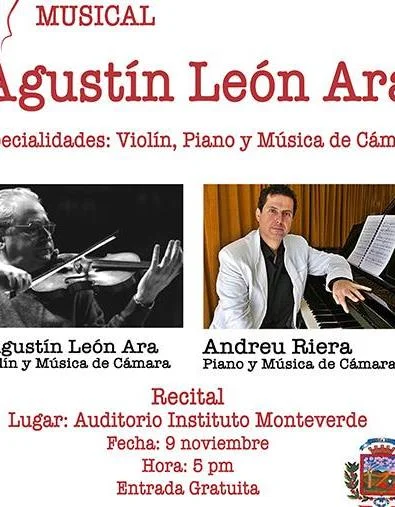
Recital Agustín León Ara
Recital de música en el Instituto Monteverde conAgustín León Ara y Andreu Riera.
En el mes de noviembre en Costa Rica se va a dar un Curso de Interpretación Musical dirigido por el gran Agustín León Ara y con la participación de Andreu Riera. Tenemos el honor de ser anfitriones en el Instituto Monteverde de una parte de este curso y de tener un recital abierto a la comunidad con estos maravillosos músicos. Los invitamos a que disfruten de esta buena oportunidad. Please scroll down to see the full biographies.
Enlish: This November in Costa Rica there will be a Workshop on Musical Interpretation given by Augustín León Ara with the participation of Andreu Riera. We have the great honor of hosting here at the Monteverde Institute a part of this course and of having a public recital with these wonderful musicians. We invite you to enjoy of this great opportunity. Favor leer más abajo para las biografías completas, gracias.

Augustín León Ara bio:
Español:
Agustín León Ara nace en Santa Cruz de Tenerife donde comienza sus estudios musicales con sus padres en el Conservatorio de dicha ciudad. Continúa en el Royal College of Music de Londres con Albert Sammons, Cecil Aronowitz y Alan Loveday, y después en el Conservatorio de Bruselas con André Gertler y Louis Poulet.
Laureado en los concursos internacionales de Darmstadt de música contemporánea, Henri Wieniawski de Polonia y Reina Elisabeth de Bélgica, León Ara pronto inicia una brillante carrera internacional que se desarrolla en toda Europa, Sudamérica, Estados Unidos y Japón,colaborando como solista con prestigiosas orquestas y bajo la dirección de los más eminentes maestros.
Diversos y destacados compositores contemporáneos le han dedicado sus obras, como Joaquín Rodrigo, Luis de Pablo, Grazyna Bacewicz, Tomás Marco, Albert Amargós.
León Ara desarrolla una intensa actividad como pedagógica además de concertista internacional. La labor pedagógica de Agustín León Ara constituye una de las más importantes aportaciones a la formación de músicos en España y en el Extranjero. Ha sido profesor de violín en los Conservatorios de Bruselas y Municipal de Barcelona, en la Chapelle Musicale Reine Elisabeth de Bélgica, de la Joven Orquesta Nacional de España, en la Escola Superior de Música de Catalunya y en el Conservatorio Superior de las Islas Baleares. Es invitado frecuentemente en diversos cursos en España y en el extranjero. Actualmente es director y profesor de los cursos "Música en Compostela".
Coronando su brillante y versátil carrera como maestro y solista, es intérprete de música de cámara, género que cultiva ampliamente formando en un principio dúo con la brillante y malograda pianista Rosa Sabater, y después con José Tordesillas, Graham Jackson y Albert Attenelle. En 1994 León Ara crea la Orquesta de Cámara Joaquín Rodrigo, siendo concertino-director.
Ha hecho interesantes grabaciones discográficas para DECCA, ARIOLA, EMI, PHONIC, CPO, y PHILIPS, entre las que destacan la integral para violín y piano de Joaquín Rodrigo, el Concierto de Estío con la London Symphony Orchestra, Cançoneta con la Academy of St. Martins in the Fields. Con la Orquesta Joaquín Rodrigo ha grabado programas monográficos del mismo autor, Rodrigo, para EMI y para JVC (Japón). En 2003, para el sello discográfico COLUMNA MUSICA ha grabado, junto con Albert Attenelle un interesante programa de sonatas de compositores españoles.
Entre las numerosas distinciones de que ha sido objeto cabe citar: Medalla de la Fundación "Eugène Isaye" de Bélgica, Miembro Numerario de la Real Academia de Bellas Artes de San Fernando, Madrid, Miembro correspondiente de la Academia de Bellas Artes de San Miguel, Tenerife, Medalla de Oro de la Isla de Tenerife, y el Premio Larios a la interpretación musical otorgado por su contribución a la difusión mundial de la música española y su fecunda labor pedagógica como creador de una personal escuela.
English:
León Ara was born in Santa Cruz de Tenerife where he started his musical studies with his parents in the Santa Cruz Conservatory. He continued his studies at the Royal College of Music in London with Albert Sammons, Cecil Aronwitz and Alan Loveday, and later at the Brussels Conservatory with Andre Gertler and Louis Poulet.
A recipient of multiple awards from international music festivals, including the Darmstadt contemporary music festival, the Henryk Wieniawski violin competition and the Queen Elisabeth Music Competition, León Ara soon started a brilliant international career that he pursued throughout Europe, South America, the United States and Japan, playing as a soloist in prestigious orchestras and under the direction of the most eminent maestros.
Diverse and prominent composers have dedicated their works to him, such as Joaquín Rodrigo, Luis de Pablo, Grazyna Bacewicz, Tomás Marco and Albert Amargós.
As well as being an international performer, León Ara dedicates a great deal of time to teaching. The pedagogical work of Augustín León Ara constitutes one of the most important contributions to the training of musicians in Spain and abroad. He has been a violin professor at the Brussels Conservatory and the Municipal Conservatory of Barcelona, the Chapelle Musicale Reine Elisabeth in Belgium, the Spanish National Youth Orchestra, the Superior School of Music of Cataluña and in the Superior Conservatory of the Balearic Islands. He is a frequent guest of various courses in Spain and abroad. He is currently the director and professor of the “Music in Compostela” workshops.
Crowning his brilliant and versatile career as a maestro and soloist, is his prodigious history with chamber music, initially forming a duo with the brilliant Spanish pianist Rosa Sabater, and later with José Tordesillas, Graham Jackson and Albert Attenelle. In 1994 León Ara created the Joaquín Rodrigo Chamber Music Orchestra, as performer and director.
He has made recordings for DECCA, ARIOLA, EMI, PHONIC, CPO and PHILIPS, notably including the uncut version for violin and piano with Joaquín Rodrigo, the Summer Concert with the London Symphonic Orchestra, and Cançoneta with the Academy of St. Martins in the Fields. With the Joaquín Rodrigo Orchestra he has recorded monographic programs of the same author, Rodrigo, for EMI and JVC (Japan). In 2003 he recorded, along with Albert Attenelle, an interesting program of sonatas by Spanish composers for the COLUMNA MUSICA recording label.
His numerous distinctions include the medal of the Belgian "Eugène Isaye" Foundation; life-long member of the Real Academia de Bellas Artes de San Fernando, Madrid; Member of the Academia de Bellas Artes de San Miguel, Tenerife; Golden Medal of the Island of Tenerife; and the Larios Prize for musical interpretation granted for his contribution to the worldwide diffusion of Spanish music and for his fruitful pedagogical labors.

Andreu Riera bio:
Español:
Andreu Riera es uno de los pianistas españoles más significativos y destacados de su generación. Nace en Manacor, Mallorca. Empieza sus estudios musicales en la Escolanía de Lluc cantando con los famosos “Blauets”, bajo la dirección de su primer guía musical, el Padre Jaume Palou. Después regresa a su ciudad natal, Manacor, donde inicia seriamente sus estudios pianísticos con la pedagoga Concepció Vadell, obteniendo el primer premio de fin de grado medio en el concurso del Conservatori Professional de Palma. Seguidamente se traslada a Madrid donde realiza sus estudios superiores en el Real Conservatorio Superior de Música con la catedrática Mª Ángeles Rentería, ganando los primeros premios fin de carrera de piano y música de cámara. Posteriormente se dirige a Viena, donde perfecciona su formación con el eminente profesor Hans Graf en la Höchschule für Musik. Finalmente se traslasda a Londres, donde finaliza sus estudios con la profesora Edith Vogel en la Guildhall School of Music and Drama. Asimismo recibe importantes consejos y clases magistrales de grandes maestros como: Dmitry Bashkirov, Vlado Perlemuter, Monique Deschausses, Mtislav Rostropovich, José Luis García, Ramón Coll, Manuel Carra, etc.
Riera ha ganado importantes Concursos Nacionales de Piano en España como el Infanta Cristina (Madrid), Caja Postal, Premio Alonso de Valencia; e Internacionales, como el Frederic Mompou (Barcelona), Jacinto Guerrero y el Concurso Mozart, Mozarteum de Salzburg.
Andreu Riera ha realizado conciertos prácticamente en toda España así como en Italia, Austria, Francia, Suiza, Alemania, Finlandia, Reino Unido, Estados Unidos, Canadá y Australia, destacando su gran versatilidad tocando en recitales de piano, conciertos de música de cámara, acompañando cantantes, de solista-concertante con orquesta e incluso últimamente en recitales combinados de música y poesía y música y teatro.
Ha actuado en importantes festivales como el de Palma (Serenates d’Estiu i Bellver), Artá, Torroella de Montgrí, Santa Cristina de Aro, Valencia, Festival Contemporaneo de Tenerife, Granada, Ópus Última de Madrid, Alicante, Pórtico do Paraíso de Ourense, Mozarteum de Salzburg, Grandes Maestros de Santander, Comunidad Europea de Venecia, Bath (Inglaterra), Colorado Springs (EUA); y en importantes salas de concierto como el Palau de la Música de Barcelona, Auditorio Nacional de Madrid, Palacio de Festivales de Santander, Auditorio Manuel de Falla de Granada, Elesbash Hall City of New York University, Teatro Manzoni de Milán, Teatro Sixtina de Roma, Palazzo Labbia de Venecia, Bridgewater Hall de Manchester, St. James Picadilly de Londres, Lincoln Centre de Nueva York, etc.
Además Riera ha formado parte del grupo de cámara “Manon” junto con Amparo Lacruz, Víctor Ambroa y José Luis Estelles, con el cual ha realizado numerosas giras de conciertos por España, Francia, Italia, Austria, Alemania, Inglaterra y USA, así como la grabación de dos CD: el Cuarteto para el fin de los tiempos de O. Messiaen, y uno de música contemporanea catalana (J. Guinjoan, B. Casablancas, J. Soler). También ha realizado grabaciones para la RTVE, la RAI de Italia y Radio France de París. Actualmente colabora regularmente con formaciones de cámara como el Image Ensemble o el Trío Kandinsky con el que ha actuado en el Festival Internacional de Granada 2008, concierto retransmitido en directo por el canal de televisión francés “Mezzo”. Es también colaborador asiduo de la formación coral de cámara “Studium Aureum” actuando regularmente en sus temporadas musicales.
Como solista, Andreu Riera ha actuado con diferentes orquestas: Camerata de Llevant, Orquestra de Cambra Ciutat de Manacor, Sinfónica de Balears “Ciutat de Palma”, Sinfónica de Sevilla, Ciudad de Granada, Nacional de Andorra, Sinfónica de Málaga, JONDE, Orquesta de Cámara “Andrés Segovia”, Kuopio Symphony, New American Chamber Orchestra, Colorado Springs Festival Orchestra, Montreal Chamber Players.
Ha formado parte del jurado del Concurso Internacional de Piano "Vila de Capdepera" y del Concurso Nacional “Jacinto Guerrero” de Toledo.
Asimismo ha estrenado obras de compositores contemporaneos como Josep Soler, Josep Prohens, Antoni Parera Fons, Xavier Gelabert, Xavier Prohens, Pare Antoni Martorell, Benet Casablancas, José Luis Turina, Antón García Abril, Joan Valent, etc.
En su actividad docente, ha impartido clases en cursos de verano como el de Guardamar del Segura (Alicante) y Quintanar de la Orden (Toledo).
Destacan sus últimos discos: "Elements", con música de Josep Prohens; "Piano Promenade" y "Música i Mots", producidos por Antoni Parera Fons; "Vora Mar", con música de Rafael Aguiló y producido por Joan Bibiloni; "Syrinx" y "Kaiassa", éste último para el sello Deustche Grammophon.
Actualmente es profesor titular del Conservatorio Superior de Música de las Islas Baleares, Presidente de la Comisión Artística de la Orquesta Sinfónica de las Islas Baleares y Director Artístico del Festival de Música de Cámara de Cala Morlanda, en Mallorca. Cabe destacar su reciente actuación en el Elesbash Hall de la University of the City of New York, estrenando la obra para Piano solo “Mentum” del compositor Antonio Parera Fons, con gran éxito, así como el ciclo integral de las polonesas de F. Chopin en el Palacio de Festivales de Santander durante el año Chopin 2010. Entre sus importantes últimas actuaciones del 2011 destacan el concierto en Nueva York con el Perspectives Ensemble, y en el Festival Pro Bono Musicae de Bielsko-Biala en Polonia. En el 2012 ha actuado en el Festival Pórtico do Paraiso de Orense, en el Petit Palau de la Música de Barcelona, interpretando con la Orquesta Nacional de Andorra con su concertino-director Gerard Claret, el Concierto nº 14 de W.A. Mozart, en la Fira Internacional World Classical Music de Verona, Italia, y en el Festival Internacional de Canto Coral de Nancy, Francia, Recital en Dinamarca y en la Sala Mendelssohn-Remise de Berlín. En Abril de 2013 ha tocado como solista con la John Hopkins Symphony Orchestra de Baltimore, USA.
English:
Andreu Riera is one of the most significant and outstanding Spanish pianists of his generation. Born in Manacor, Mallorca, his studies began in the Escolanía de Lluc, singing the famous “Blauets” under the instruction of his first musical mentor, Father Jaume Palou. He then returned to his native town, Manacor, where he began formal musical instruction with the teacher Concepción Vadell, winning first place at the end of the middle grade in the Conservatori Professional de Palma competition. Moving to Madrid, he completed his higher education at the Real Conservatorio Superior de Música with the professor Mª Ángeles Rentería, winning the piano and chamber music prizes on graduating. He later moved to Vienna, where he perfected his training with the eminent professor Hans Graf in the Höchschule für Musik. Finally in London, he culminated his studies with the professor Edith Vogel at the Guildhall School of Music and Drama. He also received important advice and classes from majestic maestros such as: Dmitry Bashkirov, Vlado Perlemuter, Monique Deschausses, Mtislav Rostropovich, José Luis García, Ramón Coll and Manuel Carra.
Riera has won major national piano contests in Spain such as the Infanta Cristina (Madrid), Caja Postal, Premio Alonso de Valencia; and international prizes including the Frederic Mompou (Barcelona), Jacinto Guerrero and the Mozart Contest, Mozarteum de Salzburg.
Andreu Riera has performed concerts throughout most of Spain as well as in Italy, Austria, France, Switzerland, Germany, Finland, the United Kingdom, Canada and Australia, highlighting his great versatility in playing at piano recitals, chamber music concerts, accompanying singers, as a soloist with an orchestra and even recently in combined music and poetry or music and theatre recitals.
Riera has performed in important Festivals such as the Palma (Serenates d’Estiu i Bellver), Artá, Torroella of Montgrí, Santa Cristina of Aro, Valencia, Contemporary Festival of Tenerife, Granada, Ópus Última of Madrid, Alicante, Pórtico do Paraíso de Ourense, Mozarteum of Salzburg, Great Maestros de Santander, European Community of Venice, Bath (UK), Colorado Springs (USA); and in important concert chambers such as the Palau of Music of Barcelona, National Auditorium of Madrid, the Santander Palacio de Festivales, Manuel de Falla de Granada Auditorium, Elesbash Hall City of New York University, Teatro Manzoni of Milán, Sixtine theatre in Rome, Palazzo Labbia in Venice, Bridgewater Hall in Manchester, St. James Picadilly in London, Lincoln Centre in New York.
Riera has also been a part of the chamber musical group “Manon” along with Amparo Lacruz, Víctor Ambroa and José Luis Estelles, with whom he has undertaken many tours throughout Spain, France, Italy, Austria, Germany, England and the U.S.A., as well as recording two albums: The Quartet for the End of Times by O. Messiaen, and one of contemporary Catalan music (J. Guinjoan, B. Casablancas, J. Soler). He has also recorded for RTVE, RAI Italia and Radio France. He is currently a regular player with chamber music ensembles such as the Image Ensemble or the Kandinsky Trio, with which he has performed in the International Festival of Granada 2008, a concert that was broadcast live by the French television station “Mezzo”. He is also a tireless collaborator with the chamber choir “Studium Aureum”, performing regularly in their musical seasons.
He has collaborated with other soloists such as Ara Malikian, Joan Enric Lluna, Isabel Rey, Josep Francesc Palou, José Luis García, Kim Scholes, Gerard Claret, Jesse Levine, Vartan Manoogian, Lucero Tena, Lluís Sintes, Maria del Mar Bonet, and chamber music groups such as the Leonor quartet.
As a soloist Andreu Riera has performed with a variety of orchestras: Camerata de Llevant, Orquestra de Cambra Ciutat de Manacor, Sinfónica de Balears “Ciutat de Palma”, Sinfónica de Sevilla, Ciudad de Granada, Nacional de Andorra, Sinfónica de Málaga, JONDE, Orquesta de Cámara “Andrés Segovia”, Kuopio Symphony, New American Chamber Orchestra, Colorado Springs Festival Orchestra and the Montreal Chamber Players.
He has been a member of the jury for the "Vila de Capdepera" International Piano Contest and the “Jacinto Guerrero” Spanish Competition in Toledo.
He has also premiered works from contemporary composers such as Josep Soler, Josep Prohens, Antoni Parera Fons, Xavier Gelabert, Xavier Prohens, Pare Antoni Martorell, Benet Casablancas, José Luis Turina, Antón García Abril and Joan Valent.
As part of his dedication to teaching, he has given summer workshops including the Guardamar del Segura (Alicante) and the Quintanar de la Orden (Toledo), both in Spain.
Among his most recent recordings, the following stand out: "Elements", with music of Josep Prohens; "Piano Promenade" and "Música i Mots", produced by Antoni Parera Fons; "Vora Mar", with music of Rafael Aguiló and produced by Joan Bibiloni; "Syrinx" and "Kaiassa", the latter for Deustche Grammophon.
Currently he is a titled professor for the Superior Conservatory of Music of the Balearic Islands, President of the Artistic Commission of the Symphonic Orchestra of the Balearic Islands and Artistic Director of the Cala Morlanda Chamber Music Festival in Mallorca. He also had a recent performance in the Elesbash Hall in the University of the City of New York, releasing the piano solo “Mentum” by the composer Antonio Parera Fons, with great success, as well as the uncut cycle from the Polishes of F. Chopin in the Palace of Festivities of Santander during the Chopin year 2010. His stand-out performances of 2011 include the concert in New York with the Perspectives Ensemble, and the Pro Bono Musical of Bielsko-Biala in Poland. En 2012 he performed in the Portico do Paraise de Orense Festival, in the Petit Palau of the Barcelonan Music interpreted with the National Orchestra of Andora with their director Gerard Claret, the Concert nº 14 of W.A. Mozart in the World Classical Music of Verona International Fair, and the Canto Caral de Nancy International Festival in France, The Recital in Denmark and in the Mendelssohn-Remise Chamber in Berlin. On April 2013 he performed as a soloist with the John Hopkins Symphony Orchestra of Baltimore, USA.
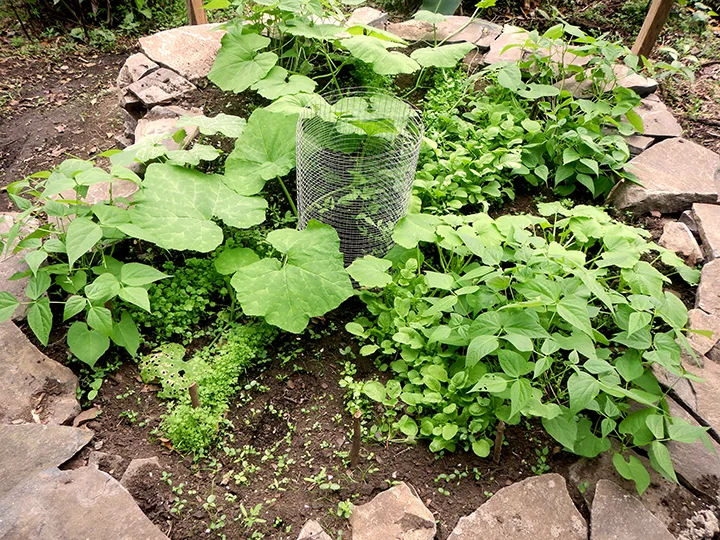
Keyhole Garden- Jardín Ojo de Herradura-Costa Rica.
Manual on how to make a KeyHole garden in the tropics. This is a high yielding agricultural system.---Manual de como hacer una huerta Keyhole en zonas lluviosas.
Keyhole Garden a la Tica: Organic and Sustainable
Sara Arias, Emily Bissett, Constanza Carney, Lillie Dao, Alejandro Garcia, Zuhra Malik
Globalization and Community Health Field School National Science Foundation REU Program University of South Florida
Monteverde Institute
Monteverde, Costa Rica May 29 – August 3, 2013
Adaptación de Keyhole para Latinoamérica en lugar lluvioso. --- Keyhole adaptation to rainy area in Latin America, this is a printable brochure.
Side one of the brochure on hoy to make a keyhole.
Side two of the brochure on how to make the keyhole.


RECOMMENDATIONS
Keyhole Construction Recommendations and Alternatives
Although the exterior of both Monteverde Institute demonstration keyhole gardens were constructed using large stones, there are many other feasible alternatives. These materials were used due to greatest availability to the Institute. Other potential exterior materials suggested by community advisors include recycled materials (glass bottles, tires), lamina roofing material, cinderblocks, or bamboo/sticks.
The layers may also be varied depending upon what is most readily available to the household or organization constructing the garden. Many other kinds of manure, such as goat, rabbit, or cow, may be used instead of chicken manure and/or coffee shells. Limestone can be easily substituted for ash because both materials maintain the neutral balance of the soil and compost pH. Finally, as recommended by several focus group participants, dry leaves can be substituted for rice shells (gransa de arroz) depending upon what is accessible.
Additionally, many other materials, specifically recycled resources, may be implemented to facilitate drainage. Focus group members and community advisors proposed several drainage items options that included halved tires, inverted plastic crates, inverted plastic bottles, and bamboo shoots. These materials, especially used tires and plastic bottles, may require further research to ensure that they are safe for food production use.
Finally, much debate was raised with regard to the roof construction. Several focus group and interview participants stated that saran was the ideal material, while other members supported the use of clear greenhouse plastic. Either of these materials could be used to form the roof. Furthermore, the roof could incorporate covered sides, though this is not required. Each of these alternative materials could be incorporated in a future experimental research garden. Local community members who decide to create their own keyhole garden could also integrate these alternative materials.
For more information please write to us at info@mvinstitute.org.
----------------------------------------------------------------------------------------------------------------------------------
Ventajas jardín Ojo de Herradura:
Producción intensiva en espacio pequeño, tiene periodo de 5 años antes de volver a cambiar los sustratos, es relajante-terapeutico y tiene diseño universal, por ello es adecuado para personas adultas mayores, personas con discapacidad o mujeres embarazadas.
Green walkways/ Aceras verdes
This project consistes on making green-paths as sidewalks from the gas station in Cerro Plano to Monteverde and was donde by the Sustainable Futures program of the Monteverde Institute along with the, Government counsel and neighbors. The Goucher and Mt. Holyoke program also colaborated on the construction. /
Proyecto de aceras verdes del Programa de Futuros Sostenibles del Instituto Monteverde en conjunto con el Consejo de Distrito de Monteverde y vecinos de la zona, este trayecto va desde la Gasolinera en Cerro Plano hasta Monteverde. El programa de Goucher y Mt. Holyoke también ayudaron con el proyecto.