
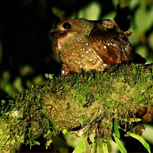
Rastreos del Pájaro Aceite (Steatornis caripensis, Steatornitidae) en Costa Rica - Lifetracks Oilbird, Costa Rica.
RASTREOS DEL PÁJARO ACEITE (STEATORNIS CARIPENSIS, STEATORNITIDAE) EN COSTARICA - LIFETRACKS OILBIRD, COSTA RICA
- Siga los pasos por Costa Rica del único pájaro volador con ecolocación que come frutas. --- Follow the footsteps through Costa Rica of the only flying bird that feeds off of fruits that also has echolocation.

Rastreos del Pájaro Aceite (Steatornis caripensis, Steatornitidae) en Costa Rica.
by:
David A. Rodríguez 1,2

1Guía Naturalista, egresado de la Universidad Técnica Nacional.
2Biólogo con énfasis en Ecología y Desarrollo Sostenible,
Universidad Latina de Costa Rica.
chiroxiphia@hotmail.com
El Guácharo (Steatornis caripensis) es una de las 918 especies de aves que se han registrado en Costa Rica (Garrigues et al, 2017), es una especie monotípica ya que es la única en su familia. Aunque esta familia, Steatornitidae, se encuentra emparentada con la familia Nyctibiidae y Caprimulgidae, se diferencia en muchos aspectos de los otros miebros del orden Caprimulgiformes, donde están clasificadas estas familias (Stiles y Skucth, 1989). En la más reciente actualización, la Auk (2016) coloca a esta ave en un orden propio, por lo que se logró determinar que difiere mucho de la taxonomía donde estuvo clasificado. En este nuevo orden, Steatornithiformes solo permanece el único ancestro que se a encontró en Wyoming, Pferica nivea (Olson, 1987).
Esta ave se encuentra en Guyana, Trinidad, Venezuela, Colombia, Ecuador, Perú y Bolivia, con algunos registros esporádicos en Centro América (del Risco y Echeverri, 2011).

Fig. 1. Distribución del Guácharo (Steatornis caripensis). Tomado de: http://neotropical.birds.cornell.edu/portal/species/distribution?p_p_spp=223931
Los registros del S. caripensis en Costa Rica han venido aumentando desde el 2009, gracias a la información recopilada se a determinado que esta especie viene a Costa Rica entre los meses de junio a setiembre. Sin los datos que puedan haber en el Museo de Historia Natural de la Universidad de CostaRica y dos otras observaciones que no se tiene claro las fechas en que se registraron, estos son los lugares y los años en que se ha registrado el S. caripensis en Costa Rica:
1.Milla Mills, 1986
2.Rara Avis (sin información del año)
3.Monteverde, 2010-2013-2016
4.Mirador de Quetzales, 2012
5.Turrialba, 2013
6.P.N. Volcán Tenorio, 2013
7.Barrio Luján, San José, 2013
8.Parque Internacional La Amistad (PILA), 2014
9.Corcovado, 2015
10. P.N. Rincón de La Vieja, 2015
11. Santa Rosa, Piedras Blancas, 2015
Datos obtenidos de: Stiles y Skutch 1989, Bolaños Redondo et al 2015, eBird 2017. Además de comunicaciones personales por parte de funcionarios del Museo Nacional de Costa Rica, 2017; así como también, observaciones personales.
Historia Natural:
Mide aproximadamente 46 cm, con 1 metro de envergadura. Además presenta dimorfismo sexual, en donde los machos son más grandes y el color café es más oscuro. Posee unas grandes bribrisas (plumas alrededor del pico) que se cree que le ayuda al ave a encontrar los huevos o polluelos que están en el nido, y además son monógamos (Snow, 1976).
Con hábitos nocturno, se cree que el Guácharo empezó a diferenciarse de sus parientes más cercanos, debido a su dieta. Al parecer, poco a poco empezó a alimentarse de frutos, debido a este comportamiento, sus nidos que estaban en el suelo eran más vulnerables a la depredación, ya que cuando regurgitaban la semillas, estas hacian más evidente su localización. Con el transcurso del tiempo, el Guácharo empezó a buscar sitios más seguros donde poder anidar, hasta que empezó a colonizar cuevas. Para poder adaptarse a las condiciones naturales de estos nichos, el ave se vio obligada a buscar algún tipo de locomoción que le permitiera volar en condiciones completamente oscuras (Carlos Bosque comp. pers).
El científico estadounidense Donald Griffin, que en 1938 fue el que describió la ecolocalización en murciélagos, fue el mismo investigador que comprobó el mismo desarrollo evolutivo en S. caripensis (Griffin, 1953). Este mecanismo funciona cuando el animal envía ondas de sonido, dichas ondas detectan los objetos que estén en el lugar al que han sido enviadas, luego se devuelven e ingresan a los oídos con la información necesaria para que el animal conozca lo que tiene al frente. Gracias a una prueba en donde se colocaron obstáculos en un cuarto oscuro y se liberaba un individuo, se descubrió que mientras el ave permanecía con los oídos tapados, no era capaz de esquivar dichos objetos. Este fue el comienzo de las investigaciones realizadas para determinar la ecolocalización en Guácharos (Carlos Bosque com. pers).
El S. caripensis es vegetariano, aparentemente subsiste a base de frutos ricos en lípidos de árboles como palmas y lauráceas (Stiles y Skutch, 1989) y burseráceas (Bosque et al. 1995). De hecho, se sugiere que gracias a este comportamiento en la dieta, lo llevó a evolucionar características que ninguna otra ave en el mundo las posee, ya que este es el único ave volador que cuya dieta consiste primordialmente de frutos (Snow, 1976). Quizá la habilidad más interesante de esta ave es que utiliza la ecolocalización para orientarse, comportamiento que poseen menos de 20 especies de aves en el mundo (Brinkløv et al, 2013).
Aunque existen registros esporádicos cada año en nuestro país, se tiene la hipótesis de que a Monteverde llega cada 3 años, en busca de alimento. Desde el 2010 se tiene registros documentados en la zona de Monteverde, en donde se han visto individuos alimentándosen de Ocotea monteverdensis, árbol endémico de Monteverde y que solo se encuentra en la zona de vida Bosque Premontano Húmedo. La fructificación de O. monteverdensis se da cada tres años, lo que coincide con la llegada de esta ave a Monteverde. Debido a su endemismo, esta especie de aguacatillo se encuentra en peligro de extinción, recientemente Dev Joslin realizó un estudio para conocer la abundancia de este árbol, encontrando un aproximado de menos de 800 individuos de O. monteverdensis, lo que suguiere que con la protección de estos árboles, se podría ayudar a la permanecia del Guácharo durante el tiempo que deseen estar.
Acerca del estudio realizado en Monteverde.
Con el apoyo del Instituto Max Planck y del Instituto Monteverde se comenzó este nuevo proyecto, el cual consiste en conocer de donde vienen y para donde se van los Guácharos que llegan a Monteverde. El Instituto Max Planck donó 2 transmisores satelitales que trabajan con páneles solares, de 20 g cada uno. Estos GPS se colocan con un harness de teflón sobre el ave, cuando están funcionando mandan una señal al satélite ARGOS, después esta señal es retransmitida a una base de datos, llamada Movebank. Con la señal que se retransmite en la base de datos, se puede llegar a conocer la ubicación de los individuos.

El lugar donde se llevó el estudio fue en el Refugio de Vida Silvestre de Monteverde. Se capturaron dos individuos, el primero fue el 16 de agosto del 2016, mientras que el segundo fue el 29 de agosto del mismo año. El primer individuo no presentó ningún problema a la hora de volar con el GPS puesto, sin embargo todavía se está a la espera de que se genere algún dato. Mientras que con el segundo individuo, se tuvo que liberar sin el GPS, ya que no quisó volar mientras lo tenía puesto.

Se tenía previsto que los GPS no funcionaran de la mejor manera, ya que necesitan la luz del sol para optener la energía necesaria para trabajar y debido a los hábitos que tienen estas aves de pasar el día en cuevas, es probable que el GPS se halla descargado. Con respecto al individuo que no quizo volar con el GPS puesto, se espera que para el 2019, que es la fecha en que se estima que el S. caripensis regrese a Monteverde, se cuente con una nueva tecnología por parte del Instituto Max Planck y los radiotransmisores serán de 4 g, lo que suguiere que al ser mucho más livianos, las aves puedan volar sin ningún problema.
Este estudio representa el primero que se realiza con esta especie de ave en Costa Rica, si bien no se ha logrado los datos esperados, se han generado muchos otros que nos ayudan a continuar investigando más acerca de su historia natural. Se espera que pronto logremos conocer de donde vienen y para donde se van, hay que recalcar que es una ave sumamente importante para la ecología del bosque ya que es un dispersor de semillas por excelencia y si analizamos bien, vemos que nos está ayudando a replantar una especie de aguacatillo endémico de Monteverde.
Personas involucradas hasta el momento,
Jorge Lizano, Cristian Chaves, Vino de Backer, Robert Dean, Rolando Mata, Guías del Refugio, Adrián Arroyo, Reserva Curi-Cancha, Instituto Monteverde, Instituto Max Planck, Victorino Molina, Juan Diego Vargas, Macklin Smith, Roberto Guido, Jorge Marín, Ghisselle Alvarado, Silvia Bolaños, Selena Avendaño, Randy Chinchilla y Debra Hamilton.
Referencias:
Bolaños Redondo, et al. 2015. Avistamiento del Guácharo (Steatornis caripensis, Caprimulgiformes, Steatornithidae) en el parque Internacional La Amistad. BRENESIA 83-84: 91-92.
Bosque, C., R. Ramírez y D. Rodríguez. 1995. The diet of the Oilbird in Venezuela. The Neotropical Ornithological Society.
Brinkløv, Signe., M. Brock Fenton., J. M. Ratcliffe. 2013. Echolocation in Oilbirds and Swiftlets. Frontiers in Physiology.
Chesser, R.T., K. J. Burns, C. Cicero, et al. 2016. Fifty-seventh Supplement to the American Ornithologists’ Union Check-list of North American Bird.
del Risco, Andrés A., y Alejandra Echeverri. 2011. Oilbird (Steatornis caripensis), Neotropical Birds Online (T. S. Schulenberg, Editor). Ithaca: Cornell Lab of Ornithology; retrieved from Neotropical Birds Online: http://neotropical.birds.cornell.edu/portal/species/overview?p_p_spp=223931. Visto el 02.02.17.
Garrigues, Richard., M. Araya-Salas, P. Camacho-Varela, J. Chaves-Campos, A. Martínez-Salinas, M. Montoya, G. Obando-Calderón y O. Ramírez-Alán. 2017. Lista Oficial de las Aves de Costa Rica – Actualización 2017. Comité de Especies Raras y Registros Ornitológicos de Costa Rica (Comité Científico), Asociación Ornitológica de Costa Rica. Zeledonia 19-2. San José, Costa Rica
Holdrige, L.R.1967. Life Zone Ecology. Centro Científico Tropical. San José, Costa Rica.
Olson, Storrs. 1987. An early Eocene Oilbird from the Green River formation of Wyoming (Caprimulgiformes: Steatornithidae)
Snow, D. 1976. The web of adatation: Bird Studies in the American Tropics. Cornell University Press.
Stiles, F.G., y A.F, Skutch. 1989. A guide to the birds of Costa Rica. Cornell University Press. New York, EE.UU.

Lifetracks Oilbird (Steatornis caripensis, Steatornitidae), Costa Rica.

David A. Rodríguez 1,2
1Nature guide, graduated from the UTN, Costa Rica.
2Biologist with a mayor in ecology and sust. development.
Universidad Latina de Costa Rica.
chiroxiphia@hotmail.com
The Oilbird (Steatornis caripensis) is one of the 918 species of birds that have been registered in Costa Ricas (Garrigues et al, 2017), it’s a monotypical species as it’s the only one in its family. However this family, Steatornitidae, is related to the Nyctibiidae and Caprimulgidae, they can be differentiated in many aspects from other members of the Caprimulgiformes order, which is where these families are classified (Stiles y Skucth, 1989). In the most current update, the Auk (2016) sets this bird in it’s own order, therefor it was possible to determine that it’s very different from the taxonomy where it was previously classified. In this new order the Steatornithiformes’s only ancestor was one found in Wyoming, the Pferica nivea (Olson, 1987).
This bird can be found in Guyana, Trinidad, Venezuela, Colombia, Ecuador, Perú and Bolivia, with some sporadic registers in Central America (del Risco y Echeverri, 2011).

Fig. 1. Oilbird distribution (Steatornis caripensis). Map from: http://eotropical.birds.cornell.edu/portal/species/distribution?p_p_spp=223931
The records of the S. caripensis in Costa Rica have been on the rise since 2009. Thanks to the gathering of data, it has been possible to determine that the species comes to Costa Rica between the months of June and September. With exception of a few records, which are records from the Natural History Museum of the University of Costa Rica and two other observations in which the dates of registration are not clear, the following are the places and years in which the S. caripensis has been registered in Costa Rica:
1.Milla Mills, 1986
2.Rara Avis (n.d))
3.Monteverde, 2010-2013-2016
4.Mirador de Quetzales, 2012
5.Turrialba, 2013
6.P.N. Volcán Tenorio, 2013
7.Barrio Luján, San José, 2013
8.Parque Internacional La Amistad (PILA), 2014
9.Corcovado, 2015
10. P.N. Rincón de La Vieja, 2015
11. Santa Rosa, Piedras Blancas, 2015
The data is from: Stiles y Skutch 1989, Bolaños Redondo et al 2015, eBird 2017. As well as from personal communications with staff members of the National Museum of Costa Rica, 2017; as well as personal observations.
Natural History:
It measures approximately 46cm, with a 1-meter wingspan. It also has sexual diphormism, in which the males are larger y are a darker shade of brown. These birds posses large vibrissae (feather around the beak) that are thought to help the bird find the eggs or chicks in the nest, these birds are monogamous. (Snow, 1976).
With nocturnal habits, it’s believed that the Oil Bird started to become different from its closer relatives due to its diet. It seems to be that little by little it started feeding off of fruit, and due to this behavior, their nests which were located on the ground became vulnerable to predation, since the regurgitated seeds made their location more obvious. As time passed by the Oil Bird started looking for safer places to nest, until it started colonizing caves. So in order to adapt to the natural conditions of these niches, the bird was forced to seek a type of locomotion that would allow it fly in conditions of total darkness (Carlos Bosque, personal communication).
The American scientist, Donal Griffin, who in 1938 was the person to discover echolocation in bats, was the same researcher who demonstrated the same evolutionary development in the S. caripensis (Griffin, 1953). The way the mechanism works is that animal sends sound waves, these waves detect objects that are in the same place as where the sound was sent, afterwards they return and go into the ear with the necessary information so that the animal is capable of recognizing what’s in front of it. Thanks to a test where the Oil Bird was placed in a dark room with obstacles, it was possible to demonstrate that as long as the bird had its ears covered, it was not able to avoid the obstacles. This was the beginning of the different investigations that have been made in relation to the ecolocation of the Oil Bird. (Carlos Bosque com. pers).
The S. caripensis is vegetarian and apparently subsists in lipid rich fruits from trees like palms, lauráceas (Stiles y Skutch, 1989) and burseráceas (Bosque et al. 1995). In fact, it’s suggested that thanks to this behavior in their diet it has allowed them to evolve different characteristics that no other bird in the world possesses, such as it being the only flying fruit eating bird with echolocation (Snow, 1979). Perhaps the most interesting ability that this bird has is precisely the echolocation which less than 20 species of birds in the world have. (Brinkløv et al, 2013).
Even though there are sporadic registers every year in our country, there is a hypothesis that it comes every three years to Monteverde in search of food. Since 2010 there are documented sightings in Monteverde where the individuals have been found eating Ocotea monteverdensis, an endemic tree of Monteverde and that can only be found in the life zone of the Humid Premontane Forest. This tree bears fruit every three years and this coincides with the arrival of this bird to Monteverde. Due to its endemism, this species of Lauraceae is endangered. Reciently Dev Joslin realized a study to find out about the abundance of this tree and found less than 800 fruiting species of the O. monteverdensis. All this suggests that by protecting these trees it might be possible to support the stay of the Oil Bird in the area.
About the research made in Monteverde.
This project was started with the support of the Max Planck Institute and the Monteverde Institute. The projects consists in finding out where do the Oil Birds that come to Monteverde come from, and where are they going. The Max Planck Institute donated 2 satellite transmitters that functioned with solar panels, each weighing 20 grams. These GPS locators where placed with a Teflon harness over the bird, and if working properly, they send a signal to the ARGOS satellite, and afterwards this signal is retransmitted to a database, called Movebank. With the signal that retransmits in the data base, it is possible to find out the location of the birds.

The place where the study was made was at the Monteverde Wildlife Refuge. Two individual were captured, the first on August 16th and the second on August 29th, 2016. The first individual had no issue flying with the harness and GPS on it, however, no data has been generated by the transmitter. While the second individual has to be freed without the GPS because it refused to fly while it had it on.

It was anticipated that the GPS would not work in its best way as it needs sunlight in order to get the energy it needs to function properly and these birds have the habit of spending the day in the caves, therefor it’s possible that the transmitters lost charge. In relation to the bird that refused to fly with the GPS on it, it’s expected that by 2019, which is the date in which the S. caripensis is estimated to return to Monteverde, a new technology will be available from the Max Planck Institute and the radio transmitter will be 4g, which is much lighter and should not affect the birds flight.
This research represents the first one that has been done with this bird species in Costa Rica, even though we haven’t gotten the information we expected, we have gotten others which will allow us to continue investigation more about its natural history. We hope to be able to understand soon where these birds come from and where they are going. It’s important to point out that this bird is very important for the forest’s ecology as it’s an excellent disperser and it’s also helping to replant and endemic species of Lauraceae in the area.
People involved so far,
Jorge Lizano, Cristian Chaves, Vino de Backer, Robert Dean, Rolando Mata, Guías del Refugio, Adrián Arroyo, Reserva Curi-Cancha, Instituto Monteverde, Instituto Max Planck, Victorino Molina, Juan Diego Vargas, Macklin Smith, Roberto Guido, Jorge Marín, Ghisselle Alvarado, Silvia Bolaños, Selena Avendaño, Randy Chinchilla and Debra Hamilton.
References:
Bolaños Redondo, et al. 2015. Avistamiento del Guácharo (Steatornis caripensis, Caprimulgiformes, Steatornithidae) en el parque Internacional La Amistad. BRENESIA 83-84: 91-92.
Bosque, C., R. Ramírez y D. Rodríguez. 1995. The diet of the Oilbird in Venezuela. The Neotropical Ornithological Society.
Brinkløv, Signe., M. Brock Fenton., J. M. Ratcliffe. 2013. Echolocation in Oilbirds and Swiftlets. Frontiers in Physiology.
Chesser, R.T., K. J. Burns, C. Cicero, et al. 2016. Fifty-seventh Supplement to the American Ornithologists’ Union Check-list of North American Bird.
del Risco, Andrés A., y Alejandra Echeverri. 2011. Oilbird (Steatornis caripensis), Neotropical Birds Online (T. S. Schulenberg, Editor). Ithaca: Cornell Lab of Ornithology; retrieved from Neotropical Birds Online: http://neotropical.birds.cornell.edu/portal/species/overview?p_p_spp=223931. Visto el 02.02.17.
Garrigues, Richard., M. Araya-Salas, P. Camacho-Varela, J. Chaves-Campos, A. Martínez-Salinas, M. Montoya, G. Obando-Calderón y O. Ramírez-Alán. 2017. Lista Oficial de las Aves de Costa Rica – Actualización 2017. Comité de Especies Raras y Registros Ornitológicos de Costa Rica (Comité Científico), Asociación Ornitológica de Costa Rica. Zeledonia 19-2. San José, Costa Rica
Holdrige, L.R.1967. Life Zone Ecology. Centro Científico Tropical. San José, Costa Rica.
Olson, Storrs. 1987. An early Eocene Oilbird from the Green River formation of Wyoming (Caprimulgiformes: Steatornithidae).
Snow, D. 1976. The web of adatation: Bird Studies in the American Tropics. Cornell University Press.
Stiles, F.G., y A.F, Skutch. 1989. A guide to the birds of Costa Rica. Cornell University Press. New York, EE.UU.
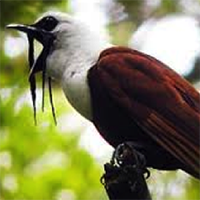
The Bellbird and Ocotea monteverdensis, A Special Relationship - El pájaro campana y el Ocotea monteverdensis, una relación muy especial
Of course the relationship between fruit-bearing trees and fruit-eating birds is mutually beneficial. The latter get free food and the former get their seeds spread across the landscape. However, the quality of this “spreading of seeds” is not always the same. The bellbird and O. m. appear to have a special relationship in this regard.
--- Por supuesto la relación entre árboles que tiene fruto y los pájaros que comen de estos es mutualmente beneficioso. Los pájaros reciben fruta y el árbol logra esparcir sus semillas en lugares ideales. Sin embargo la calidad de esta propagación de semillas no es siempre la misma. El pájaro campana y el O.m. parece que tienen una relación especial en cuanto a esto.
In my last blog I wrote about Ocotea monteverdensis (referred to here as “O. m.”), a critically endangered tree found only in the Monteverde “zone.” It was noted that, when it is fruiting during June to August, it is eaten by a number of large and unique birds, several of which are also threatened and found only in wet highland forests (i.e., resplendent quetzal, black guan, three-wattled bellbird). In this blog I want to discuss the special relationship that exists between O. m. and the three-wattled bellbird.


The three-wattled bellbird (called here simply “the bellbird”) is endemic to Central America and ranges between southeastern Honduras and western Panama. There are several populations that have their own breeding areas and own migration routes. The largest populations are (1) one that resides in the Tilaran mountains, in the general vicinity of Monteverde, for six months out of the year (March – August), and (2) one that is chiefly found in the Talamanca region of Costa Rica and Panama and the surrounding foothills and lowlands. These two sub-populations even call with very different “bonks”! The work of Don Kroodsma, George Powell, Debra Hamilton, Vinodkumar Saranathan, and Julio Sanchez has shown that the bellbird has three confirmed dialects and a suspected fourth.
BONK LINKS:
Listen to the Monteverde dialect bellbird bonking on dead branch perch:
https://www.youtube.com/watch?v=Gnu8QbpImWw
Talamancan dialect bellbird bonking:
https://www.youtube.com/watch?v=GMoEOjsHw4E
Powell and Robin Bjork documented the complex migrations of the bellbird in Monteverde, chiefly designed to maximize the availability of the fruit it depends upon. The “Monteverde population” breeds chiefly on the Caribbean slope of the Tilaran Cordillera, in the wet foothills and highlands east of Monteverde, during February to May. By June, many of the trees that were fruiting where these bellbirds breed have stopped bearing fruit. After breeding, this population journeys to the Tilaran Pacific slope between 1200 m and 1500 m (that would be here in the “Monteverde zone”!). For about three months (June to August or September), it feeds on fruit of trees here that are on a different annual cycle of fruiting, from those where the bellbird just finished raising young. Most of this fruit consists of small avocados of Lauraceae species that regularly bear fruit during these months.

Picture of an avocado fruit.
Debra Hamilton and Victorino Molina (with assistance from guides, interns, and ornithological associations) have been conducting research and censuses of bellbirds as they pass through “the Monteverde zone” for about 2 decades. They have noted that the birds concentrate in different areas of “the zone” in different years. Assuming that these concentration patterns are determined by what fruit the birds are eating, Debra and Rhine Singleton started a 6-year study of the principal fruiting tree species in these areas between 1200 and 1500 m. They studied when these species were fruiting (both monthly and annual patterns) and how this related to where the bellbirds were concentrated from year to year, and month to month. Eladio Cruz, Juan Fuentes, I, and others assisted them in data collection for these six years. Most of the tree species were small avocadoes (Lauraceae family).
After months and months of tedious data analysis, Debra, Rhine, and I have concluded that the preferred fruit of the bellbird is that of our friend O. m. Whenever and wherever O. m. is fruiting, the bellbird can be found nearby. Our data shows that O. m. generally only bears abundant fruit here every three years, so that a distinct pattern of concentration of birds around areas of O. m. trees can be seen during these years. In other years, the birds move to different places in the zone. During those years, other species of fruit trees attract them.
Of course the relationship between fruit-bearing trees and fruit-eating birds is mutually beneficial. The latter get free food and the former get their seeds spread across the landscape. However, the quality of this “spreading of seeds” is not always the same. The bellbird and O. m. appear to have a special relationship in this regard.
The nature of this relationship was illustrated by Dan Wenny and Doug Levy when they studied an avocado species very closely related to Ocotea monteverdensis— Ocotea endresiana. This tree grows at a slightly higher elevation than O. m., up in the Monteverde cloud forest reserves. It is not only in the same genus, but in the same sub-group of species in the genus Ocotea. Wenny and Levy studied where various bird species that ate this fruit distributed the seeds. Toucans, guans, quetzals, mountain robins and others all dropped their seeds fairly close to the adult fruiting tree they were feeding on (within 20 m). Bellbirds, in contrast, habitually went to their “perching branch” to finish digesting their fruit, and regurgitated their seeds there.
REGURGITATING:
https://www.youtube.com/watch?v=hPJMcNQB_4Y
Bellbirds select perches that they claim and re-use for months at a time, and these perches typically are on mid-canopy, dead branches in slightly open gaps in the forest canopy. These locations just happen to be ideal for germination and growth of both Ocotea endresiana and O. m. Directly under parent trees, soil microbes pathogenic to the tree species (including seedlings) often concentrate. But bellbird perches typically are located further from parent trees (>50 m). And, perhaps more important, the canopy cover is frequently closed under the parent tree, but more open under the bellbird perch “mini-gap.” This means that newly germinating seedlings—and later when they are saplings—receive more light for growth and survival. Wenny and Levy found that seedlings were twice as likely to survive where bellbirds dropped seeds as where other birds did. They were also one-third less likely to be infected with pathogenic root fungi.


So one can see how O. m. trees and the bellbird may have co-evolved to be particularly mutually beneficial to each other. O. m., it would seem, has evolved to produce fruit that is nutritious, easily located, and the right size for the bellbird to swallow whole and digest slowly. And the bellbird has perhaps evolved to be exhibit behaviors that just happen to result in the distribution of O. m. seeds in ideal locations. Walking through the forests here, I sometimes find small clusters of O. m. saplings that are some distance (> 60 m) from any parent tree. These trees usually appear to be the same age. It is easy enough to imagine that a bellbird perched years before above those locations and regurgitated seeds there. Further research and documentation is needed!
Four 3-m-tall (about 5 years old) O. m. saplings (red flagging) growing in a cluster.
Semi-open canopy, with dead branches, above the same sapling cluster above:
In my next blog, I want to discuss how this endangered tree can be conserved and even encouraged to replenish its population. This involves both saving the few remaining mature trees (only about 750!) and promoting new seedling establishment.
About the author:
Dev Joslin is a scientist who enjoys research that combines his interests and expertise in forest ecology, soils, ornithology, and reforestation. With a masters and a Ph. D. in forestry and soil science, he conducted research for 30 years in North America and Europe on air pollution and climate change impacts on forests, soils, and streams. He has been an active birder and conservationist in Tennessee and Costa Rica for the past 26 years. He and his wife, Harriet, have lived in Monteverde for the past 11 years, during which time he has been active in community organisations, “gentleman farming,” and conservation research involving frugivorous birds and their relationships to wild avocados.
Dev is the main person responsible for helping to put the Ocotea monteverdensis on the critically endangered species list.
REFERENCES
POWELL, G., and R. BJORK (2004) Habitat Linkages and the Conservation of Tropical Biodiversity as Indicated by Seasonal Migrations of Three-Wattled Bellbirds. Bird Conservation International 4:161-174.
WENNY, D.G., and D. J. LEVEY. 1998. Directed seed dispersal by bellbirds in a tropical cloud forest. Proc. Natl. Acad. Sci. USA. 95: 6204–6207.
VAN DER WERFF, H. 2002. A synopsis of Ocotea (Lauraceae) in Central America and Southern Mexico. Annals of the Missouri Botanical Garden. 89: 429-451.

El pájaro campana y el Ocotea monteverdensis,
una relación muy especial
En mi último blog escribí sobre el Ocotea monteverdensis (mencionado aquí como “O.m.”), el cual es un árbol que está críticamente en peligro de extinción y que únicamente se encuentra en la “zona” de Monteverde. Aquí se notó que cuando está en fruta, de junio a agosto, este es comido por una cantidad de pájaros que son grandes y únicos, muchos de los cuales también están en peligro y que solo se encuentran en bosques húmedos altos (ej. El quetzal, pava negra, pájaro campana). En este nuevo blog me gustaría discutir la relación especial que existe entre los O.m. y el pájaro campana.


El Procnias tricarunculatus (aquí simplemente llamado “pájaro campana”) es endémico de Centroamérica y se encuentra entre el sureste de Honduras y el oeste de Panamá. Hay varias poblaciones que cuentan con sus propias zonas de apareamiento y sus propias zonas migratorias. Las poblaciones más grandes son (1) una que reside en las montañas de Tilarán, en la vecindad de Monteverde, por seis meses al año (marzo- agosto), y (2) otra que se encuentra principalmente en la región de Talamanca entre Costa Rica y Panamá y en sus respectivas estribaciones y tierras bajas. Estas sub-poblaciones hasta tienen llamados diferentes o “boinj”. El trabajo de Don Kroodsma, George Powell, Debra Hamilton, Vinodkumar Saranathan, y Julio Sanchez ha demostrado que el pájaro campana tiene tres dialectos confirmados y se sospecha de una cuarta.
Enlaces para los “boinjs”:
Pájaro campana en Monteverde hacienda su sonido de “boinj” mientras está perchado en una rama muerta.
https://www.youtube.com/watch?v=Gnu8QbpImWw
Pájaro campana de Talamanca haciendo su sonido “boinj”: https://www.youtube.com/watch?v=GMoEOjsHw4E
Powell y Robin Bjork documentaron la complejidad de las migraciones del pájaro campana, estas son principalmente diseñadas para maximizar la disponibilidad de fruta de la cual depende. La “población de Monteverde” se reproduce principalmente en la vertiente caribeña de la cordillera de Tilarán, en las estribaciones húmedas y las tierras altas del este de Monteverde, de febrero a mayo. Al llegar al mes de junio, muchos de los árboles que estaban en fruta donde estos pájaros se reproducen, habrán dejado de producir. Después de la época de cría, esta población viaja hacia la vertiente pacífica de Tilarán entre los 1200m y los 1500m (eso sería aquí, en la “zona de Monteverde”). Por cerca de tres meses (junio a agosto o septiembre) estos se alimentan de las frutas de los árboles que están allí, las cuales se encuentran en un ciclo anual distinto que aquel donde el pájaro campana acaba de terminar de criar a sus pichones. La mayor parte de esta dieta consiste en pequeños aguacates de las especies de Lauraceae que regularmente producen frutas durante estos meses.
Foto del fruto de un aguacatillo.
Debra Hamilton y Victorino Molina (con ayuda de guías, pasantes y asociaciones ornitológicas) han estado conduciendo censos de las poblaciones de los pájaros campana cuando estos pasan por la “zona de Monteverde” por cerca de dos décadas. Al hacer esto notaron de que los pájaros se concentran en partes distintas de la “zona” en diferentes años. Asumiendo que estos patrones de concentración eran determinados por el tipo de fruta del cual se alimentaban los pájaros, Deb y Rhine Singleton comenzaron una investigación de seis años sobre las principales especies de árboles frutales entre los 1200 y 1500m. Ellos estudiaron cuando estas especies estaban en fruta (los patrones mensuales y los anuales) y como estos se relacionaban a donde los pájaros campana se concentraban año a año y mes a mes. Eladio Cruz, Juan Fuentes, yo y otros asistimos en la recolecta de información durante estos seis años. La mayoría de estas especies eran aguacatillos (familia Lauraceae).
Después de meses y meses de una labor tediosa en análisis de datos, Deb, Rhine y yo hemos concluido que la fruta favorita del pájaro campana es la de nuestro amigo el O.m. Cuando sea y donde sea que el O.m. están en fruto el pájaro campana se puede encontrar en su cercanía. Nuestra información muestra que el O.m. suele solo tener fruta en abundancia cada tres años, así que en estos periodos se puede encontrar un patrón distintivo de concentración de los pájaros. En otros años los pájaros campana se trasladan a diferentes lugares de la zona. Durante esos años otras especies de árboles frutales son los que los atraen.
Por supuesto la relación entre árboles que tiene fruto y los pájaros que comen de estos es mutualmente beneficioso. Los pájaros reciben fruta y el árbol logra esparcir sus semillas en lugares ideales. Sin embargo la calidad de esta propagación de semillas no es siempre la misma. El pájaro campana y el O.m. parece que tienen una relación especial en cuanto a esto.
La naturaleza de esta relación fue ilustrado por Dan Wenny y Doug Levy al estudiar una especie de aguacatillo que es muy cercana al Ocotea monteverdensis, y este es el Ocotea endresiana. Este árbol crece a una elevación ligeramente más alta que el O.m., en las reservas del bosque nuboso de Monteverde. Esta especie no es solamente el mismo género, pero además se encuentra en el mismo sub-grupo de especies del género Ocotea. Wenny y Levy estudiaron la ubicación donde varias especies de pájaros que se alimentaban de esta fruta distribuían las semillas. Tucanes, pavas, quetzales, zorzales y otros sueltan las semillas cerca del árbol frutal adulto de donde se alimentan (dentro de los 20m.). Los pájaros campana, en contraste, habitualmente iban a su “rama de percha” para terminar de digerir su fruta, y regurgitaban sus semillas ahí.
Pájaro regurgitando semillas:
https://www.youtube.com/watch?v=hPJMcNQB_4Y
Los pájaros campana seleccionan perchas de las cuales ellos se apoderan y reutilizan por meses, estas perchas habitualmente se encuentran a medio dosel, en ramas muertas ubicadas en aperturas del bosque. Estas ubicaciones son justamente ideales para la germinación y crecimiento de ambas: el Ocotea endresiana y el O. m. Justo debajo de los árboles madre suelen concentrarse los microbios de suelo que son patógenos a estas especies de árboles (incluyendo cuando se encuentran como plántulas). Las perchas del pájaro campana usualmente se encuentran lejos de los árboles madre (>50m). Y, seguramente de manera más importante, la cobertura boscosa es más cerrada debajo de los árboles madre, pero más abierta debajo de la percha del pájaro campana por su ubicación en una apertura boscosa. Esto significa que semillas recién germinadas – y luego cuando son árboles jóvenes- van a recibir más luz para su crecimiento y sobrevivencia. Wenny y Levy encontraron que los árboles tenían el doble de oportunidades de sobrevivencia de donde los pájaros campana dejaban las semillas en relación a donde eran dejados por otros pájaros. También tenían una tercera parte menos de posibilidades de ser infectados por el hongo de raíz patógeno.


Así que uno puede ver como los árboles O.m. y el pájaro campana han co-evolucionado para beneficiarse mutuamente el uno del otro. El O.m., al parecer, ha evolucionado para producir fruta llena de nutrientes, fácil de encontrar, y el tamaño apropiado para que el pájaro la pueda comer entero y digerir lentamente. Y el pájaro campana ha evolucionado para tener costumbres que resultan en la distribución de las semillas del O.m. en locaciones ideales. Al caminar por los bosques en esta zona he podido encontrar grupos de árboles juveniles que se encuentran a más de 60 metros del árbol madre. Estos árboles aparentan ser de la misma edad, por lo tanto es lo suficientemente fácil de imaginar que un pájaro estaba en esta zona regurgitando semillas. Hace falta más investigación y documentación para poder demostrar esto apropiadamente.
Cuatro árboles juveniles de O.m. de 3 metros de alto (aprox. 5 años de edad) marcados con cinta roja creciendo en un grupo:
Dosel parcialmente abierto, con ramas muertas por encima del grupo de árboles juveniles.
En mi siguiente blog quiero discutir como este árbol en peligro puede ser conservado y hasta fomentado para reponer su población. Esto implica rescatando los árboles maduros restantes (solo son como 750) y promoviendo el establecimiento de plántula.
Sobre el autor:
Dev Joslin es un científico que disfruta la investigación y combina sus intereses y pericia en ecología forestal, suelos, ornitología y reforestación. Con una maestría y un doctorado en ciencias forestales y ciencias de suelos el ha conducido investigación por 30 años en América del Norte y Europa en el impacto de la contaminación de aires y el cambio climático en los bosques, suelos y quebradas. Él ha sido un pajarero y conservacionista active en Tennessee y Costa Rica por los últimos 26 años. Él y su esposa, Harriet, han vivido en Monteverde por 11 años en los cuales han participado activamente en organizaciones comunitarias, “agricultura de caballeros”, y investigación de conservación involucrando pájaros fructíferos y su relación con el aguacatillo Silvestre.
Dev es además la principal persona responsable en ayudar a colocar el Ocotea monteverdensis en la lista de críticamente en peligro de extinción.
REFERENCIAS:
POWELL, G., and R. BJORK (2004) Habitat Linkages and the Conservation of Tropical Biodiversity as Indicated by Seasonal Migrations of Three-Wattled Bellbirds. Bird Conservation International 4:161-174.
WENNY, D.G., and D. J. LEVEY. 1998. Directed seed dispersal by bellbirds in a tropical cloud forest. Proc. Natl. Acad. Sci. USA. 95: 6204–6207.
VAN DER WERFF, H. 2002. A synopsis of Ocotea (Lauraceae) in Central America and Southern Mexico. Annals of the Missouri Botanical Garden. 89: 429-451.
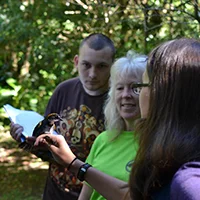
Programa de MOSI en el IMV - MOSI Program at the MVI
Programa MOSI (Monitoreo de Sobrevivencia Invernal) en pájaros migratorios del Neotrópico --- MOSI Program (Interval Survival Monitoring) in migrant neotropical birds.
En español (for English please scroll down)

MoSI (Monitoreo de Sobrevivencia Invernal) es un programa de monitoreo de pájaros neotropicales terrestres que se enfoca en el monitoreo de pájaros migratorios a través de las Americas con estaciones en los neotrópicos del norte. La meta del programa es el de poder evaluar las tazas de sobrevivencia de la hibernación y las condiciones físicas de los pájaros en su llegada a sus zonas de invernada. Los pájaros migratorios del neotrópico viajan un promedio de 3000 millas hasta llegar a sus zonas de invernada donde permanecen al menos la mitad del año. Debido a la disminución de muchas especies migratorias, la "Bird Population Organization" (Organización de Poblaciones de Aves) empezaron un proyecto de investigación para estudiar la sobreviviencia de invernación. Si la sobrevivencia es baja en los trópicos, entonces los esfuerzos de conservación se deben de enfocar en la necesidades de las aves en estas zonas, en lugar de enfocarse en las necesidades en sus zonas de reproducción en latitudes más altas.
En Monteverde, Costa Rica se trabaja de noviembre a marzo intentando poner anillos de identificación a la mayor cantidad posible de pájaros migratorios y residentes. Pueden ver el siguiente video para escuchar sobre la experiencia de una de las pasantes que colaboró junto con Deb Hamilton en el proyecto. La estación de MoSI de Monteverde es uno de las 29 estaciones situadas entre México y el norte de Sur América. Se colocaron once redes siguiendo todos los protocolos de redes de niebla en laReserva Crandell detrás del Instituto Monteverde. A las especies migratorias que se encontraron se les colocaron anillos informativos del U.S. Fish and Wildlife y se soltaron ilesos con el fin de que se les pudiera seguir el rastro en caso de que los re-capturaran en Norte América.
Esta es una gran oportunidad educacional no solo para los miembros del equipo de MoSI, sino también para algunos miembros de la comunidad y las escuelas visitantes (programa de EAP y Goucher - Mt. Holyoke, entre otros) que tienen la oportunidad de ver el proceso en persona y poder aprender de los procesos migratorios de diferentes especies. Este proyecto ha dado la oportunidad a los participantes de entender un poco más sobre la importancia del conservación de hábitat en los bosques tropicales de Costa Rica.

English (Para español favor de subir) --
MoSI (Interval Survival Monitoring) is a Neotropical migrant landbird monitoring program that focuses on migratory birds throughout the Americas with stations in the northern Neotropics. The goal of this program is to assess overwintering survival rates and physical conditions of birds passing through and arriving at wintering grounds.
Neotropical migratory birds fly an average of 3000 miles to reach their wintering grounds where they live for at least one half of the year. Due to the decline of many migratory species, the Bird Population Organization started a research project to assess the migratory bird’s overwintering survival. If survival is low in the tropics, conservation efforts will need to focus on the birds’ survival needs here, rather than in their reproductive areas at higher latitudes.
In Monteverde, Costa Rica people work together from November through March to band as many migratory and resident passerines as possible. You can see a video about the experience of one of the participating interns here. The Monteverde MoSI station is one of 29 stations situated from Mexico to northern South America. Eleven nets were set up using standard mist netting protocols within the Crandell Reserve behind the Monteverde Institute. Migratory species that were captured were banded with U.S. Fish and Wildlife bands and released unharmed so they could be tracked if they are re-captured in North America.
This is great educational opportunity not only for theMoSI team but also for the community and visiting schools (EAP program and Goucher - Mt. Holyoke, amongst others) that get an opportunity to experience bird banding in person and learn about the migrating process for different bird species. This project also gives participants an opportunity to experience the importance of habitat conservation in tropical rainforests of Costa Rica.

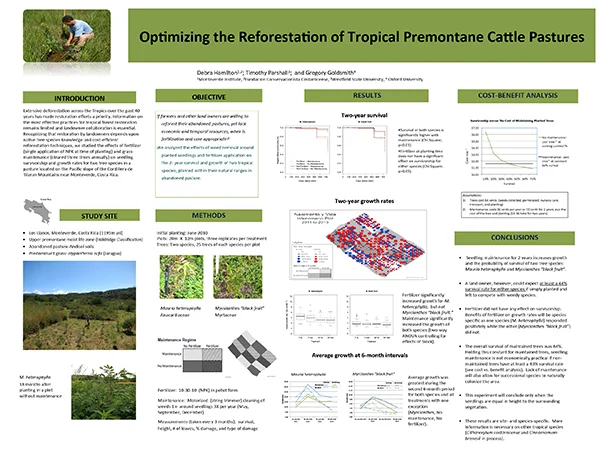
Poster: “ Optimizing the reforestation of tropical premontane cattle pasture through fertilization and grass maintenance”.
At the 26th International Congress for Conservation Biology in Baltimore, Debra Hamilton (Monteverde Institute), Tim Parshall (Westfield State University) and Greg Goldsmith (Oxford University) presented a poster entitled “ Optimizing the reforestation of tropical premontane cattle pasture through fertilization and grass maintenance”.
Poster: “ Optimizing the reforestation of tropical premontane cattle pasture through fertilization and grass maintenance”.
Afiche:
“Optimizando la reforestación de portrero tropical premontano a través de fertilización y mantenimiento”.
English: At the 26th International Congress for Conservation Biology in Baltimore, Debra Hamilton (Monteverde Institute), Tim Parshall (Westfield State University) and Greg Goldsmith (Oxford University) presented a poster entitled “ Optimizing the reforestation of tropical premontane cattle pasture through fertilization and grass maintenance”.
While the results of the two-year investigation demonstrate that grass maintenance significantly increased the survivorship and growth of planted seedlings, the application of fertilizer (10-30-10) at the time of planting had no effect on survivorship. Fertilizer application at time of planting did increase growth rates for one of the two tree species in the experiment.
More importantly, >44% of seedlings of both tree species (Mauria heterophylla (Cirri) and Myrsianthes “black fruit”) survived whether the seedlings received grass competition removal or not. Reforestation, therefore, should not necessarily be discouraged if a landowner does not have the economic resources to maintain the seedlings free of grass. This research is continuing to examine additional species and grass types.
Español:
En los 26th Congreso Internacional para Biología de la Conservación en Baltimore, Debra Hamilton (Instituto Monteverde), Tim Parshall (Westfield State University) y Greg Goldsmith (Oxford University) presentó un poster titulado “Optimizando la reforestación de portrero tropical premontano a través de fertilización y mantenimiento”.
Mientras que los resultados de la investigación de dos años demuestran que mantenimiento de pastos aumentó significativamente la supervivencia y crecimiento de los arbolitos, la aplicación de fertilizante (10/30/10) en el momento de la siembra no tuvo efecto sobre la supervivencia. La aplicación de fertilizantes en el momento de la plantación aumentar las tasas de crecimiento de una de las dos especies en el experimento.
Más importante aún, > 44% de las plántulas de ambas especies arbóreas (Mauria heterophylla (Cirri) y Myrsianthes "black fruit") sobrevivieron si los arbolitos recibieron mantenimiento o no. Por lo tanto, no necesariamente deben desanimarse si un terrateniente no tiene los recursos económicos para mantener las plantas de semillero libres de hierba. Esta investigación continúa para examinar otras especies de arboles y tipos de pastos.