
The Night of the Bat---La Noche de los Murciélagos
The night of the bat was nothing to be scared of. Truthfully, it was an incredible night. I am so happy we had nice weather and had the luck to meet the expert Dr. Laval and his friends.
Blog 9.7.13 by Lana Panitch Lake Forest Intern
After a day´s work at the Monteverde Institute, my cohorts from Lake Forest and I went to Tramonti´s for a dinner full of pizza (or pixa as they called it here) and laughs. We ordered my favorite type, vegetarian, and some meaty ones as well for the meat-lovers at the table. We demolished three pizzas between the four of us in hardly any time at all. We left very satisfied.

Having Pizza at Tramonti
Soon after, we hiked back up to the Institute to meet up with our Costa Rican “Mommy away from home” (our internship coordinator), Sarah Burbank. An adventure in the forest behind the Institute awaited us. We mounted the stairway, passing the strong, perfumed odor of the Angel’s Trumpets flowers. We entered the Dwight and Rachel Crandell preserve when the sun had just set.
As we approached, we could see with our headlamps a net, almost like a tennis net, stretched between two big trees. Then, we saw three figures…the legendary local bat expert, Dr. Richard LaVal and his assistants, his daughter and son-in-law. Right away, the fun began. Dr. LaVal brought us the first victim…a brown insectivorous bat that belongs to the same family of brown bats that are very common where I live in Chicago, Illinois.
Dr. LaVal explained to us that this bat was clearly an insect bat because it has a simpler nose than fruit bats. He showed us the length and breadth of its wings. The wings are made up of a very fine and smooth skin that is surprisingly strong and durable. I learned that if a wing breaks or tears, it would take five days for it to heal. I feel very thankful for these bats because they eat thousands of insects, such as mosquitoes, every night. What nice pest control!
Then, he brought us a fruit bat. These bats are also very cute, I think, although their noses are more complex, bigger, and uglier than those of the insect bats. The fruit bats are also very important for humans because they help to distribute many types of fruits’ seeds. Some fruit they pollinate, for example, are mangos, peaches, and even almonds! If I were a bat, I would most definitely be a fruit bat. This victim was very small, and calmer than the insect bat. Dr. LaVal thought it was a good candidate for us to hold. Gabe was the first brave soul to hold it, followed by Ashley, Luis, and then me. At first I hesitated…then I had to ask myself, “When will I ever get this opportunity to hold a wild bat again in the future?” The answer was, “Never!” And that was that. I held it carefully, and it was a wonderful experience. My new little friend was soft and its heart beat like a little drum. It was an experience I will never forget.

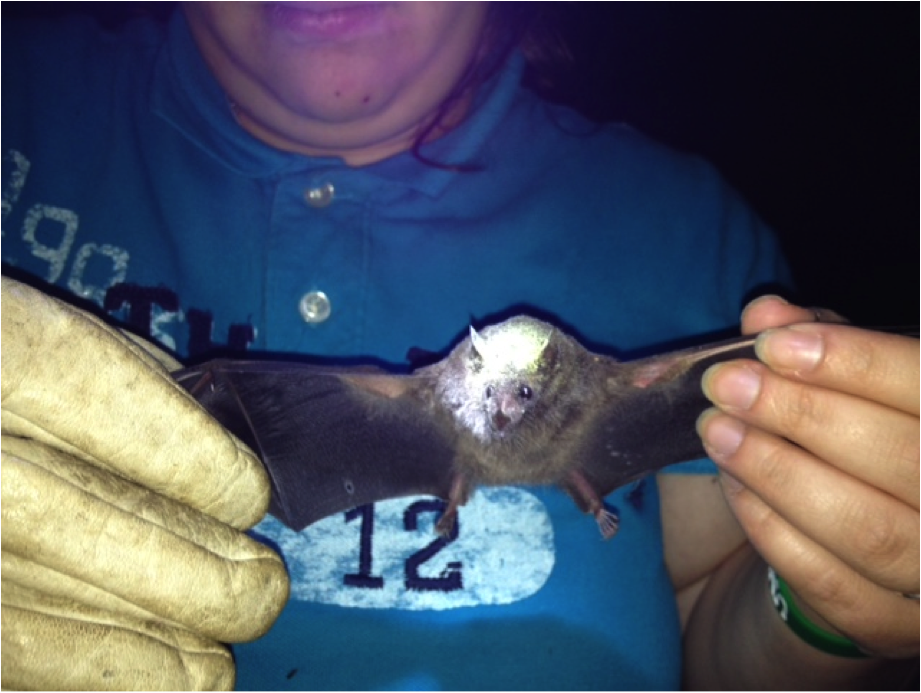
Lana with a bat, and Richard Laval in the Background.
For the rest of the night, Dr. LaVal showed us many more fruit and insect bats. Surprisingly though, many of them were quite unique. Some were male, some were juvenile, and some were female. The females interested me the most because some were pregnant with big, swollen bellies. Dr. LaVal was good at guessing how much more time they had until delivery. We also got to see lactating females, which meant that they were mothers of pups. What a treat it was to learn and see all of those small details in real life!
After more than fifteen bats of all shapes, sizes, and life stages, we were getting ready to leave. Suddenly, Kelly LaVal brought us the final bat…a nectar bat! It had pollen on its head! This bat is in the photo below, but the flash makes it a little tricky to see the yellow pollen. This bat was a pleasure and total surprise!
The night of the bat was nothing to be scared of. Truthfully, it was an incredible night. I am so happy we had nice weather and had the luck to meet the expert Dr. Laval and his friends.
-------------------------------------------------------------------------------------------------------------------------------------
En Español:
La Noche de Murciélagos
Después de un día de trabajo en el Instituto Monteverde, mis compañeros de Lake Forest College y yo fuimos a Tramonti´s por una cena llena de pizza (o pixa como se llama aquí) y risas. Pedimos mi tipo favorito, vegetariano, y otras de carnes ricas como salami y salchicha. Nosotros cuatro matamos tres pizzas en poco tiempo, y nos sentimos muy satisfechos.
Luego, nos juntamos con nuestra mamacita de acogida, Sarah Burbank (nuestra coordinadora de pasantías), para una aventura en la selva detrás del instituto. Subimos la escalera, pasando el olor fuerte y perfumado de las flores de las Trompetas de Ángel. Entramos la reserva de Dwight y Rachel Crandell cuando el sol acabó de atardecer.
Vimos con los focos de cabeza una red, casi como una red de tenis, estirado entre dos árboles grandes. Luego, vimos dos hombres…el legendario experto de murciélagos, Dr. Richard Laval, y su asistente, Kelly LaVal. Pronto después, la diversión empezó. Dr. Laval nos trajo el primer victima…un murciélago café e insectívoro que pertenece a la misma familia de murciélagos cafés que son comunes donde yo vivo en Chicago, Illinois.
Dr. Laval nos explicó que este murciélago es claramente un insectívoro porque tiene una nariz más sencilla que los murciélagos de fruta. Nos mostró la longitud de sus alas que son de piel muy fuerte pero muy fina y lisa también. Aprendí que si un ala se rompe, duraría cinco días para curarse. Yo me siento muy agradecida a estos murciélagos porque comen millones de insectos, como mosquitos, ¡cada noche! ¡Que útiles son!

Sosteniendo un murciélago!
Luego, nos trajo un murciélago de fruta. Estos murciélagos también son muy preciosos, yo pienso, aunque tienen narices complejas, grandes, y un poco feas. Los murciélagos de fruta también son muy importantes para los humanos porque ayudan a distribuir las semillas de muchas y muchas frutas que comimos cada día. Si yo fuera un murciélago, pienso que yo sería un murciélago de fruta. Este victima también fue muy pequeño, pero más tranquilo. Por eso, Dr. Laval pensó que sería un buen tipo para nosotros agarrar. Gabe fue el primer valiente agarrarlo, luego Ashley, Luis, y finalmente yo. Me pregunté, ¿Cuándo tendré la oportunidad agarrar un murciélago silvestre en el futuro? Me respondí, ¡nunca!, y eso fue. Lo agarré, y me alegró mucho. El amiguito nuevo fue suave y su corazón latió como un tambor. Fue una experiencia que nunca me olvidaré.
Por el resto de la noche, Dr. Laval nos mostró muchos más murciélagos insectívoros y de fruta. Pero no eran todos los mismos. Algunos eran machos, algunos juveniles, y algunos eran hembras. Las hembras me interesaban mucho porque algunas estaban embarazadas. Tenían panzas llenas e hinchadas. Dr. Laval adivinó cuanto tiempo se las quedaba hasta que dirían la luz. También, había hembras en lactancia, lo que significa que tenían cachorros. Que regalo fue aprender y ver estos detalles en vivo.
Después de más de quince murciélagos, de todos talleres y formas, íbamos a salir. De repente, Kelly nos trajo un murciélago final… ¡un murciélago que come néctar de las flores! ¡Tenía polen en la cabeza! Está en la foto abaja, pero por la luz es un poco difícil ver el polen amarillo. De ninguna manera, ¡fue un placer y sorpresa total!
La noche de murciélagos no fue nada escalofriante. De veras, fue una noche increíble. Me alegro que hacía buen tiempo y que tuvimos la suerte de conocer al experto Dr. Richard Laval y a sus amigos.
The Institute and Living Routes Program- El programa del Instituto y Living Routes
About the Living Routes program of the Monteverde Institute- sobre el programa de Living Routes del Instituto Monteverde
"The Living Routes Program: Tropical Ecology, Development, and Social Justice began as a spring pilot project in the Spring of 2011; since 2011-2013, it has been offered fall and spring semesters. Living Routes, a non-profit organization focused on intentional communities and located in Amherst, MA, has a number of international programs. While the University of Massachusetts, Amherst grants academic credit for the courses, the program is open enrollment and has drawn students from many different universities and colleges, including Stanford, Sarah Lawrence, Cornell, Smith, the University of Vanderbilt, etc..
The Program in Monteverde urges students to "explore how international and national trends and policies have affected local sustainable development, environmental conservation and social justice efforts" This Program stresses experiential learning, community building, and personal sustainability (including yoga). Students take four courses: Ecological Relationships in the Tropics (primarily a field course), Community Service Learning in Costa Rica: Theory and Practice (also a field course that involves a heavy internship component), Sustainable Development and Social Justice, and Spanish Language and Costa Rican Culture (students pick appropriate language level). While classes are held at MVI and in forest reserves, much service learning (such as creating material for a rural school) and personal knowledge comes from the small agricultural community of San Luis where students live with a local family."
By: Leslie Burlingame
The Monteverde Institute has as one its goals to offer an integrated education to our students, which includes an active participation in the community. This involvement allows mutual learning experiences where our students learn from the community they live in and the community learns from our students.
As an example, last semester our students from the Living Routes program who live with homestay families in San Luis, worked on projects in both schools (Alto y Bajo), also worked in permaculture projects in Finca la Querencia and helped establish an ecology program for schools in the Monteverde Butterfly Farm.
In the last year, two of our students were really impressed with the community and decided to offer extra support once the program was finished: Lauren Wallace donated funds for an English program in the San Luis schools and Emily Barbour decided to finance the entire tuition for the final year at the Creativa (CFS) for a San Luis student.
tuition for the final year at the Creativa (CFS) for a San Luis student.
Our students leave with positive and transformative experiences and we would like to thank the community for helping to make this possible.
This video was made by one Sarah Fletcher about her internship and the butterfly farm:
http://www.youtube.com/watch?v=t221X7FGgmc&feature=youtu.be
El Instituto Monteverde tiene como una de sus metas ofrecer una educación integral a nuestros estudiantes donde se incluye una participación activa en la comunidad. Esto tiene como fin que haya un aprendizaje mutuo: los estudiantes aprenden de la comunidad y la comunidad de los estudiantes..
A modo de ejemplo el semestre pasado nuestros estudiantes del programa de Living Routes que se hospedan con familias en San Luis, trabajaron con las escuelas del Alto y Bajo, además hicieron unos proyectos de permacultura en Finca la Carencia y ayudaron a establecer el programa de ecología para las escuelas del Mariposario Monteverde.
El año pasado dos de nuestros estudiantes quedaron realmente impresionadas con la comunidad, y decidieron apoyar un poco más una vez que terminaron el proyecto, Lauren Wallace dono fondos para un programa de ingles para las escuelas de San Luis, y Emily Barbour que decidió financiar el ultimo año de estudio en la Escuela Creativa (CFS) a un estudiante de San Luis.
Nuestros estudiantes salen con experiencias muy lindas y queremos agradecer a la comunidad ayudar hacer esto, por compartir con ellos.

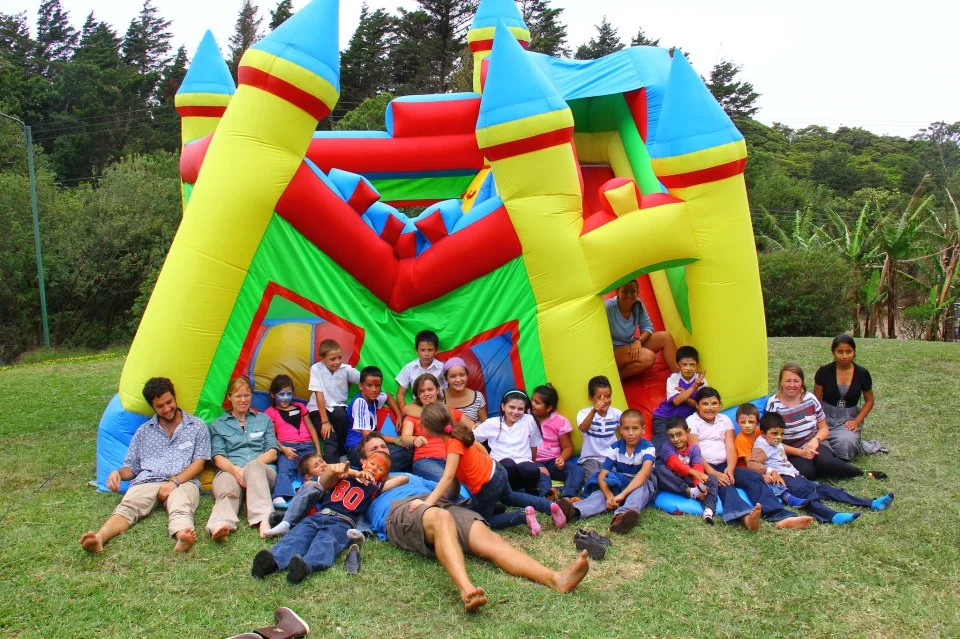
Living Routes students chilling with kids from San Luis Monteverde